Liver Diseases Research Lab, Department of Biochemistry, Jawaharlal Institute of Postgraduate Medical Education and Research (JIPMER), Dhanvantari Nagar, Puducherry, 605006, India.
Department of Surgical Gastroenterology, Jawaharlal Institute of Postgraduate Medical Education and Research (JIPMER), Pondicherry, 605006, India.
BMC Cancer. 2018 May 18;18(1):572. doi: 10.1186/s12885-018-4484-5.
Hepatocellular carcinoma (HCC) is a frequent type of primary liver cancer, and its prevalence is increasing worldwide. Indeed, the underlying molecular mechanism is not well understood. Previous studies have shown evidence that tight junction (TJ) components were correlated with carcinogenesis and tumor development. Our aims were to determine the serum levels of tight junction protein Zonula Occludens (ZO)-1 and an inflammatory marker such as high-sensitive C-reactive protein (hs-CRP) in HCC patients compared to healthy volunteers and also to identify the association between ZO-1 and inflammation in HCC.
Thirty HCC patients and 30 healthy volunteers were recruited in the current study. Clinical data regarding child class, BCLC staging, the number of lesions, tumor size, absence or presence of metastasis, cirrhosis and hepatitis infection were also collected in HCC patients. Plasma ZO-1 and serum hsCRP were analyzed by EIA and ELISA respectively and biochemical parameters by autoanalyser (AU680 Beckman Coulter, USA). Furthermore, hepatic ZO-1 protein expression and tissue localization were examined.
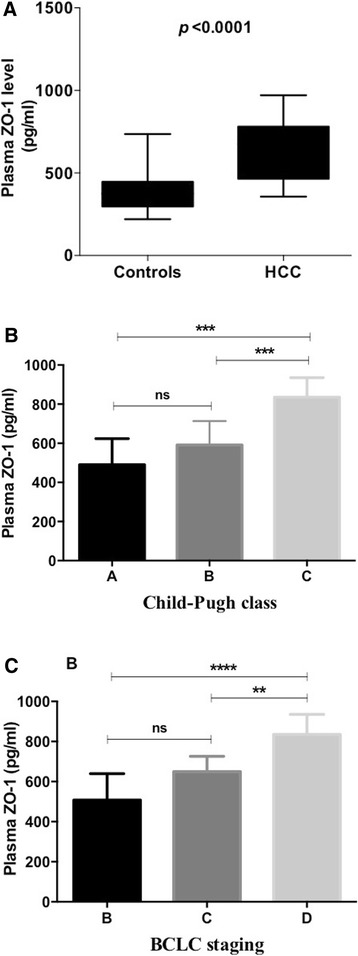
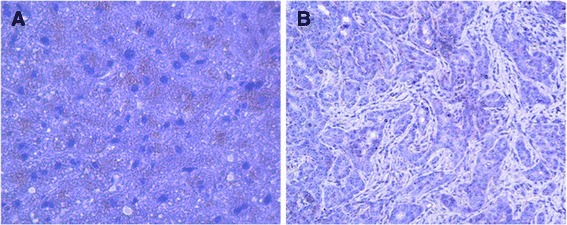
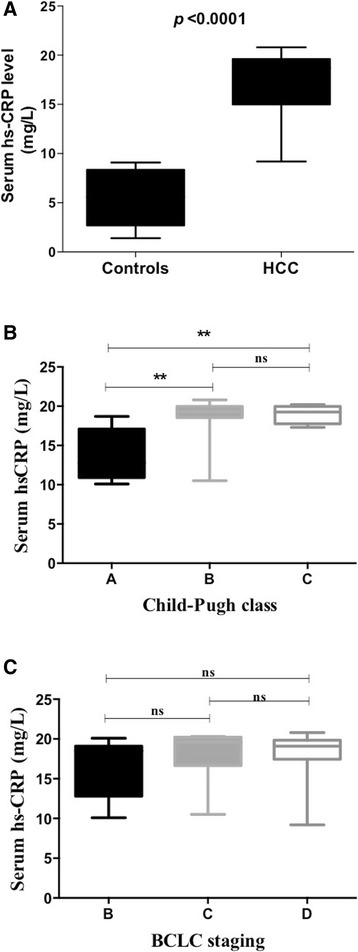
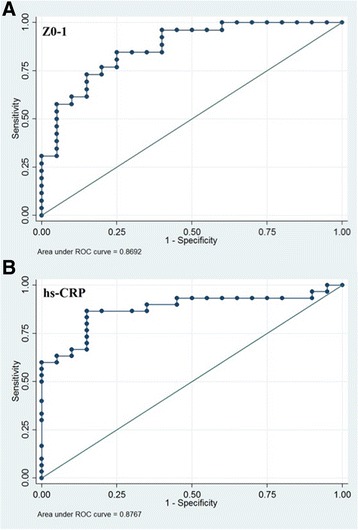
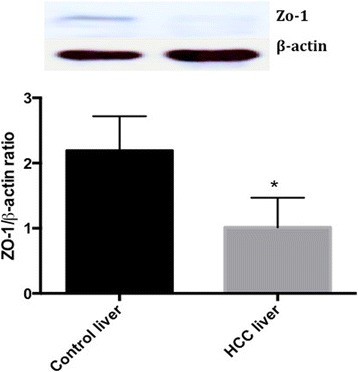
Compared to healthy individuals, the serum levels of bilirubin, alanine aminotransferase (ALT), aspartate aminotransferase (AST), gamma-glutamyltransferase (GGT) and alkaline phosphatase (ALP) were elevated significantly (P < 0.0001) whilst serum albumin level was significantly (P < 0.0001) decreased in HCC patients. Furthermore, tight junction protein ZO-1 concentration was significantly elevated in HCC patients compared to control subjects (648 ± 183.8 vs. 396.4 ± 135.8 pg/ml, respectively; P < 0.0001). Serum hsCRP level was also significantly increased in HCC patients compared to control subjects (17.25 ± 3.57 vs. 5.54 ± 2.62 mg/L, respectively; P < 0.0001). Moreover, decreased protein expression of ZO-1 was found in liver tissue obtained from HCC patients.
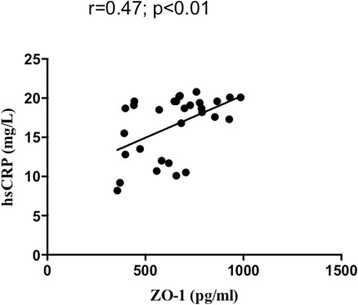
Our findings show for the first time that the systemic concentration of ZO-1 was significantly elevated in HCC patients and is positively correlated with inflammatory markers. Thus, the current study showing evidence that inflammation promotes plasma ZO-1 concentration and raises the possibility that it could be used as a potential diagnostic biomarker for HCC progression.
肝细胞癌(HCC)是一种常见的原发性肝癌,其全球发病率正在上升。事实上,其潜在的分子机制尚不清楚。先前的研究表明,紧密连接(TJ)成分与癌变和肿瘤发展有关。我们的目的是确定与健康志愿者相比,HCC 患者血清中紧密连接蛋白 Zonula Occludens(ZO)-1 和炎症标志物如高敏 C 反应蛋白(hs-CRP)的水平,并确定 ZO-1 与 HCC 中的炎症之间的关系。
本研究纳入了 30 名 HCC 患者和 30 名健康志愿者。还收集了 HCC 患者的临床数据,包括儿童分级、BCLC 分期、病变数量、肿瘤大小、有无转移、肝硬化和肝炎感染。通过 EIA 和 ELISA 分别分析血浆 ZO-1 和血清 hsCRP,通过自动分析仪(AU680 Beckman Coulter,美国)分析生化参数。此外,还检测了肝组织中 ZO-1 蛋白的表达和组织定位。
与健康个体相比,HCC 患者的胆红素、丙氨酸氨基转移酶(ALT)、天冬氨酸氨基转移酶(AST)、γ-谷氨酰转移酶(GGT)和碱性磷酸酶(ALP)水平显著升高(P<0.0001),而血清白蛋白水平显著降低(P<0.0001)。此外,与对照组相比,HCC 患者的紧密连接蛋白 ZO-1 浓度显著升高(分别为 648±183.8 和 396.4±135.8 pg/ml,P<0.0001)。与对照组相比,HCC 患者的血清 hsCRP 水平也显著升高(分别为 17.25±3.57 和 5.54±2.62 mg/L,P<0.0001)。此外,还发现 HCC 患者肝组织中 ZO-1 蛋白表达降低。
我们的研究结果首次表明,HCC 患者的全身性 ZO-1 浓度显著升高,且与炎症标志物呈正相关。因此,本研究表明炎症促进了血浆 ZO-1 浓度的升高,并提出了它可能作为 HCC 进展的潜在诊断生物标志物的可能性。