Department of Obstetrics & Gynecology, Indiana University School of Medicine, Indianapolis, Indiana.
Division of Clinical Research, Department of Obstetrics & Gynecology, Washington University in St. Louis School of Medicine, St. Louis, MO.
Contraception. 2018 Sep;98(3):223-227. doi: 10.1016/j.contraception.2018.05.010. Epub 2018 May 18.
To investigate whether an early 3-week postpartum visit in addition to the standard 6-week visit increases long-acting reversible contraception (LARC) initiation by 8 weeks postpartum compared to the routine 6-week visit alone.
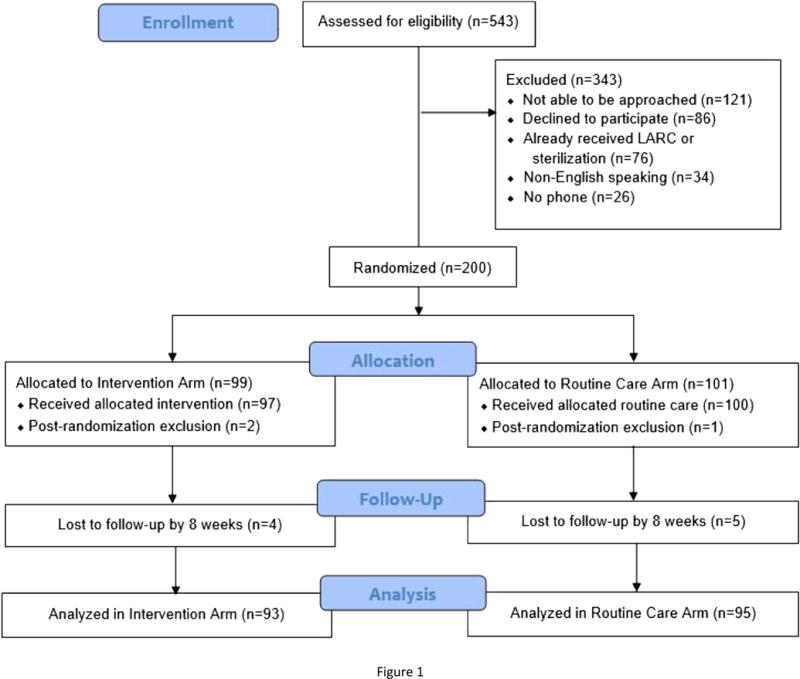
We enrolled pregnant and immediate postpartum women into a prospective randomized, non-blinded trial comparing a single 6-week postpartum visit (routine care) to two visits at 3 and 6 weeks postpartum (intervention), with initiation of contraception at the 3-week visit, if desired. All participants received structured contraceptive counseling. Participants completed surveys in-person at baseline and at the time of each postpartum visit. A sample size of 200 total participants was needed to detect a 2-fold difference in LARC initiation (20% vs. 40%).
Between May 2016 and March 2017, 200 participants enrolled; outcome data are available for 188. The majority of LARC initiation occurred immediately postpartum (25% of the intervention arm and 27% of the routine care arm). By 8 weeks postpartum, 34% of participants in the intervention arm initiated LARC, compared to 41% in the routine care arm (p=.35). Overall contraceptive initiation by 8 weeks was 83% and 84% in the intervention and routine care arms, respectively (p=.79). There was no difference between the arms in the proportion of women who attended at least one postpartum visit (70% vs. 74%, p=.56).
The addition of a 3-week postpartum visit to routine care does not increase LARC initiation by 8 weeks postpartum. The majority of LARC users desired immediate rather than interval postpartum initiation.
Clinicaltrials.govNCT02769676 IMPLICATIONS: The addition of a 3-week postpartum visit to routine care does not increase LARC or overall contraceptive initiation by 8 weeks postpartum when the option of immediate postpartum placement is available. The majority of LARC users desired immediate rather than interval postpartum initiation.
探讨与标准 6 周产后访视相比,在常规 6 周访视的基础上增加 3 周产后访视是否能增加 8 周产后长效可逆避孕(LARC)的使用率。
我们将孕妇和产后即刻的妇女纳入一项前瞻性随机、非盲试验,比较 6 周产后单次访视(常规护理)与 3 周和 6 周产后 2 次访视(干预组),如果需要,可在 3 周访视时开始避孕。所有参与者均接受了结构化的避孕咨询。参与者在基线和每次产后访视时亲自完成了问卷调查。需要 200 名总参与者的样本量来检测 LARC 起始率(20%与 40%)的两倍差异。
2016 年 5 月至 2017 年 3 月,共纳入 200 名参与者;188 名参与者有结局数据。大多数 LARC 起始发生在产后即刻(干预组的 25%和常规护理组的 27%)。到 8 周产后时,干预组有 34%的参与者开始使用 LARC,而常规护理组有 41%(p=.35)。到 8 周时,干预组和常规护理组的总避孕起始率分别为 83%和 84%(p=.79)。两组之间至少参加一次产后访视的妇女比例无差异(70%比 74%,p=.56)。
在可立即进行产后放置的情况下,常规护理中增加 3 周产后访视并不能增加 8 周产后 LARC 的使用。大多数 LARC 用户希望立即而不是间隔产后开始使用。
Clinicaltrials.gov NCT02769676
当立即进行产后放置的选择可用时,在常规护理中增加 3 周产后访视并不能增加 8 周产后 LARC 或总避孕的起始率。大多数 LARC 用户希望立即而不是间隔产后开始使用。