Lin Shuyan, Shao Lijuan, Hui Cang, Song Yu, Reddy Gadi V P, Gielis Johan, Li Fang, Ding Yulong, Wei Qiang, Shi Peijian
Co-Innovation Centre for Sustainable Forestry in Southern China, Bamboo Research Institute, Nanjing Forestry University, Nanjing, China.
Department of Mathematical Sciences, Centre for Invasion Biology, African Institute for Mathematical Sciences, Stellenbosch University, Matieland, South Africa.
Front Plant Sci. 2018 May 4;9:583. doi: 10.3389/fpls.2018.00583. eCollection 2018.
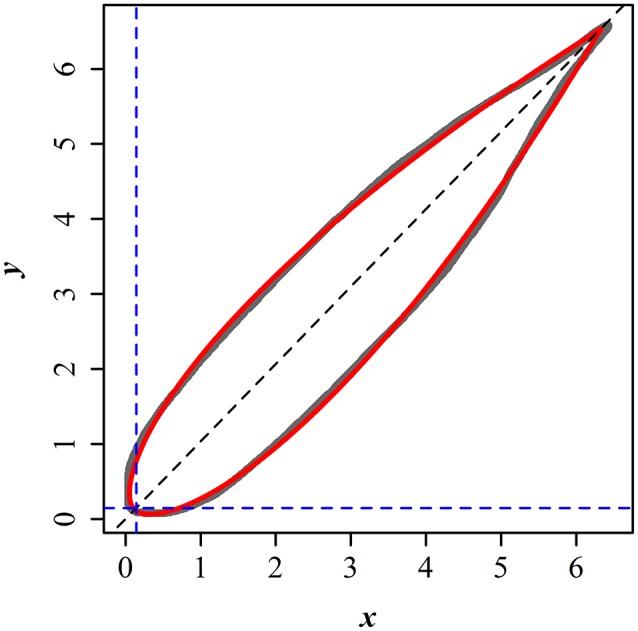
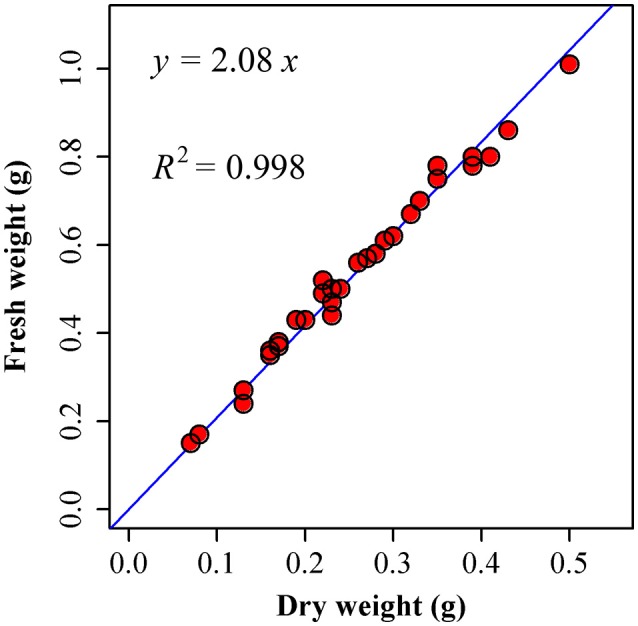
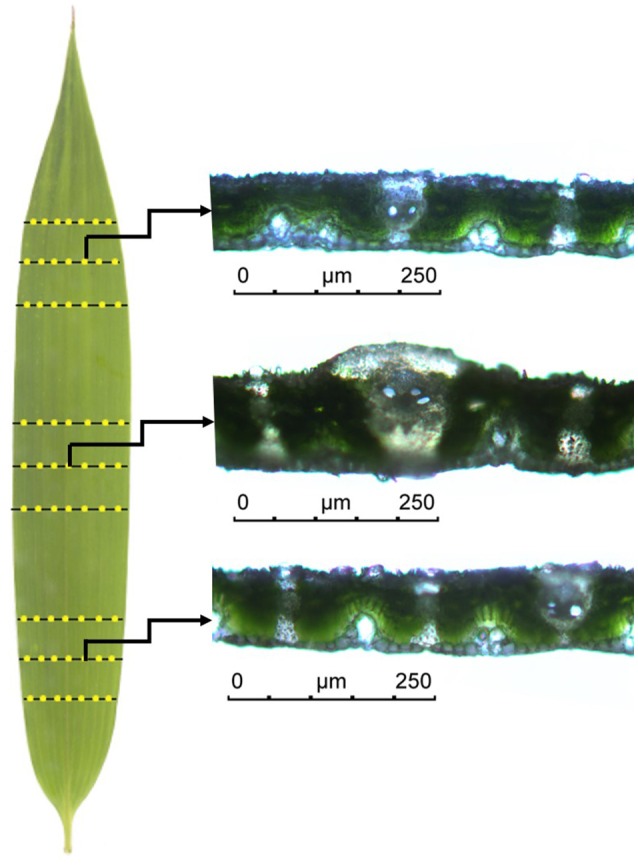
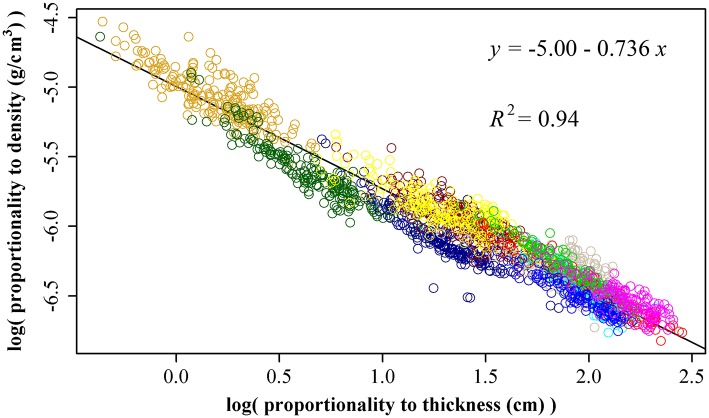
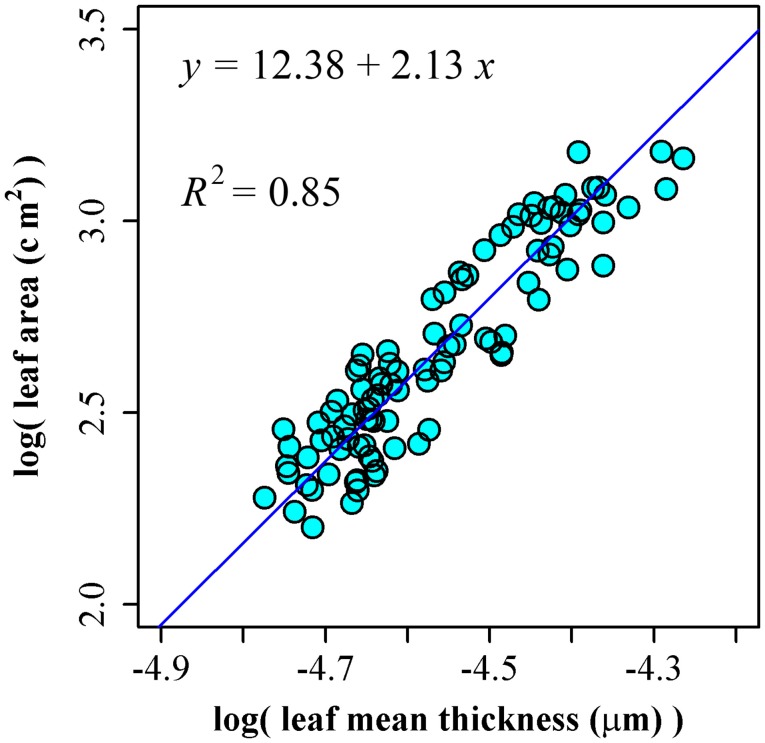
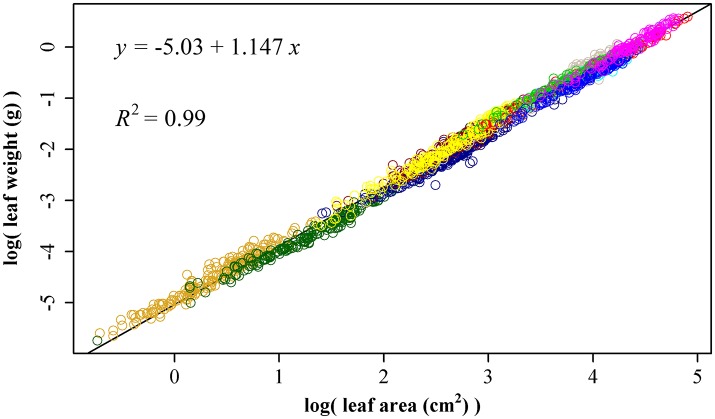
The principle of similarity (Thompson, 1917) states that the weight of an organism follows the 3/2-power law of its surface area and is proportional to its volume on the condition that the density is constant. However, the allometric relationship between leaf weight and leaf area has been reported to greatly deviate from the 3/2-power law, with the irregularity of leaf density largely ignored for explaining this deviation. Here, we choose 11 bamboo species to explore the allometric relationships among leaf area (), density (ρ), length (), thickness (), and weight (). Because the edge of a bamboo leaf follows a simplified two-parameter Gielis equation, we could show that ∝ and that ∝ . This then allowed us to derive the density-thickness allometry ρ ∝ and the weight-area allometry ∝ ≈ , where approximates -3/4. Leaf density is strikingly negatively associated with leaf thickness, and it is this inverse relationship that results in the weight-area allometry to deviate from the 3/2-power law. In conclusion, although plants are prone to invest less dry mass and thus produce thinner leaves when the leaf area is sufficient for photosynthesis, such leaf thinning needs to be accompanied with elevated density to ensure structural stability. The findings provide the insights on the evolutionary clue about the biomass investment and output of photosynthetic organs of plants. Because of the importance of leaves, plants could have enhanced the ratio of dry material per unit area of leaf in order to increase the efficiency of photosynthesis, relative the other parts of plants. Although the conclusion is drawn only based on 11 bamboo species, it should also be applicable to the other plants, especially considering previous works on the exponent of the weight-area relationship being less than 3/2 in plants.
相似性原理(汤普森,1917年)指出,在密度恒定的条件下,生物体的重量遵循其表面积的3/2幂定律,且与体积成正比。然而,据报道,叶重与叶面积之间的异速生长关系与3/2幂定律有很大偏差,叶密度的不规则性在很大程度上被忽视,未被用于解释这种偏差。在这里,我们选择了11种竹子来探究叶面积()、密度(ρ)、长度()、厚度()和重量()之间的异速生长关系。由于竹叶边缘遵循简化的双参数吉列斯方程,我们可以证明 ∝ 且 ∝ 。这进而使我们能够推导出密度-厚度异速生长关系 ρ ∝ 以及重量-面积异速生长关系 ∝ ≈ ,其中 近似为-3/4。叶密度与叶厚度显著负相关,正是这种反比关系导致重量-面积异速生长关系偏离3/2幂定律。总之,虽然当叶面积足以进行光合作用时,植物倾向于投入较少的干物质,从而产生较薄的叶子,但这种叶片变薄需要伴随着密度的增加以确保结构稳定性。这些发现为植物光合器官生物量投资和产出的进化线索提供了见解。由于叶子的重要性,相对于植物的其他部分,植物可能提高了单位叶面积的干物质比例,以提高光合作用效率。尽管该结论仅基于11种竹子得出,但考虑到之前关于植物重量-面积关系指数小于3/2的研究,它也应该适用于其他植物。