Guo Xuchen, Niklas Karl J, Li Yirong, Xue Jianhui, Shi Peijian, Schrader Julian
Bamboo Research Institution, College of Biology and the Environment, Nanjing Forestry University, Nanjing, China.
School of Integrative Plant Science, Cornell University, Ithaca, NY, United States.
Front Plant Sci. 2022 Oct 4;13:832300. doi: 10.3389/fpls.2022.832300. eCollection 2022.
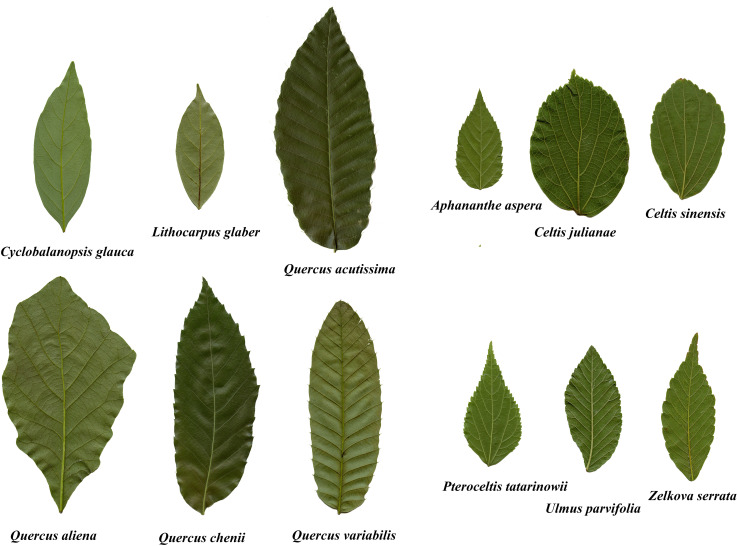
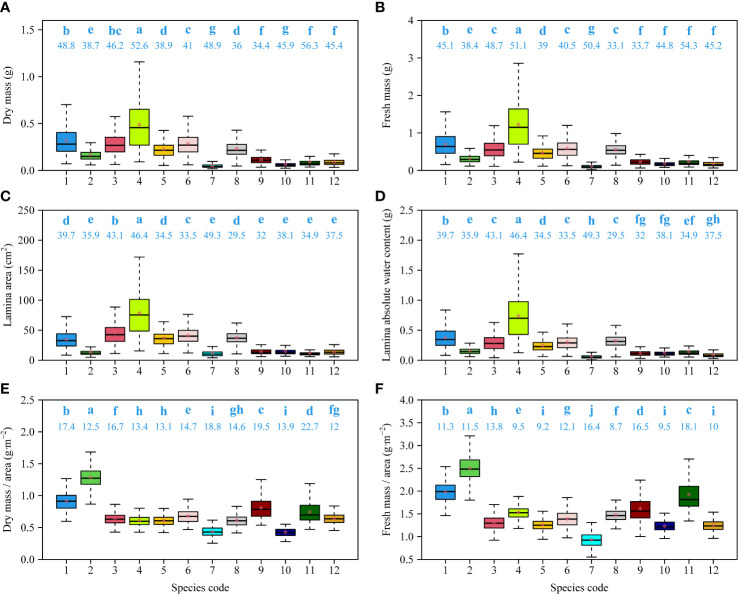
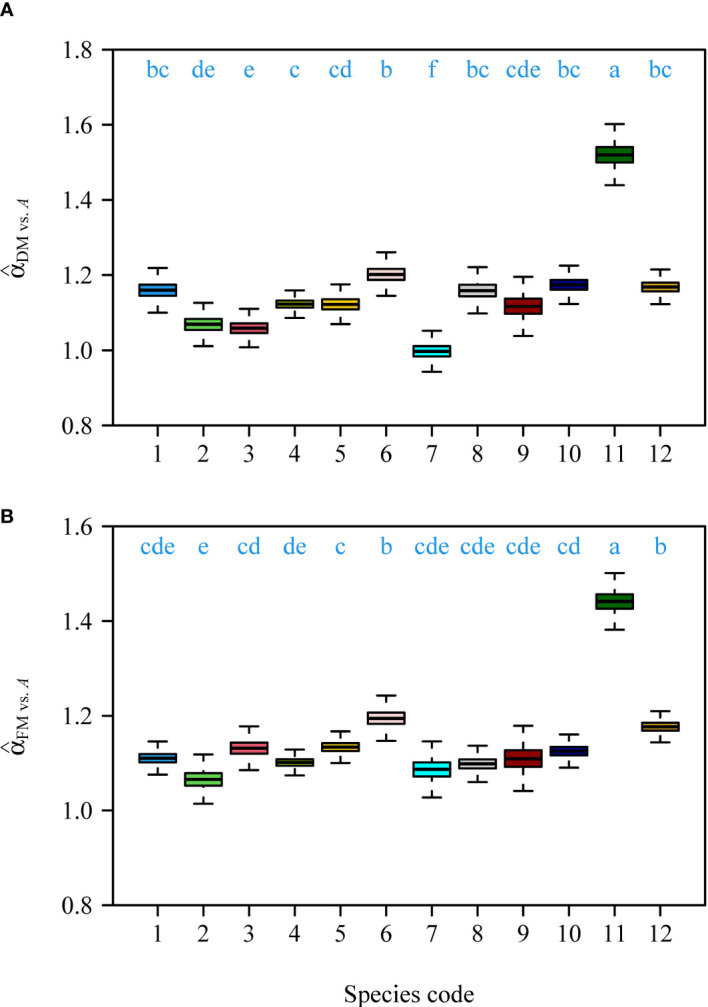
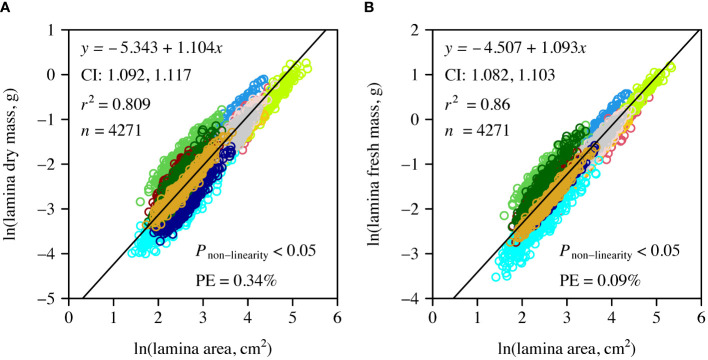
"Diminishing returns" in leaf economics occurs when increases in lamina mass (), which can either be represented by lamina dry mass (DM) or fresh mass (FM), fail to produce proportional increases in leaf surface area (), such that the scaling exponent (α) for the vs. scaling relationship exceeds unity (i.e., α > 1.0). Prior studies have shown that FM vs. is better than DM vs in assessing diminishing returns in evergreen species. However, the superiority of FM vs. over DM vs. has been less well examined for deciduous species. Here, we applied reduced major axis protocols to test whether FM vs. is better than DM vs. to describe the vs. scaling relationship, using a total of 4271 leaves from ten deciduous and two evergreen tree species in the Fagaceae and Ulmaceae for comparison. The significance of the difference between the scaling exponents of FM vs. and DM vs. was tested using the bootstrap percentile method. Further, we tested the non-linearity of the FM (DM) vs. data on a log-log scale using ordinary least squares. We found that (i) the majority of scaling exponents of FM vs. and DM vs. were >1 thereby confirming diminishing returns for all 12 species, (ii) FM vs. was more robust than DM vs. to identify the vs. scaling relationship, (iii) the non-linearity of the allometric model was significant for both DM vs. and FM vs. ., and (iv) the evergreen species of Fagaceae had significantly higher DM and FM per unit area than other deciduous species. In summary, FM vs. is a more reliable measure than DM vs. when dealing with diminishing returns, and deciduous species tend to invest less biomass in unit leaf light harvesting area than evergreen species.
叶片经济学中的“收益递减”现象是指,叶片质量()增加时(叶片质量可以用叶片干质量(DM)或鲜质量(FM)表示),叶片表面积()并未按比例增加,使得与的缩放关系的缩放指数(α)超过1(即α>1.0)。先前的研究表明,在评估常绿树种的收益递减情况时,FM与的关系比DM与的关系表现更好。然而,对于落叶树种,FM与相较于DM与的优越性尚未得到充分研究。在此,我们应用主轴缩减法,通过比较壳斗科和榆科10种落叶树种和2种常绿树种的总共4271片叶子,来测试FM与相较于DM与,是否能更好地描述与的缩放关系。使用自助百分位数法测试FM与和DM与的缩放指数之间差异的显著性。此外,我们用普通最小二乘法在对数-对数尺度上测试FM(DM)与数据的非线性。我们发现:(i)FM与和DM与的大多数缩放指数都>1,从而证实了所有12个物种都存在收益递减现象;(ii)在识别与的缩放关系方面,FM与比DM与更稳健;(iii)异速生长模型的非线性对于DM与和FM与均显著;(iv)壳斗科的常绿树种单位面积的DM和FM显著高于其他落叶树种。总之,在处理收益递减问题时,FM与比DM与是更可靠的衡量指标,并且落叶树种在单位叶光捕获面积上投入的生物量往往比常绿树种少。