From the Department of Clinical and Scientific Affairs, Hanger Clinic, Austin, Texas (SRW, PMS, JHC); Department of Biomechanics, University of Nebraska, Omaha, Nebraska (SRW); and Division of Physical Medicine & Rehabilitation, University of Utah, Salt Lake City, Utah (PMS).
Am J Phys Med Rehabil. 2018 Nov;97(11):782-788. doi: 10.1097/PHM.0000000000000967.
The aim of the study was to determine the impact of comorbidities on mobility in patients with lower limb prostheses.
Cohort database chart review was conducted to examine mobility in lower limb prosthesis users grouped according to comorbidities. Regression models were used to determine significant predictor comorbidities for mobility. General linear univariate models were implemented to investigate differences in mobility among cohorts (N = 596).
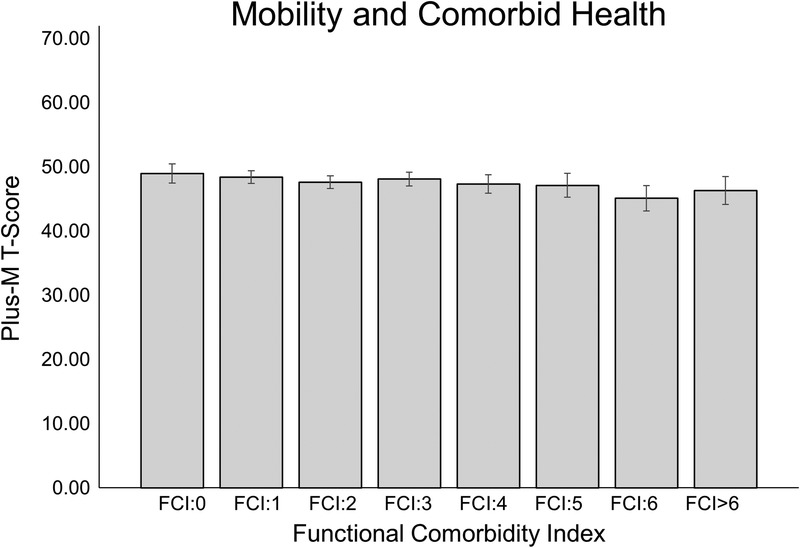
Patient age and history of stroke, peripheral vascular disease, and anxiety/panic disorders were predictors of decreased mobility. After adjusting for covariates, the differences in mobility reported by patients older than 65 yrs was compared with those younger than 65 yrs; in addition, we compared those with a history of peripheral vascular disease with those without. The comparative analyses for both categories did not satisfy the minimal clinically important difference. There were no significant differences when comparing overall comorbid health after adjusting for covariates.
Clinicians should consider patient age and history of stroke, peripheral vascular disease, or anxiety/panic disorders when optimizing a lower limb prosthesis users' mobility because these variables may be predictive of modest but clinically meaningful decreased prosthetic mobility. By contrast, common comorbid health conditions such as arthritis, chronic obstructive pulmonary disease, congestive heart failure, and diabetes do not seem predictive of decreased mobility among lower limb prosthesis users.
本研究旨在确定合并症对下肢假体患者活动能力的影响。
通过队列数据库图表回顾,检查根据合并症分组的下肢假体使用者的活动能力。回归模型用于确定对活动能力有显著预测作用的合并症。实施一般线性单变量模型,以研究不同队列之间活动能力的差异(N=596)。
患者年龄以及卒中、外周血管疾病和焦虑/惊恐障碍病史是活动能力下降的预测因素。调整协变量后,将年龄>65 岁的患者与年龄<65 岁的患者进行比较;此外,还将有外周血管疾病病史的患者与无该病史的患者进行比较。这两个类别的比较分析均未达到最小临床重要差异。调整协变量后,整体合并症健康状况之间无显著差异。
临床医生在优化下肢假体使用者的活动能力时,应考虑患者的年龄和卒中、外周血管疾病或焦虑/惊恐障碍病史,因为这些变量可能预示着假体活动能力适度但具有临床意义的下降。相比之下,关节炎、慢性阻塞性肺疾病、充血性心力衰竭和糖尿病等常见合并症似乎并不能预测下肢假体使用者活动能力的下降。