Tadesse Sileshi, Alemayehu Haile, Tenna Admasu, Tadesse Getachew, Tessema Tefaye Sisay, Shibeshi Workineh, Eguale Tadesse
Yekatit 12 Hospital Medical College, P.O. Box157, Addis Ababa, Ethiopia.
Aklilu Lemma Institute of Pathobiology, Addis Ababa University, P.O. Box 1176, Addis Ababa, Ethiopia.
BMC Pharmacol Toxicol. 2018 May 21;19(1):24. doi: 10.1186/s40360-018-0210-9.
Staphylococcus aureus is one of the major pathogens of public health importance responsible for various forms of infection. Development of resistance to commonly used antimicrobials limited treatment options against infections due to this pathogen. Antimicrobial resistance profile of Staphylococcus aureus isolated from patients with surgical site infection and ear infection and corresponding nasal swab was investigated in Tikur Anbessa Specialized Hospital (TASH), Addis Ababa, Ethiopia.
Wound and corresponding nasal swabs from patients with surgical site infection from general surgery ward (n = 14), orthopedic ward (n = 21) and those with otitis media (n = 59) from Ear Nose and Throat (ENT) ward were cultured for S. aureus isolation according to standard procedures from December 2013 to June 2014. Isolates were investigated for susceptibility to panel of 17 antimicrobials using Kirby Bauer disc diffusion assay. Susceptibility to methicillin was phenotypically determined based on sensitivity of isolates to cefoxitin and oxacillin.
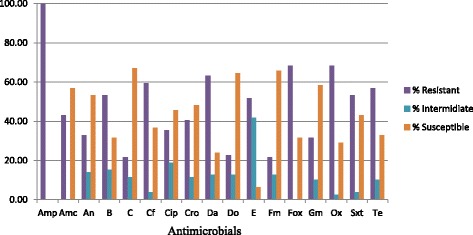
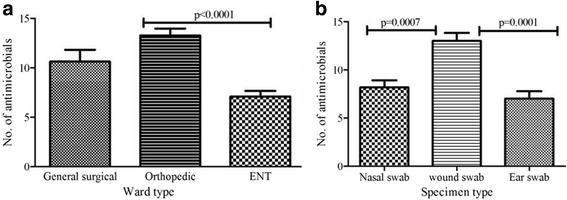
A total of 79 S. aureus isolates were recovered from 54(57.4%) of patients. The isolates were resistant to ampicillin (100%), oxacillin and cefoxitin (68.4%, each), clindamycin (63.3%), cephalothin (59.5%), tetracycline (57%), sulfamethoxazole + trimethoprim and bacitracin (53.2%, each), and erythromycin (51.9%). Resistance to two or more antimicrobials was recorded in 74 (95%) of the isolates, while resistance to 3 or more antimicrobials was detected in 65(82.3%) of the isolates. Fifty-four (68.4%) of the isolates were methicillin resistant S. aureus (MRSA). Rate of occurrence of MRSA was more common among isolates from surgical wards (p < 0.001) compared to those from ENT ward. High level of multi-drug resistance (MDR) was detected more commonly among isolates from orthopedic ward than those from general surgical ward and patients with ear infection (p < 0.001). One of the isolate cultured from wound swab of a patient with surgical site infection from orthopedic ward was resistant to all of the 17 antimicrobials tested.
S. aureus isolates from patients in TASH exhibited resistance to majority of antimicrobials commonly employed for the treatment of staphylococcal infections which calls for urgent need of prudent use of antimicrobials and the need for implementation of effective infection control practices to hamper spread of MDR S. aureus.
金黄色葡萄球菌是对公共卫生具有重要意义的主要病原体之一,可引发多种感染。对常用抗菌药物产生耐药性限制了针对该病原体感染的治疗选择。在埃塞俄比亚亚的斯亚贝巴的提库尔·安贝萨专科医院(TASH),对从手术部位感染和耳部感染患者以及相应鼻拭子中分离出的金黄色葡萄球菌的抗菌药物耐药情况进行了调查。
2013年12月至2014年6月,按照标准程序,对普通外科病房手术部位感染患者(n = 14)、骨科病房手术部位感染患者(n = 21)以及耳鼻喉科病房中耳炎患者(n = 59)的伤口及相应鼻拭子进行培养,以分离金黄色葡萄球菌。使用 Kirby Bauer 纸片扩散法检测分离株对17种抗菌药物的敏感性。根据分离株对头孢西丁和苯唑西林的敏感性,表型确定对甲氧西林的敏感性。
共从54名(57.4%)患者中分离出79株金黄色葡萄球菌。分离株对氨苄西林耐药率为100%,对苯唑西林和头孢西丁耐药率均为68.4%,对克林霉素耐药率为63.3%,对头孢噻吩耐药率为59.5%,对四环素耐药率为57%,对磺胺甲恶唑+甲氧苄啶和杆菌肽耐药率均为53.2%,对红霉素耐药率为51.9%。74株(95%)分离株对两种或更多种抗菌药物耐药,65株(82.3%)分离株对三种或更多种抗菌药物耐药。54株(68.4%)分离株为耐甲氧西林金黄色葡萄球菌(MRSA)。与耳鼻喉科病房分离株相比,手术病房分离株中MRSA的发生率更高(p < 0.001)。与普通外科病房和耳部感染患者相比,骨科病房分离株中检测到的高水平多重耐药(MDR)更为常见(p < 0.001)。从骨科病房一名手术部位感染患者伤口拭子培养出的一株分离株对所有17种测试抗菌药物均耐药。
TASH医院患者分离出的金黄色葡萄球菌对大多数常用于治疗葡萄球菌感染的抗菌药物耐药,这迫切需要谨慎使用抗菌药物,并需要实施有效的感染控制措施以阻止耐多药金黄色葡萄球菌的传播。