Institute of Groundwater Ecology , Helmholtz Zentrum München , Ingolstädter Landstrasse 1 , 85764 Neuherberg , Germany.
Department of Chemistry , Mwenge Catholic University , P.O. Box 1226, Moshi , Tanzania.
Environ Sci Technol. 2018 Jul 3;52(13):7259-7268. doi: 10.1021/acs.est.8b01004. Epub 2018 Jun 19.
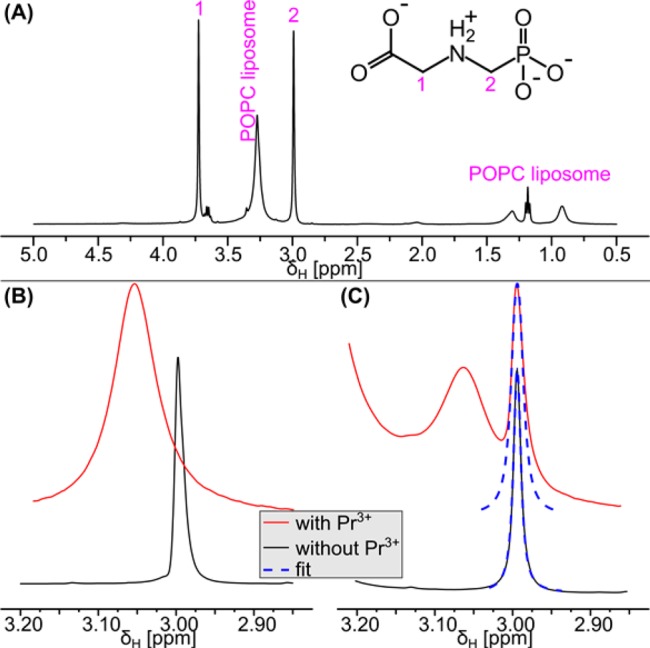
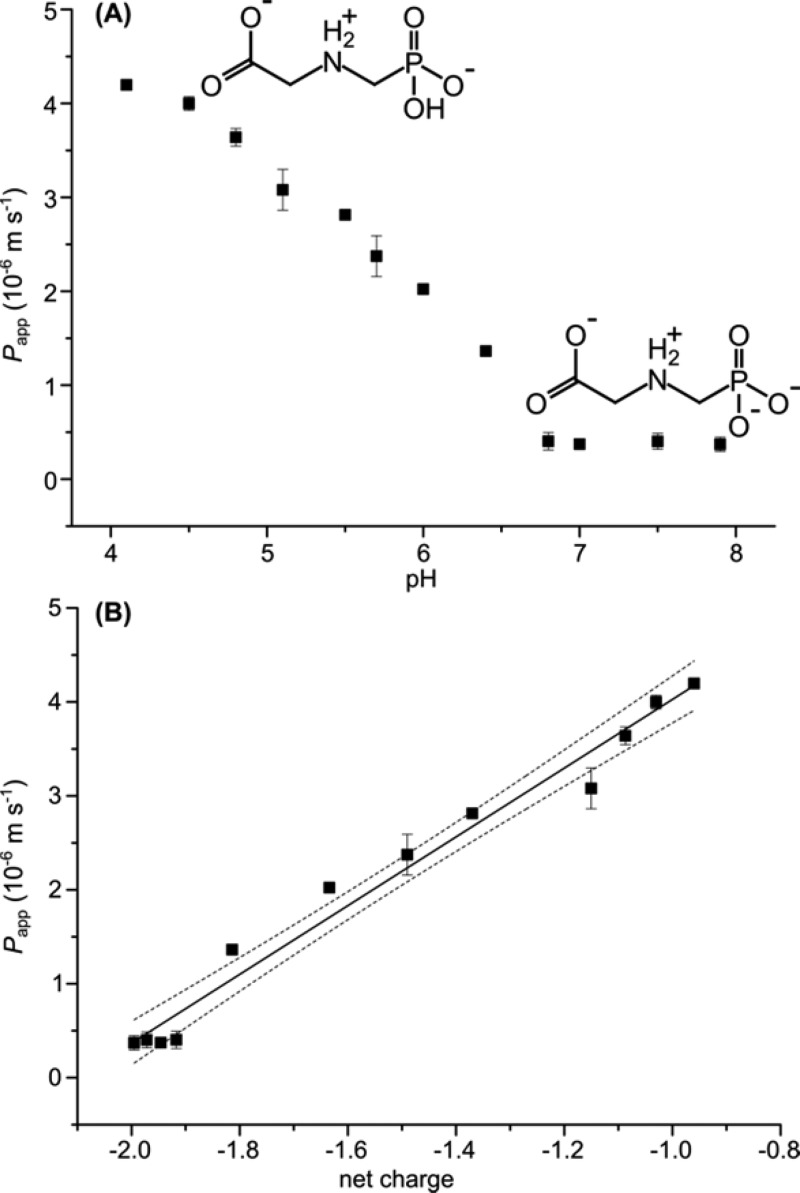
Bacterial uptake of charged organic pollutants such as the widely used herbicide glyphosate is typically attributed to active transporters, whereas passive membrane permeation as an uptake pathway is usually neglected. For 1-palmitoyl-2-oleoyl- sn-glycero-3-phosphocholine (POPC) liposomes, the pH-dependent apparent membrane permeation coefficients ( P) of glyphosate, determined by nuclear magnetic resonance (NMR) spectroscopy, varied from P (pH 7.0) = 3.7 (±0.3) × 10 m·s to P (pH 4.1) = 4.2 (±0.1) × 10 m·s. The magnitude of this surprisingly rapid membrane permeation depended on glyphosate speciation and was, at circumneutral pH, in the range of polar, noncharged molecules. These findings point to passive membrane permeation as a potential uptake pathway during glyphosate biodegradation. To test this hypothesis, a Gram-negative glyphosate degrader, Ochrobactrum sp. FrEM, was isolated from glyphosate-treated soil and glyphosate permeation rates inferred from the liposome model system were compared to bacterial degradation rates. Estimated maximum permeation rates were, indeed, 2 orders of magnitude higher than degradation rates of glyphosate. In addition, biodegradation of millimolar glyphosate concentrations gave rise to pronounced carbon isotope fractionation with an apparent kinetic isotope effect, AKIE, of 1.014 ± 0.003. This value lies in the range typical of non-masked enzymatic isotope fractionation demonstrating that glyphosate biodegradation was not subject to mass transfer limitations and glyphosate exchange across the cell membrane was rapid relative to enzymatic turnover.
细菌摄取带电荷的有机污染物,如广泛使用的除草剂草甘膦,通常归因于主动转运体,而被动的膜渗透作为一种摄取途径通常被忽视。对于 1-棕榈酰基-2-油酰基- sn-甘油-3-磷酸胆碱(POPC)脂质体,通过核磁共振(NMR)光谱法测定的草甘膦的 pH 依赖性表观膜渗透系数(P),从 P(pH 7.0)= 3.7(±0.3)×10 m·s 变化到 P(pH 4.1)= 4.2(±0.1)×10 m·s。这种惊人的快速膜渗透的大小取决于草甘膦的形态,并且在近中性 pH 下,处于极性非带电分子的范围内。这些发现表明被动膜渗透是草甘膦生物降解过程中潜在的摄取途径。为了验证这一假设,从草甘膦处理过的土壤中分离出一种革兰氏阴性草甘膦降解菌 Ochrobactrum sp. FrEM,并将从脂质体模型系统推断出的草甘膦渗透速率与细菌降解速率进行了比较。估计的最大渗透速率确实比草甘膦的降解速率高 2 个数量级。此外,草甘膦浓度为毫摩尔级的生物降解导致明显的碳同位素分馏,表观动力学同位素效应(AKIE)为 1.014±0.003。该值位于典型的非掩蔽酶促同位素分馏的范围内,表明草甘膦生物降解不受传质限制,草甘膦通过细胞膜的交换相对于酶的转化是快速的。