Wang Lu, Huang Mingtao, Ding Hui, Jin Guangfu, Chen Liang, Chen Feng, Shen Hongbing
Department of Epidemiology and Biostatistics, School of Public Health, Nanjing Medical University, Nanjing, China.
Jiangsu Key Lab of Cancer Biomarkers, Prevention and Treatment, Collaborative Innovation Center of Cancer Medicine, Nanjing Medical University, Nanjing, China.
Cancer Med. 2018 Jul;7(7):3445-3452. doi: 10.1002/cam4.1557. Epub 2018 May 23.
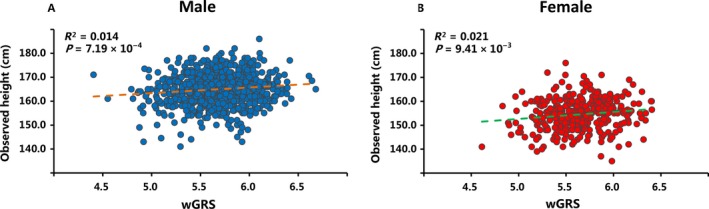
The association between adult height and risk of lung cancer has been investigated by epidemiology studies, but the results are inconsistent. Mendelian randomization (MR) analyses with individual-level data from two genome-wide association studies, including a total of 7127 lung cancer cases and 6818 controls, were carried out to explore whether adult height is causally associated with risk of lung cancer. A weighted genetic risk score (wGRS) was created based on genotypes of 101 known height-associated genetic variants. Association between the wGRS and risk of lung cancer was analyzed by logistic regression for each study separately. The combined effect was calculated using fixed effect meta-analysis. MR analyses showed that increased risk of lung cancer (OR = 1.19, 95%CI: 1.05-1.35, P = 0.006) associated with taller genetically determined height. Compared with individuals in the lowest tertile of the height-associated wGRS, those in the highest tertile had 1.10-fold (95% CI: 1.01-1.20) increased risk of developing lung cancer. Sensitivity analyses excluding BMI-associated genetic variants demonstrated consistent association. Our study suggested that genetically taller height was associated with increased risk of lung cancer in East Asian population, indicating that increasing height may have a causal role in lung cancer carcinogenesis.
流行病学研究已对成人身高与肺癌风险之间的关联进行了调查,但结果并不一致。利用两项全基因组关联研究的个体水平数据进行孟德尔随机化(MR)分析,共纳入7127例肺癌病例和6818例对照,以探讨成人身高是否与肺癌风险存在因果关联。基于101个已知的身高相关基因变异的基因型创建了加权遗传风险评分(wGRS)。分别对每项研究通过逻辑回归分析wGRS与肺癌风险之间的关联。使用固定效应荟萃分析计算合并效应。MR分析显示,遗传决定的身高越高,肺癌风险增加(比值比=1.19,95%置信区间:1.05-1.35,P=0.006)。与身高相关wGRS处于最低三分位数的个体相比,最高三分位数的个体患肺癌的风险增加1.10倍(95%置信区间:1.01-1.20)。排除与体重指数相关的基因变异的敏感性分析显示出一致的关联。我们的研究表明,在东亚人群中,遗传身高较高与肺癌风险增加相关,这表明身高增加可能在肺癌致癌过程中起因果作用。