• 文献检索
  • 文档翻译
  • 深度研究
  • 学术资讯
  • Suppr Zotero 插件Zotero 插件
  • 邀请有礼
  • 套餐&价格
  • 历史记录
应用&插件
Suppr Zotero 插件Zotero 插件浏览器插件Mac 客户端Windows 客户端微信小程序
定价
高级版会员购买积分包购买API积分包
服务
文献检索文档翻译深度研究API 文档MCP 服务
关于我们
关于 Suppr公司介绍联系我们用户协议隐私条款
关注我们

Suppr 超能文献

核心技术专利:CN118964589B侵权必究
粤ICP备2023148730 号-1Suppr @ 2026

文献检索

告别复杂PubMed语法,用中文像聊天一样搜索,搜遍4000万医学文献。AI智能推荐,让科研检索更轻松。

立即免费搜索

文件翻译

保留排版,准确专业,支持PDF/Word/PPT等文件格式,支持 12+语言互译。

免费翻译文档

深度研究

AI帮你快速写综述,25分钟生成高质量综述,智能提取关键信息,辅助科研写作。

立即免费体验

英国生物库和大型国际联盟中人体大小和组成与特定部位癌症风险的关系:一项孟德尔随机化研究。

Body size and composition and risk of site-specific cancers in the UK Biobank and large international consortia: A mendelian randomisation study.

机构信息

MRC Cancer Unit, University of Cambridge, Cambridge, United Kingdom.

Department of Public Health and Primary Care, University of Cambridge, Cambridge, United Kingdom.

出版信息

PLoS Med. 2021 Jul 29;18(7):e1003706. doi: 10.1371/journal.pmed.1003706. eCollection 2021 Jul.

DOI:10.1371/journal.pmed.1003706
PMID:34324486
原文链接:https://pmc.ncbi.nlm.nih.gov/articles/PMC8320991/
Abstract

BACKGROUND

Evidence for the impact of body size and composition on cancer risk is limited. This mendelian randomisation (MR) study investigates evidence supporting causal relationships of body mass index (BMI), fat mass index (FMI), fat-free mass index (FFMI), and height with cancer risk.

METHODS AND FINDINGS

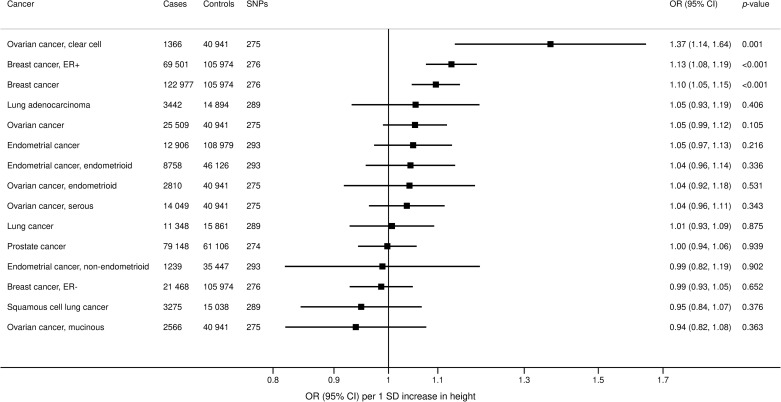
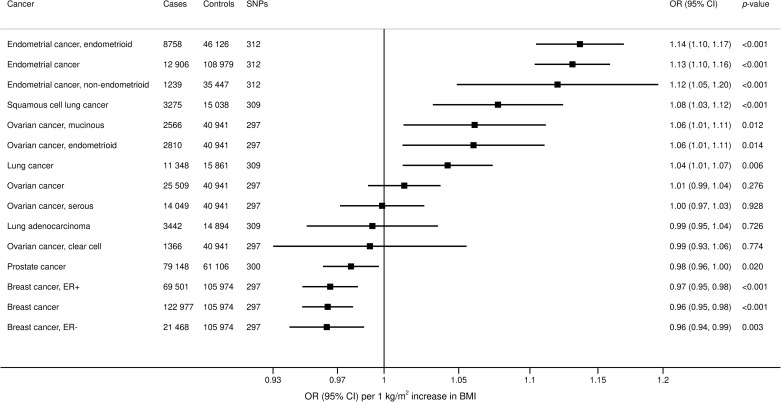
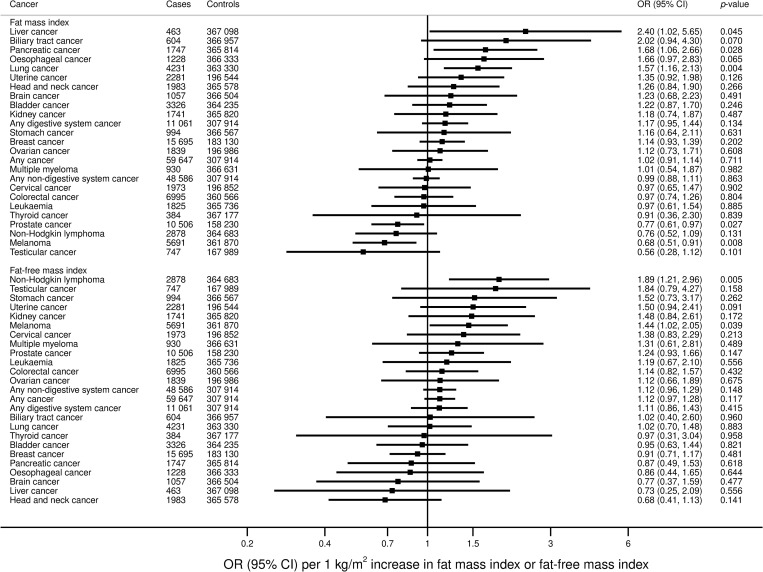
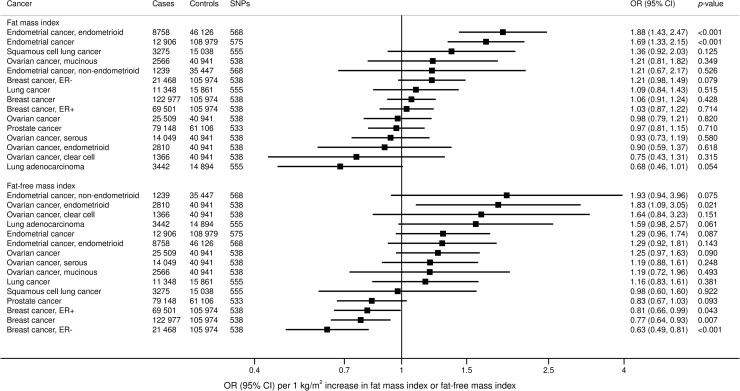
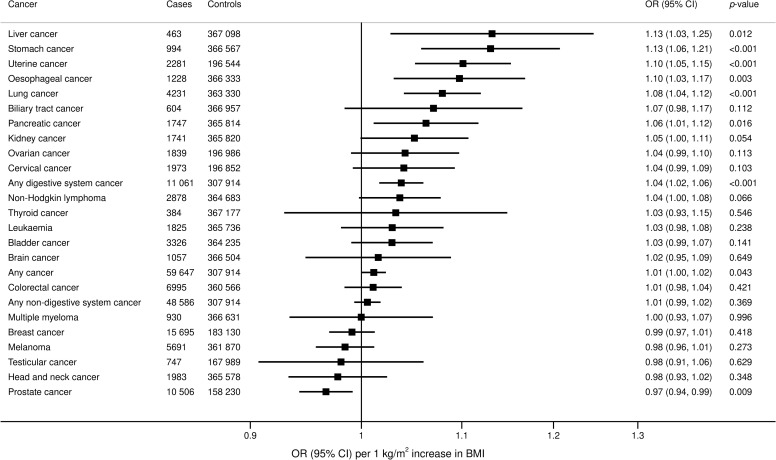
Single nucleotide polymorphisms (SNPs) were used as instrumental variables for BMI (312 SNPs), FMI (577 SNPs), FFMI (577 SNPs), and height (293 SNPs). Associations of the genetic variants with 22 site-specific cancers and overall cancer were estimated in 367,561 individuals from the UK Biobank (UKBB) and with lung, breast, ovarian, uterine, and prostate cancer in large international consortia. In the UKBB, genetically predicted BMI was positively associated with overall cancer (odds ratio [OR] per 1 kg/m2 increase 1.01, 95% confidence interval [CI] 1.00-1.02; p = 0.043); several digestive system cancers: stomach (OR 1.13, 95% CI 1.06-1.21; p < 0.001), esophagus (OR 1.10, 95% CI 1.03, 1.17; p = 0.003), liver (OR 1.13, 95% CI 1.03-1.25; p = 0.012), and pancreas (OR 1.06, 95% CI 1.01-1.12; p = 0.016); and lung cancer (OR 1.08, 95% CI 1.04-1.12; p < 0.001). For sex-specific cancers, genetically predicted elevated BMI was associated with an increased risk of uterine cancer (OR 1.10, 95% CI 1.05-1.15; p < 0.001) and with a lower risk of prostate cancer (OR 0.97, 95% CI 0.94-0.99; p = 0.009). When dividing cancers into digestive system versus non-digestive system, genetically predicted BMI was positively associated with digestive system cancers (OR 1.04, 95% CI 1.02-1.06; p < 0.001) but not with non-digestive system cancers (OR 1.01, 95% CI 0.99-1.02; p = 0.369). Genetically predicted FMI was positively associated with liver, pancreatic, and lung cancer and inversely associated with melanoma and prostate cancer. Genetically predicted FFMI was positively associated with non-Hodgkin lymphoma and melanoma. Genetically predicted height was associated with increased risk of overall cancer (OR per 1 standard deviation increase 1.09; 95% CI 1.05-1.12; p < 0.001) and multiple site-specific cancers. Similar results were observed in analyses using the weighted median and MR-Egger methods. Results based on consortium data confirmed the positive associations between BMI and lung and uterine cancer risk as well as the inverse association between BMI and prostate cancer, and, additionally, showed an inverse association between genetically predicted BMI and breast cancer. The main limitations are the assumption that genetic associations with cancer outcomes are mediated via the proposed risk factors and that estimates for some lower frequency cancer types are subject to low precision.

CONCLUSIONS

Our results show that the evidence for BMI as a causal risk factor for cancer is mixed. We find that BMI has a consistent causal role in increasing risk of digestive system cancers and a role for sex-specific cancers with inconsistent directions of effect. In contrast, increased height appears to have a consistent risk-increasing effect on overall and site-specific cancers.

摘要

背景

目前有关身体大小和组成对癌症风险影响的证据有限。本孟德尔随机化(MR)研究旨在调查支持身体质量指数(BMI)、脂肪质量指数(FMI)、无脂肪质量指数(FFMI)和身高与癌症风险之间因果关系的证据。

方法和发现

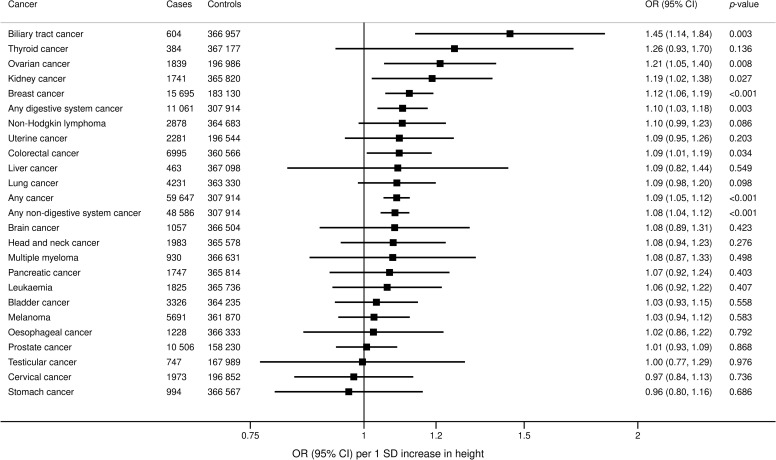
使用单核苷酸多态性(SNP)作为 BMI(312 个 SNP)、FMI(577 个 SNP)、FFMI(577 个 SNP)和身高(293 个 SNP)的工具变量。在英国生物库(UKBB)中,从 367561 名个体中估计了遗传变异与 22 种特定部位癌症和总体癌症的关联,并在大型国际联盟中估计了与肺癌、乳腺癌、卵巢癌、子宫癌和前列腺癌的关联。在 UKBB 中,遗传预测的 BMI 与总体癌症呈正相关(每增加 1kg/m2 的比值比[OR]为 1.01,95%置信区间[CI]为 1.00-1.02;p=0.043);几种消化系统癌症:胃(OR 1.13,95%CI 1.06-1.21;p<0.001)、食管(OR 1.10,95%CI 1.03-1.17;p=0.003)、肝(OR 1.13,95%CI 1.03-1.25;p=0.012)和胰腺(OR 1.06,95%CI 1.01-1.12;p=0.016);以及肺癌(OR 1.08,95%CI 1.04-1.12;p<0.001)。对于性别特异性癌症,遗传预测的 BMI 升高与子宫癌(OR 1.10,95%CI 1.05-1.15;p<0.001)风险增加和前列腺癌(OR 0.97,95%CI 0.94-0.99;p=0.009)风险降低相关。当将癌症分为消化系统癌症和非消化系统癌症时,遗传预测的 BMI 与消化系统癌症呈正相关(OR 1.04,95%CI 1.02-1.06;p<0.001),但与非消化系统癌症无关(OR 1.01,95%CI 0.99-1.02;p=0.369)。遗传预测的 FMI 与肝癌、胰腺癌和肺癌呈正相关,与黑色素瘤和前列腺癌呈负相关。遗传预测的 FFMI 与非霍奇金淋巴瘤和黑色素瘤呈正相关。遗传预测的身高与总体癌症(每增加 1 个标准差的 OR 为 1.09;95%CI 1.05-1.12;p<0.001)和多种特定部位癌症的风险增加相关。使用加权中位数和 MR-Egger 方法进行的分析也得到了类似的结果。基于联盟数据的结果证实了 BMI 与肺癌和子宫癌风险之间的正相关关系,以及 BMI 与前列腺癌之间的负相关关系,此外,还显示了遗传预测的 BMI 与乳腺癌之间的负相关关系。主要限制是假设与癌症结果相关的遗传关联是通过提出的风险因素介导的,并且一些较低频率的癌症类型的估计受到低精度的限制。

结论

我们的研究结果表明,BMI 作为癌症的因果风险因素的证据是混杂的。我们发现 BMI 在增加消化系统癌症的风险方面具有一致的因果作用,而在性别特异性癌症方面具有不一致的作用方向。相比之下,身高的增加似乎对总体和特定部位癌症的风险增加具有一致的影响。
https://cdn.ncbi.nlm.nih.gov/pmc/blobs/56bb/8320991/9e875d035de7/pmed.1003706.g006.jpg
https://cdn.ncbi.nlm.nih.gov/pmc/blobs/56bb/8320991/24f9da3836e5/pmed.1003706.g001.jpg
https://cdn.ncbi.nlm.nih.gov/pmc/blobs/56bb/8320991/dd644bdc6831/pmed.1003706.g002.jpg
https://cdn.ncbi.nlm.nih.gov/pmc/blobs/56bb/8320991/016b6b972af3/pmed.1003706.g003.jpg
https://cdn.ncbi.nlm.nih.gov/pmc/blobs/56bb/8320991/dba8ffa27b6c/pmed.1003706.g004.jpg
https://cdn.ncbi.nlm.nih.gov/pmc/blobs/56bb/8320991/5960fb21705b/pmed.1003706.g005.jpg
https://cdn.ncbi.nlm.nih.gov/pmc/blobs/56bb/8320991/9e875d035de7/pmed.1003706.g006.jpg
https://cdn.ncbi.nlm.nih.gov/pmc/blobs/56bb/8320991/24f9da3836e5/pmed.1003706.g001.jpg
https://cdn.ncbi.nlm.nih.gov/pmc/blobs/56bb/8320991/dd644bdc6831/pmed.1003706.g002.jpg
https://cdn.ncbi.nlm.nih.gov/pmc/blobs/56bb/8320991/016b6b972af3/pmed.1003706.g003.jpg
https://cdn.ncbi.nlm.nih.gov/pmc/blobs/56bb/8320991/dba8ffa27b6c/pmed.1003706.g004.jpg
https://cdn.ncbi.nlm.nih.gov/pmc/blobs/56bb/8320991/5960fb21705b/pmed.1003706.g005.jpg
https://cdn.ncbi.nlm.nih.gov/pmc/blobs/56bb/8320991/9e875d035de7/pmed.1003706.g006.jpg

相似文献

1
Body size and composition and risk of site-specific cancers in the UK Biobank and large international consortia: A mendelian randomisation study.英国生物库和大型国际联盟中人体大小和组成与特定部位癌症风险的关系:一项孟德尔随机化研究。
PLoS Med. 2021 Jul 29;18(7):e1003706. doi: 10.1371/journal.pmed.1003706. eCollection 2021 Jul.
2
Smoking, alcohol consumption, and cancer: A mendelian randomisation study in UK Biobank and international genetic consortia participants.吸烟、饮酒与癌症:英国生物银行和国际遗传联盟参与者的孟德尔随机化研究。
PLoS Med. 2020 Jul 23;17(7):e1003178. doi: 10.1371/journal.pmed.1003178. eCollection 2020 Jul.
3
Assessing the causal role of epigenetic clocks in the development of multiple cancers: a Mendelian randomization study.评估表观遗传时钟在多种癌症发生发展中的因果作用:一项孟德尔随机化研究。
Elife. 2022 Mar 29;11:e75374. doi: 10.7554/eLife.75374.
4
A data-driven approach for studying the role of body mass in multiple diseases: a phenome-wide registry-based case-control study in the UK Biobank.一种基于数据驱动的研究体重在多种疾病中作用的方法:英国生物库中基于表型全基因组注册的病例对照研究。
Lancet Digit Health. 2019 Jul;1(3):e116-e126. doi: 10.1016/S2589-7500(19)30028-7. Epub 2019 Jun 27.
5
Mendelian randomization study of adiposity-related traits and risk of breast, ovarian, prostate, lung and colorectal cancer.肥胖相关性状与乳腺癌、卵巢癌、前列腺癌、肺癌和结直肠癌风险的孟德尔随机化研究。
Int J Epidemiol. 2016 Jun;45(3):896-908. doi: 10.1093/ije/dyw129. Epub 2016 Jul 17.
6
Body mass index and body composition in relation to 14 cardiovascular conditions in UK Biobank: a Mendelian randomization study.英国生物库中 14 种心血管疾病与体重指数和身体成分的关系:一项孟德尔随机化研究。
Eur Heart J. 2020 Jan 7;41(2):221-226. doi: 10.1093/eurheartj/ehz388.
7
[Genetic Causation Analysis of Hyperandrogenemia Testing Indicators and Preeclampsia].[高雄激素血症检测指标与子痫前期的遗传因果关系分析]
Sichuan Da Xue Xue Bao Yi Xue Ban. 2024 May 20;55(3):566-573. doi: 10.12182/20240560106.
8
Assessment of causal effects of visceral adipose tissue on risk of cancers: a Mendelian randomization study.内脏脂肪组织对癌症风险因果关系的评估:一项孟德尔随机化研究。
Int J Epidemiol. 2022 Aug 10;51(4):1204-1218. doi: 10.1093/ije/dyac025.
9
Body mass index and height and risk of cutaneous melanoma: Mendelian randomization analyses.体质指数与身高和皮肤黑色素瘤风险:孟德尔随机分析。
Int J Epidemiol. 2020 Aug 1;49(4):1236-1245. doi: 10.1093/ije/dyaa009.
10
The effects of height and BMI on prostate cancer incidence and mortality: a Mendelian randomization study in 20,848 cases and 20,214 controls from the PRACTICAL consortium.身高和体重指数对前列腺癌发病率和死亡率的影响:一项针对来自PRACTICAL联盟的20848例病例和20214例对照的孟德尔随机化研究。
Cancer Causes Control. 2015 Nov;26(11):1603-16. doi: 10.1007/s10552-015-0654-9. Epub 2015 Sep 19.

引用本文的文献

1
Advances in Mendelian Randomization Studies of Obesity Over the Past Decade: Uncovering Key Genetic Mechanisms.过去十年肥胖孟德尔随机化研究的进展:揭示关键遗传机制
Diabetes Metab Syndr Obes. 2025 Jul 17;18:2399-2415. doi: 10.2147/DMSO.S528669. eCollection 2025.
2
Genetically proxied risk and protective factors for pancreatic cancer: a systematic review and meta-analysis of Mendelian randomization studies.胰腺癌的遗传代理风险和保护因素:孟德尔随机化研究的系统评价和荟萃分析
J Gastrointest Oncol. 2025 Jun 30;16(3):1233-1247. doi: 10.21037/jgo-2025-305. Epub 2025 Jun 27.
3
Unraveling the influence of body mass index on complex diseases in East Asians: Insights from Mendelian randomization phenome-wide association study.

本文引用的文献

1
Insulin-like growth factor-1 and site-specific cancers: A Mendelian randomization study.胰岛素样生长因子-1 与特定部位癌症:一项孟德尔随机化研究。
Cancer Med. 2020 Sep;9(18):6836-6842. doi: 10.1002/cam4.3345. Epub 2020 Jul 27.
2
The Role of Dysfunctional Adipose Tissue in Pancreatic Cancer: A Molecular Perspective.功能失调的脂肪组织在胰腺癌中的作用:分子视角
Cancers (Basel). 2020 Jul 9;12(7):1849. doi: 10.3390/cancers12071849.
3
Fat mass and fat-free mass in relation to cardiometabolic diseases: a two-sample Mendelian randomization study.
揭示体重指数对东亚人群复杂疾病的影响:孟德尔随机化全表型关联研究的见解
Medicine (Baltimore). 2025 Jun 27;104(26):e42998. doi: 10.1097/MD.0000000000042998.
4
Mendelian Randomisation: Concepts, Opportunities, Challenges, and Future Directions.孟德尔随机化:概念、机遇、挑战及未来方向。
Glob Heart. 2025 Jun 17;20(1):54. doi: 10.5334/gh.1438. eCollection 2025.
5
Mendelian randomization analysis of modifiable risk factors for breast cancer.乳腺癌可改变风险因素的孟德尔随机化分析。
Discov Oncol. 2025 Jun 16;16(1):1123. doi: 10.1007/s12672-025-02412-7.
6
The global burden of polycystic ovary syndrome, endometriosis, uterine fibroids, cervical cancer, uterine cancer, and ovarian cancer from 1990 to 2021.1990年至2021年多囊卵巢综合征、子宫内膜异位症、子宫肌瘤、宫颈癌、子宫癌和卵巢癌的全球负担。
BMC Public Health. 2025 May 14;25(1):1774. doi: 10.1186/s12889-025-22881-3.
7
Causal Effects of Breast Cancer Risk Factors across Hormone Receptor Breast Cancer Subtypes: A Two-Sample Mendelian Randomization Study.激素受体乳腺癌亚型中乳腺癌风险因素的因果效应:一项两样本孟德尔随机化研究
Cancer Epidemiol Biomarkers Prev. 2025 Jun 3;34(6):933-943. doi: 10.1158/1055-9965.EPI-24-1440.
8
Prospective Associations of Body Composition and Body Shape With the Risk of Developing Pancreatic Cancer in the UK Biobank Cohort.英国生物银行队列中身体成分和体型与患胰腺癌风险的前瞻性关联。
Cancer Med. 2025 Mar;14(6):e70809. doi: 10.1002/cam4.70809.
9
Causal relationships between body composition and hematological malignancies: a multivariable mendelian randomization analysis.身体成分与血液系统恶性肿瘤之间的因果关系:多变量孟德尔随机化分析
Cancer Causes Control. 2025 Mar 4. doi: 10.1007/s10552-025-01980-x.
10
Insights from the largest diverse ancestry sex-specific disease map for genetically predicted height.来自最大规模不同血统性别特异性疾病图谱对基因预测身高的见解。
NPJ Genom Med. 2025 Feb 27;10(1):14. doi: 10.1038/s41525-025-00464-w.
与心血管代谢疾病相关的脂肪量和去脂体重:一项两样本孟德尔随机化研究。
J Intern Med. 2020 Aug;288(2):260-262. doi: 10.1111/joim.13078. Epub 2020 May 4.
4
Expression of Genes Related to Lipid Handling and the Obesity Paradox in Melanoma: Database Analysis.黑色素瘤中与脂质处理及肥胖悖论相关基因的表达:数据库分析
JMIR Cancer. 2020 May 19;6(1):e16974. doi: 10.2196/16974.
5
Sarcopenia as a predictor of mortality in women with breast cancer: a meta-analysis and systematic review.肌肉减少症作为乳腺癌女性死亡率的预测因子:一项荟萃分析和系统综述。
BMC Cancer. 2020 Mar 4;20(1):172. doi: 10.1186/s12885-020-6645-6.
6
Body mass index and height and risk of cutaneous melanoma: Mendelian randomization analyses.体质指数与身高和皮肤黑色素瘤风险:孟德尔随机分析。
Int J Epidemiol. 2020 Aug 1;49(4):1236-1245. doi: 10.1093/ije/dyaa009.
7
Appraising causal relationships of dietary, nutritional and physical-activity exposures with overall and aggressive prostate cancer: two-sample Mendelian-randomization study based on 79 148 prostate-cancer cases and 61 106 controls.评估饮食、营养和身体活动暴露与整体和侵袭性前列腺癌之间因果关系的研究:基于 79148 例前列腺癌病例和 61106 例对照的两样本孟德尔随机研究。
Int J Epidemiol. 2020 Apr 1;49(2):587-596. doi: 10.1093/ije/dyz235.
8
Genetic Determinants of Lipids and Cardiovascular Disease Outcomes: A Wide-Angled Mendelian Randomization Investigation.遗传因素对脂质和心血管疾病结局的影响:广泛视角下的孟德尔随机化研究。
Circ Genom Precis Med. 2019 Dec;12(12):e002711. doi: 10.1161/CIRCGEN.119.002711. Epub 2019 Nov 22.
9
Modifiable pathways for colorectal cancer: a mendelian randomisation analysis.结直肠癌的可调节途径:孟德尔随机化分析。
Lancet Gastroenterol Hepatol. 2020 Jan;5(1):55-62. doi: 10.1016/S2468-1253(19)30294-8. Epub 2019 Oct 24.
10
Commentary: What can Mendelian randomization tell us about causes of cancer?评论:孟德尔随机化能告诉我们关于癌症病因的哪些信息?
Int J Epidemiol. 2019 Jun 1;48(3):816-821. doi: 10.1093/ije/dyz151.