Division of Cancer Epidemiology and Genetics, National Cancer Institute, Rockville, MD, USA.
Division of Genome Biology, National Cancer Research Institute, Tokyo, Japan.
Nat Commun. 2023 May 26;14(1):3043. doi: 10.1038/s41467-023-38196-z.
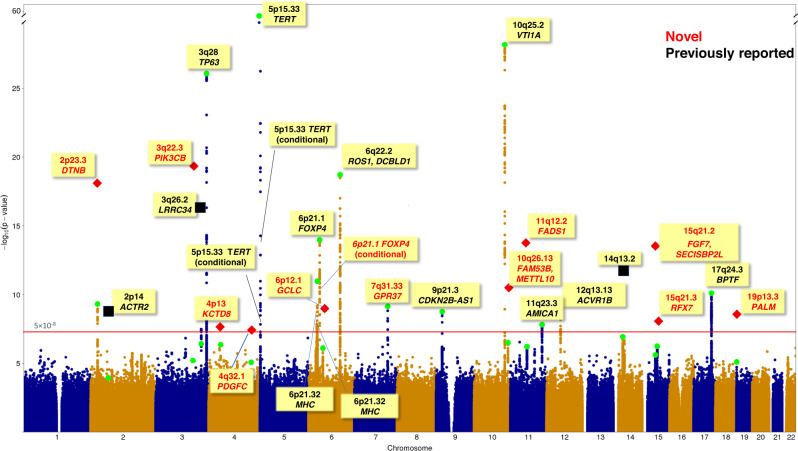
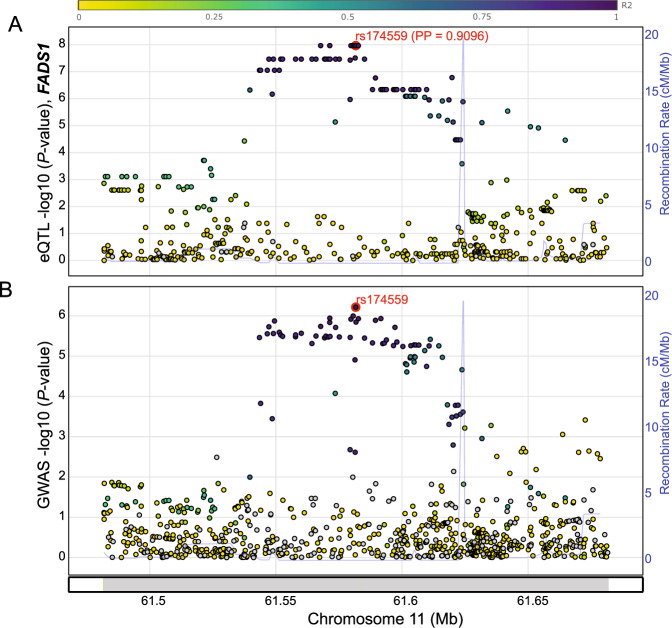
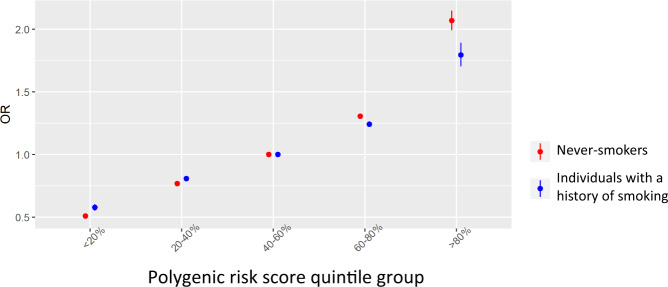
Lung adenocarcinoma is the most common type of lung cancer. Known risk variants explain only a small fraction of lung adenocarcinoma heritability. Here, we conducted a two-stage genome-wide association study of lung adenocarcinoma of East Asian ancestry (21,658 cases and 150,676 controls; 54.5% never-smokers) and identified 12 novel susceptibility variants, bringing the total number to 28 at 25 independent loci. Transcriptome-wide association analyses together with colocalization studies using a Taiwanese lung expression quantitative trait loci dataset (n = 115) identified novel candidate genes, including FADS1 at 11q12 and ELF5 at 11p13. In a multi-ancestry meta-analysis of East Asian and European studies, four loci were identified at 2p11, 4q32, 16q23, and 18q12. At the same time, most of our findings in East Asian populations showed no evidence of association in European populations. In our studies drawn from East Asian populations, a polygenic risk score based on the 25 loci had a stronger association in never-smokers vs. individuals with a history of smoking (P = 0.0058). These findings provide new insights into the etiology of lung adenocarcinoma in individuals from East Asian populations, which could be important in developing translational applications.
肺腺癌是最常见的肺癌类型。已知的风险变异体仅能解释肺腺癌遗传率的一小部分。在这里,我们对东亚血统的肺腺癌(21658 例病例和 150676 例对照;54.5%从不吸烟)进行了两阶段全基因组关联研究,确定了 12 个新的易感性变异体,使总数达到 25 个独立位点的 28 个。全转录组关联分析以及使用台湾肺表达数量性状基因座数据集(n=115)进行的共定位研究确定了新的候选基因,包括 11q12 上的 FADS1 和 11p13 上的 ELF5。在东亚和欧洲研究的多血统荟萃分析中,在 2p11、4q32、16q23 和 18q12 处确定了四个位点。同时,我们在东亚人群中的大多数发现结果在欧洲人群中没有关联证据。在我们来自东亚人群的研究中,基于 25 个位点的多基因风险评分在从不吸烟者与有吸烟史者(P=0.0058)之间具有更强的相关性。这些发现为东亚人群肺腺癌的病因学提供了新的见解,这可能对转化应用的发展很重要。