Division of Newborn Medicine, Harvard Medical School, Boston, Massachusetts, USA.
Division of Genetics and Genomics, Harvard Medical School, Boston, Massachusetts, USA.
Genet Med. 2018 Nov;20(11):1396-1404. doi: 10.1038/gim.2018.17. Epub 2018 Apr 12.
Infants admitted to a level IV neonatal intensive care unit (NICU) who do not survive early childhood are a population that is probably enriched for rare genetic disease; we therefore characterized their genetic diagnostic evaluation.
This is a retrospective analysis of infants admitted to our NICU between 1 January 2011 and 31 December 2015 who were deceased at the time of records review, with age at death less than 5 years.
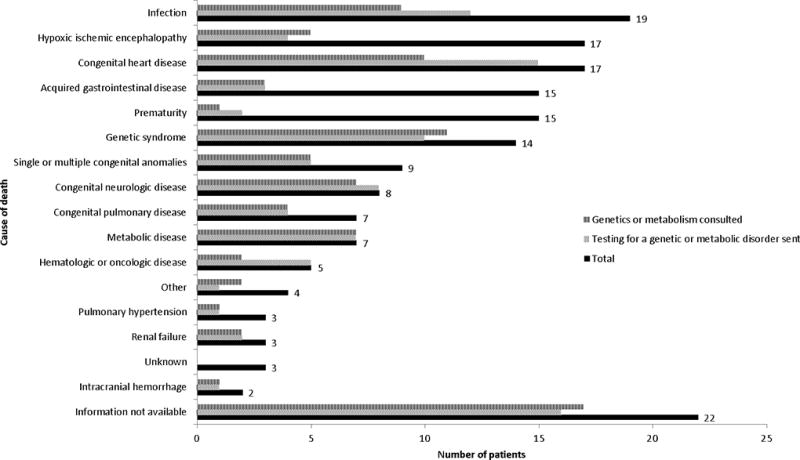
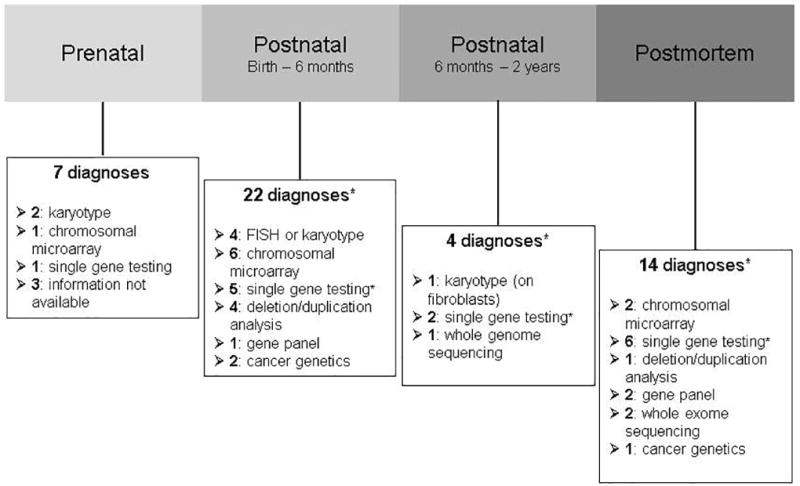
A total of 2,670 infants were admitted; 170 later died. One hundred six of 170 (62%) had an evaluation for a genetic or metabolic disorder. Forty-seven of 170 (28%) had laboratory-confirmed genetic diagnoses, although 14/47 (30%) diagnoses were made postmortem. Infants evaluated for a genetic disorder spent more time in the NICU (median 13.5 vs. 5.0 days; p = 0.003), were older at death (median 92.0 vs. 17.5 days; p < 0.001), and had similarly high rates of redirection of care (86% vs. 79%; p = 0.28).
Genetic disorders were suspected in many infants but found in a minority. Approximately one-third of diagnosed infants died before a laboratory-confirmed genetic diagnosis was made. This highlights the need to improve genetic diagnostic evaluation in the NICU, particularly to support end-of-life decision making.
住进四级新生儿重症监护病房(NICU)但未能存活至幼儿期的婴儿,其人群可能存在丰富的罕见遗传病;因此,我们对其进行了遗传诊断评估。
这是对 2011 年 1 月 1 日至 2015 年 12 月 31 日期间入住我们 NICU 的婴儿进行的回顾性分析,这些婴儿在记录审查时已经死亡,死亡时的年龄小于 5 岁。
共有 2670 名婴儿被收治;其中 170 名后来死亡。在 170 名死亡婴儿中,有 106 名接受了遗传或代谢障碍的评估。在 170 名死亡婴儿中,有 47 名(28%)被确诊为遗传性疾病,尽管有 14/47(30%)的诊断是在死后做出的。接受遗传疾病评估的婴儿在 NICU 中停留的时间更长(中位数 13.5 天 vs. 5.0 天;p=0.003),死亡时的年龄更大(中位数 92.0 天 vs. 17.5 天;p<0.001),但同样高的转归率(86% vs. 79%;p=0.28)。
许多婴儿被怀疑患有遗传疾病,但只有少数被确诊。约三分之一被诊断出患有遗传疾病的婴儿在获得实验室确认的遗传诊断之前死亡。这凸显了在 NICU 中改进遗传诊断评估的必要性,特别是为了支持临终决策。