Department of Human Genetics, Radboud University Medical Center, Radboud Institute of Health Sciences, Nijmegen, The Netherlands.
Department of Health Sciences and Primary Care, University Medical Center, Utrecht, The Netherlands.
Eur J Pediatr. 2022 Jan;181(1):359-367. doi: 10.1007/s00431-021-04213-w. Epub 2021 Aug 4.
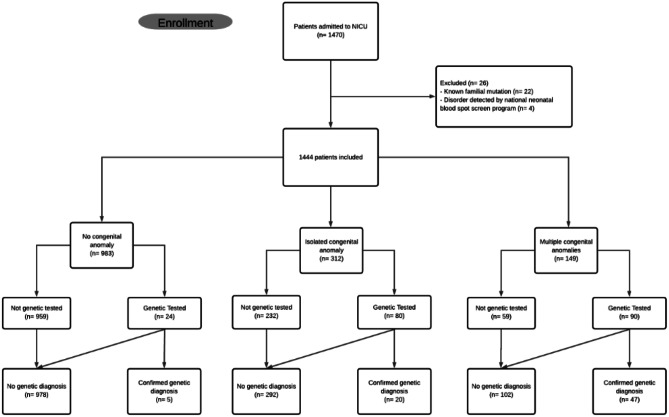
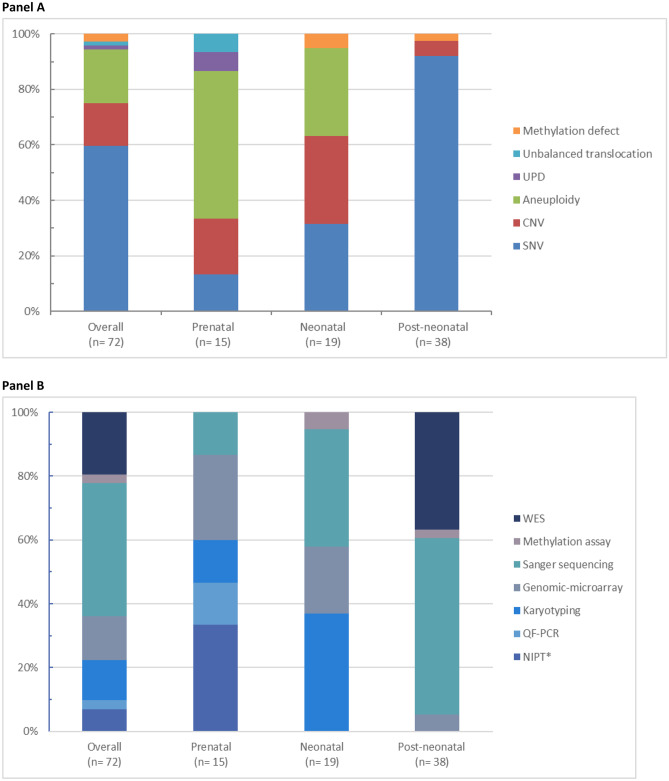
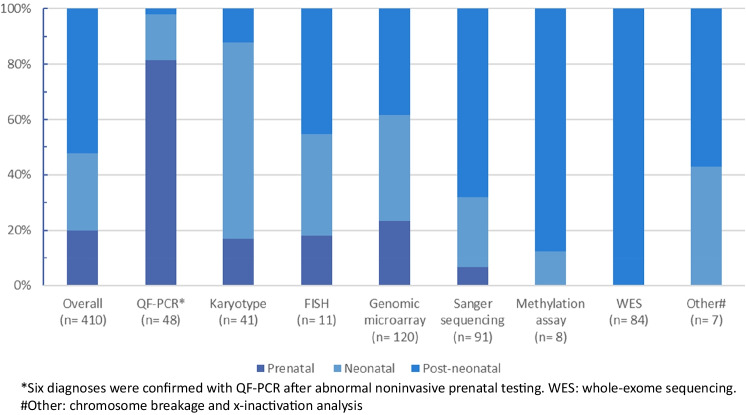
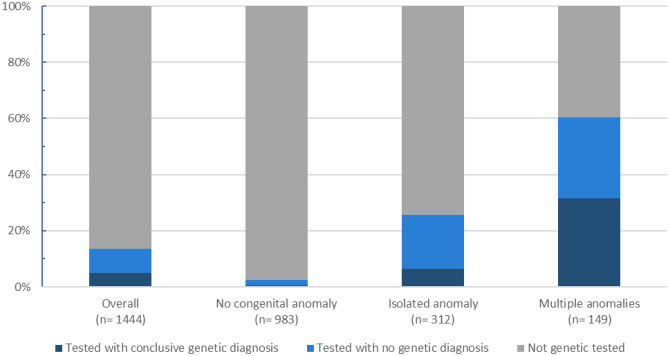
Neonates with genetic disorders or congenital anomalies (CA) contribute considerably to morbidity and mortality in neonatal intensive care units (NICUs). The objective of this study is to study the prevalence of genetic disorders in an academic level IV NICU. We retrospective collected and analyzed both clinical and genetic data of all 1444 infants admitted to the NICU of the Radboudumc (October 2013 to October 2015). Data were collected until infants reached at least 2 years of age. A total of 13% (194/1444) of the patients were genetically tested, and 32% (461/1444) had a CA. A total of 37% (72/194) had a laboratory-confirmed genetic diagnosis. In 53%, the diagnosis was made post-neonatally (median age = 209 days) using assays including exome sequencing. Exactly 63% (291/461) of the patients with CA, however, never received genetic testing, despite being clinically similar those who did.Conclusions: Genetic disorders were suspected in 13% of the cohort, but only confirmed in 5%. Most received their genetic diagnosis in the post-neonatal period. Extrapolation of the diagnostic yield suggests that up to 6% of our cohort may have remained genetically undiagnosed. Our data show the need to improve genetic care in the NICU for more inclusive, earlier, and faster genetic diagnosis to enable tailored management. What is Known: • Genetic disorders are suspected in many neonates but only genetically confirmed in a minority. • The presence of a genetic disorder can be easily missed and will often lead to a diagnostic odyssey requiring extensive evaluations, both clinically and genetically. What is New: • Different aspects of the clinical features and uptake of genetic test in a NICU cohort. • The need to improve genetic care in the NICU for more inclusive, earlier, and faster genetic diagnosis to enable tailored management.
患有遗传疾病或先天异常 (CA) 的新生儿在新生儿重症监护病房 (NICU) 中发病率和死亡率都相当高。本研究旨在研究学术四级 NICU 中遗传疾病的患病率。我们回顾性地收集并分析了 2013 年 10 月至 2015 年 10 月期间入住 Radboudumc 新生儿重症监护病房的 1444 名婴儿的临床和遗传数据。数据收集一直持续到婴儿至少达到 2 岁。共有 13%(194/1444)的患者接受了基因检测,32%(461/1444)患有 CA。共有 37%(72/194)的患者实验室确诊存在遗传诊断。其中 53%(53/100)的患者在新生儿期后(中位年龄=209 天)通过外显子组测序等检测手段做出诊断。然而,461 名患有 CA 的患者中,有 63%(291/461)的患者从未接受过基因检测,尽管他们在临床上与接受基因检测的患者相似。结论:该队列中怀疑存在遗传疾病的患者占 13%,但仅 5%的患者得到了确认。大多数患者在新生儿期后接受了基因诊断。根据诊断率推断,我们的队列中可能有多达 6%的患者仍未得到基因诊断。我们的数据表明,需要改善 NICU 的遗传护理,以便更全面、更早、更快地进行基因诊断,从而实现个体化管理。已知:• 许多新生儿都怀疑存在遗传疾病,但只有少数患者得到了基因确认。• 遗传疾病很容易被忽视,通常会导致需要进行广泛的临床和遗传评估的诊断性探索。新发现:• NICU 队列中不同的临床特征和基因检测采用情况。• 需要改善 NICU 的遗传护理,以便更全面、更早、更快地进行基因诊断,从而实现个体化管理。