Center for Vaccine Development and Global Health, University of Maryland School of Medicine, Baltimore, Maryland, United States of America.
Department of Medicine, University of Maryland School of Medicine, Baltimore, Maryland, United States of America.
PLoS Negl Trop Dis. 2018 May 23;12(5):e0006522. doi: 10.1371/journal.pntd.0006522. eCollection 2018 May.
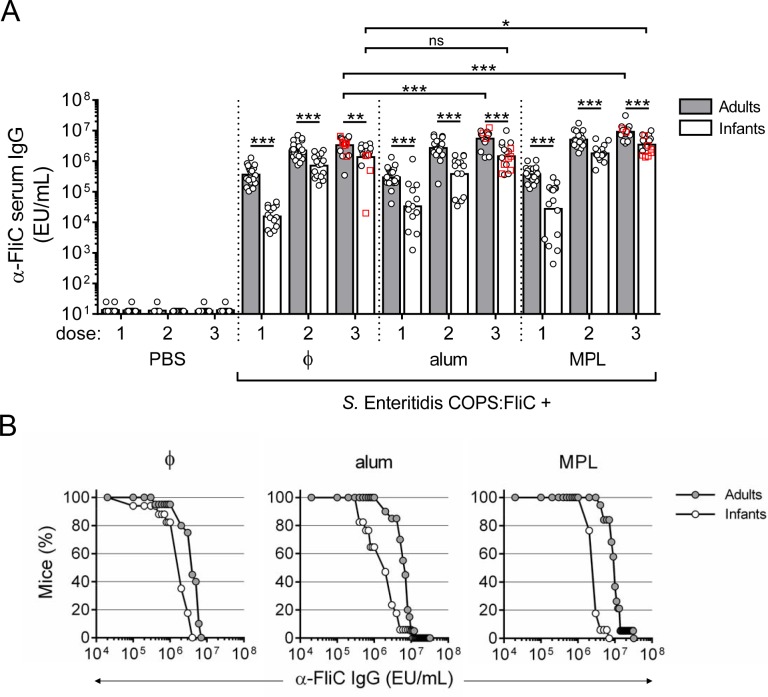
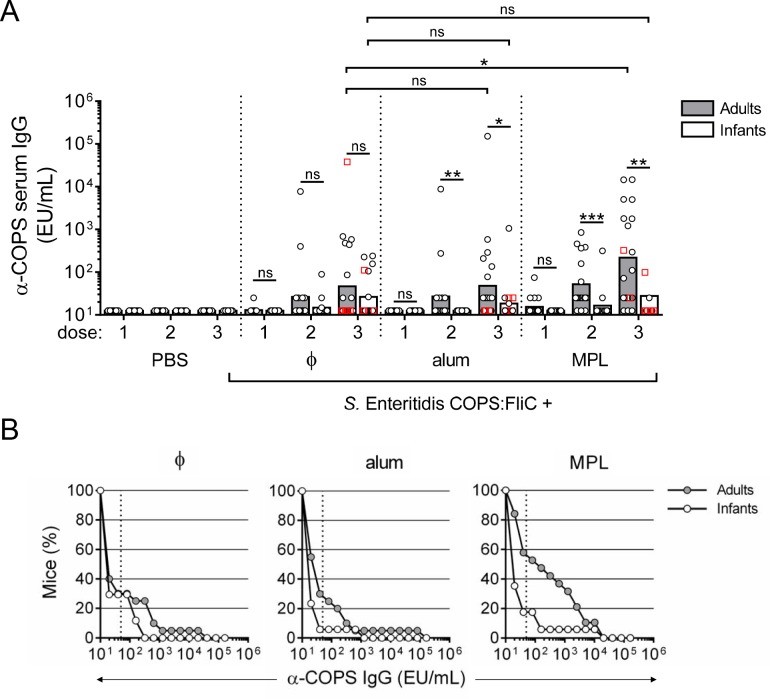
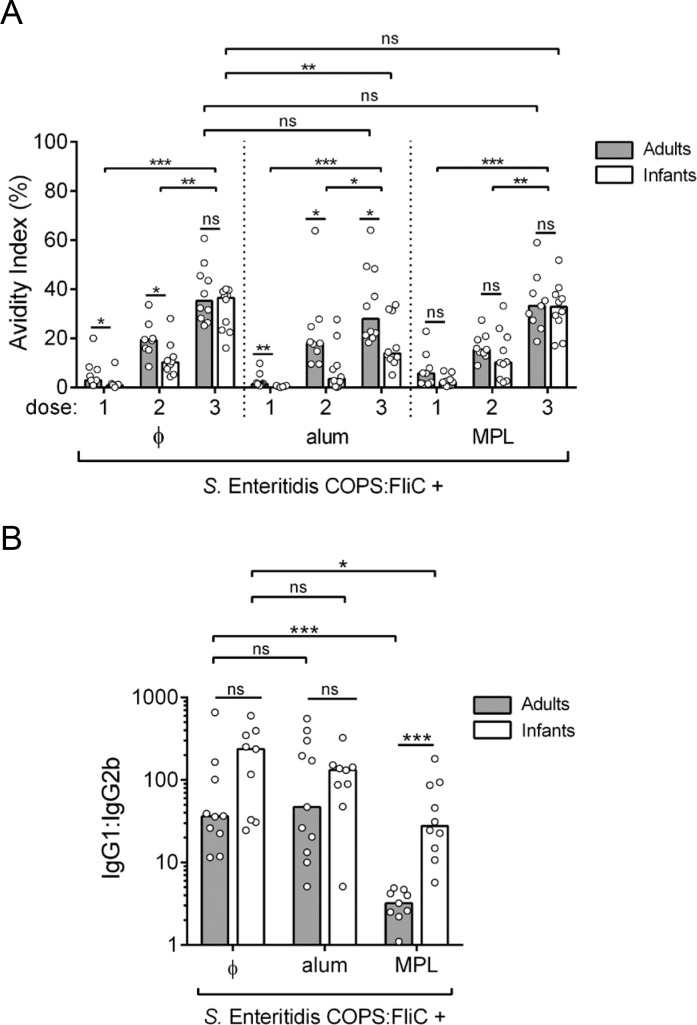
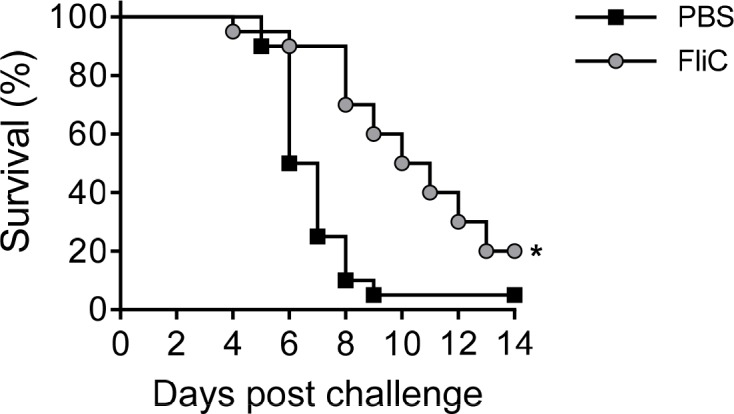
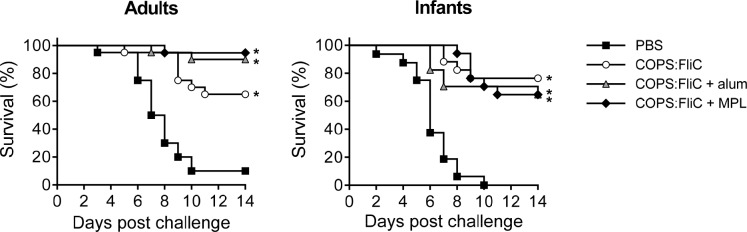
In sub-Saharan Africa, invasive nontyphoidal Salmonella (iNTS) infections with serovars S. Enteritidis, S. Typhimurium and I 4,[5],12:i:- are widespread in children < 5 years old. Development of an efficacious vaccine would provide an important public health tool to prevent iNTS disease in this population. Glycoconjugates of S. Enteritidis core and O-polysaccharide (COPS) coupled to the homologous serovar phase 1 flagellin protein (FliC) were previously shown to be immunogenic and protected adult mice against death following challenge with a virulent Malian S. Enteritidis blood isolate. This study extends these observations to immunization of mice in early life and also assesses protection with partial and full regimens. Anti-COPS and anti-FliC serum IgG titers were assessed in infant and adult mice after immunization with 1, 2 or 3 doses of S. Enteritidis COPS:FliC alone or co-formulated with aluminum hydroxide or monophosphoryl lipid A (MPL) adjuvants. S. Enteritidis COPS:FliC was immunogenic in both age groups, although the immune responses were quantitatively lower in infants. Kinetics of antibody production were similar for the native and adjuvanted formulations after three doses; conjugates formulated with MPL elicited significantly increased anti-COPS IgG titers in adult but not infant mice. Nevertheless, robust protection against S. Enteritidis challenge was seen for all three formulations when three doses were given either during infancy or as adults. We further found that significant protection could be achieved with two COPS:FliC doses, despite elicitation of modest serum anti-COPS IgG antibody titers. These findings guide potential immunization strategies that may be translated to develop a human pediatric iNTS vaccine for sub-Saharan Africa.
在撒哈拉以南非洲,血清型为 S. Enteritidis、S. Typhimurium 和 I 4,[5],12:i:-的侵袭性非伤寒沙门氏菌(iNTS)感染在 5 岁以下儿童中广泛存在。开发有效的疫苗将为预防该人群中的 iNTS 疾病提供重要的公共卫生工具。先前已经证明,与同源血清型 1 鞭毛蛋白(FliC)偶联的 S. Enteritidis 核心和 O-多糖(COPS)糖缀合物具有免疫原性,并可保护成年小鼠免受致命的马里 S. Enteritidis 血液分离株的攻击。本研究将这些观察结果扩展到早期生命中对小鼠的免疫接种,并评估部分和完全方案的保护作用。在免疫接种 1、2 或 3 剂 S. Enteritidis COPS:FliC 后,评估婴儿和成年小鼠中的抗-COPS 和抗-FliC 血清 IgG 滴度,这些制剂单独或与氢氧化铝或单磷酰脂质 A(MPL)佐剂联合配制。S. Enteritidis COPS:FliC 在两个年龄组中均具有免疫原性,尽管婴儿中的免疫反应数量较低。在三剂后,天然和佐剂制剂的抗体产生动力学相似;在成年小鼠中,与 MPL 配制的缀合物可显著增加抗-COPS IgG 滴度,但在婴儿小鼠中则不然。然而,当在婴儿期或成年期给予三剂时,所有三种制剂均能提供针对 S. Enteritidis 挑战的强大保护。我们还发现,尽管仅能引起适度的血清抗-COPS IgG 抗体滴度,但使用两剂 COPS:FliC 也能获得显著的保护作用。这些发现为开发撒哈拉以南非洲地区的人类儿科 iNTS 疫苗提供了潜在的免疫接种策略。