Department of Rheumatology, Medisch Spectrum Twente, Enschede, The Netherlands.
Department of Psychology, Health & Technology, University of Twente, Enschede, The Netherlands.
PLoS One. 2018 May 23;13(5):e0192425. doi: 10.1371/journal.pone.0192425. eCollection 2018.
Successfully stopping or reducing treatment for patients with rheumatoid arthritis (RA) in low disease activity (LDA) may improve cost-effectiveness of care. We evaluated the multi-biomarker disease activity (MBDA) score as a predictor of disease relapse after discontinuation of TNF inhibitor (TNFi) treatment.
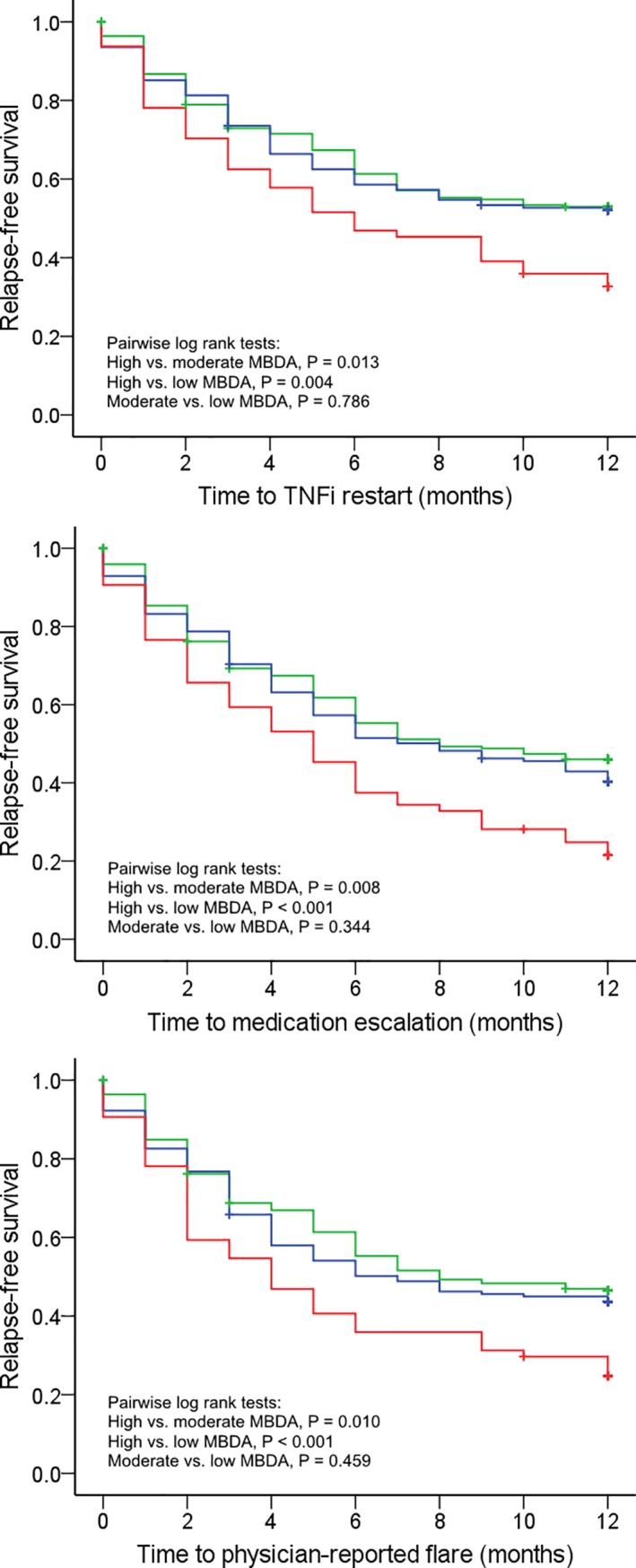
439 RA patients who were randomized to stop TNFi treatment in the POET study were analyzed post-hoc. Three indicators of disease relapse were assessed over 12 months: 1) restarting TNFi treatment, 2) escalation of any DMARD therapy and 3) physician-reported flare. MBDA score was assessed at baseline. Associations between MBDA score and disease relapse were examined using univariate analysis and multivariate logistic regression.
At baseline, 50.1%, 35.3% and 14.6% of patients had low (<30), moderate (30-44) or high (>44) MBDA scores. Within 12 months, 49.9% of patients had restarted TNFi medication, 59.0% had escalation of any DMARD and 57.2% had ≥1 physician-reported flare. MBDA score was associated with each indicator of relapse. At least one indicator of relapse was observed in 59.5%, 68.4% and 81.3% of patients with low, moderate or high MBDA scores, respectively (P = 0.004). Adjusted for baseline DAS28-ESR, disease duration, BMI and erosions, high MBDA scores were associated with increased risk for restarting TNFi treatment (OR = 1.85, 95% CI 1.00-3.40), DMARD escalation (OR = 1.99, 95% CI 1.01-3.94) and physician-reported flare (OR = 2.00, 95% 1.06-3.77).
For RA patients with stable LDA who stopped TNFi, a high baseline MBDA score was independently predictive of disease relapse within 12 months. The MBDA score may be useful for identifying patients at risk of relapse after TNFi discontinuation.
成功停止或减少类风湿关节炎(RA)低疾病活动(LDA)患者的治疗可能会提高治疗的成本效益。我们评估了多生物标志物疾病活动(MBDA)评分作为停止肿瘤坏死因子抑制剂(TNFi)治疗后疾病复发的预测指标。
对 POET 研究中随机停止 TNFi 治疗的 439 例 RA 患者进行了事后分析。在 12 个月内评估了 3 种疾病复发的指标:1)重新开始 TNFi 治疗,2)任何 DMARD 治疗的升级,以及 3)医生报告的病情恶化。在基线时评估 MBDA 评分。使用单变量分析和多变量逻辑回归检查 MBDA 评分与疾病复发之间的关联。
在基线时,50.1%、35.3%和 14.6%的患者具有低(<30)、中(30-44)或高(>44)MBDA 评分。在 12 个月内,49.9%的患者重新开始 TNFi 治疗,59.0%的患者升级了任何 DMARD,57.2%的患者有≥1 名医生报告的病情恶化。MBDA 评分与每种复发指标均相关。在低、中或高 MBDA 评分的患者中,分别有 59.5%、68.4%和 81.3%的患者至少出现了一种复发指标(P=0.004)。在调整基线 DAS28-ESR、疾病持续时间、BMI 和侵蚀后,高 MBDA 评分与重新开始 TNFi 治疗(OR=1.85,95%CI 1.00-3.40)、DMARD 升级(OR=1.99,95%CI 1.01-3.94)和医生报告的病情恶化(OR=2.00,95%CI 1.06-3.77)的风险增加相关。
对于稳定的 LDA 并停止 TNFi 治疗的 RA 患者,基线时的高 MBDA 评分独立预测了 12 个月内的疾病复发。MBDA 评分可能有助于识别停止 TNFi 治疗后复发风险高的患者。