de la Iglesia Gonzalo, Walter André, de la Iglesia Fernando, Winsauer Heinz, Puigdollers Andreu
Department of Orthodontics, Universitat Internacional de Catalunya, Barcelona, Spain.
Barcelona, Barcelona, Spain.
Dental Press J Orthod. 2018 Jan;23(1):37-45. doi: 10.1590/2177-6709.23.1.037-045.oar.
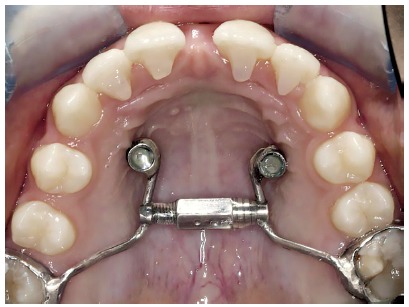
The force applied to the teeth by fixed orthopaedic expanders has previously been studied, but not the force applied to the orthodontic mini-implant (OMI) used to expand the maxilla with Hyrax hybrid expanders (HHE).
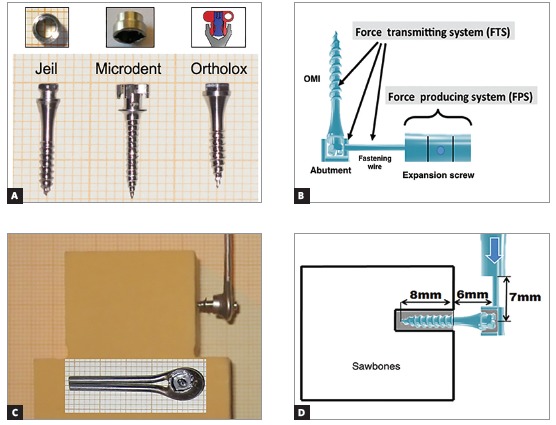
The aim of this article was to evaluate the clinical safety of the components (OMI, abutment and double wire arms) of three different force-transmitting systems (FTS) for conducting orthopaedic maxillary expansion: Jeil Medical & Tiger Dental™, Microdent™ and Ortholox™.
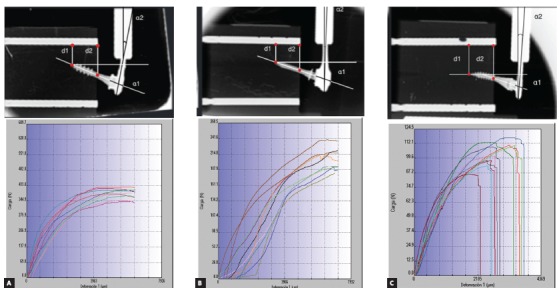
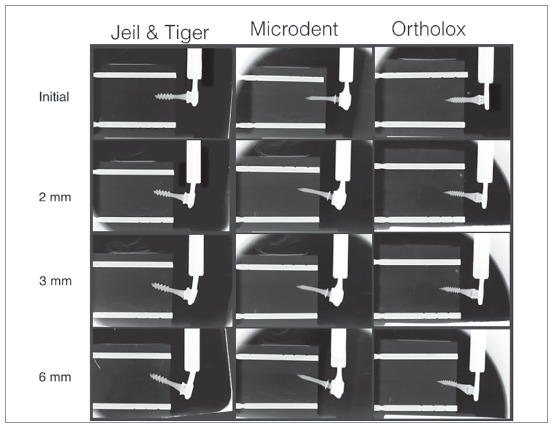
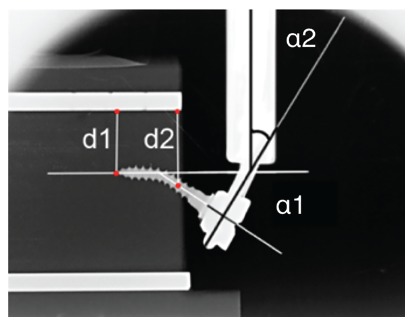
For the realization of this in vitro study of the resistance to mechanical load, three different abutment types (bonded, screwed on, and coupling) and three different OMIs' diameters (Jeil™ 2.5 mm, Microdent™ 1.6 mm and Ortholox™ 2.2 mm) were used. Ten tests for each of these three FTS were carried out in a static lateral load in artificial bone blocks (Sawbones™) by a Galdabini universal testing machine, then comparing its performance. Comparisons of loads, deformations and fractures were carried out by means of radiographs of FTS components in each case.
At 1- mm load and within the elastic deformation, FTS values ranged from 67 ± 13 N to 183 ± 48 N. Under great deformations, Jeil & Tiger™ was the one who withstood the greatest loads, with an average 378 ± 22 N; followed by Microdent™, with 201 ± 18 N, and Ortholox™, with 103 ± 10 N. At 3 mm load, the OMIs shaft bends and deforms when the diameter is smaller than 2.5 mm. The abutment fixation is crucial to transmit forces and moments.
The present study shows the importance of a rigid design of the different components of HHEs, and also that HHEs would be suitable for maxillary expansion in adolescents and young adults, since its mean expansion forces exceed 120N. Furthermore, early abutment detachment or smaller mini-implants diameter would only be appropriate for children.
以往曾对固定正畸扩弓器作用于牙齿的力进行过研究,但未对用于通过Hyrax混合扩弓器(HHE)扩宽上颌骨的正畸微型种植体(OMI)所施加的力进行研究。
本文旨在评估三种不同的用于上颌骨正畸扩弓的力传递系统(FTS)(Jeil Medical & Tiger Dental™、Microdent™和Ortholox™)的组件(OMI、基台和双丝臂)的临床安全性。
为实现这项关于机械负荷抗性的体外研究,使用了三种不同类型的基台(粘结型、拧入型和耦联型)以及三种不同直径的OMI(Jeil™ 2.5毫米、Microdent™ 1.6毫米和Ortholox™ 2.2毫米)。通过Galdabini万能试验机在人工骨块(Sawbones™)中对这三种FTS中的每一种进行十次静态侧向负荷测试,然后比较其性能。通过对每种情况下FTS组件的X线片进行负荷、变形和骨折的比较。
在1毫米负荷且处于弹性变形范围内时,FTS值范围为67±13牛至183±48牛。在大变形情况下,Jeil & Tiger™承受的负荷最大,平均为378±22牛;其次是Microdent™,为201±18牛,Ortholox™为103±10牛。在3毫米负荷时,当直径小于2.5毫米时,OMI的杆体会弯曲和变形。基台固定对于传递力和力矩至关重要。
本研究表明了HHE不同组件进行刚性设计的重要性,并且HHE适用于青少年和年轻成年人的上颌骨扩弓,因为其平均扩弓力超过120牛。此外,早期基台脱离或较小的微型种植体直径仅适用于儿童。