Department of Global Health and Population, Harvard T.H. Chan School of Public Health, Boston, USA.
Carolina Population Center, University of North Carolina, Chapel Hill, USA.
BMC Med Res Methodol. 2018 May 25;18(1):46. doi: 10.1186/s12874-018-0507-9.
List randomization (LR), a survey method intended to mitigate biases related to sensitive true/false questions, has received recent attention from researchers. However, tests of its validity are limited, with no study comparing LR-elicited results with individually known truths. We conducted a test of LR for HIV-related responses in a high HIV prevalence setting in KwaZulu-Natal. By using researcher-known HIV serostatus and HIV test refusal data, we were able to assess how LR and direct questionnaires perform against individual known truth.
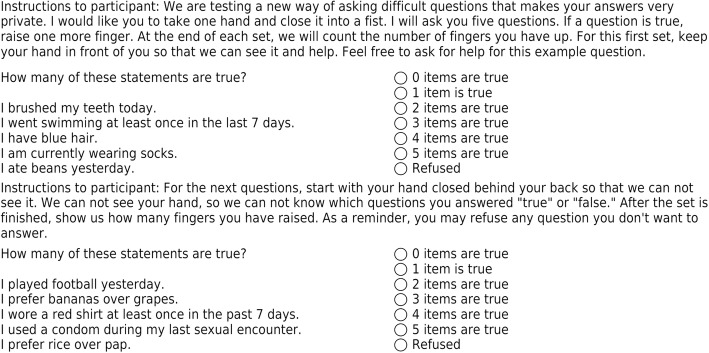
Participants were recruited from the participation list from the 2016 round of the Africa Health Research Institute demographic surveillance system, oversampling individuals who were HIV positive. Participants were randomized to two study arms. In Arm A, participants were presented five true/false statements, one of which was the sensitive item, the others non-sensitive. Participants were then asked how many of the five statements they believed were true. In Arm B, participants were asked about each statement individually. LR estimates used data from both arms, while direct estimates were generated from Arm B alone. We compared elicited responses to HIV testing and serostatus data collected through the demographic surveillance system.
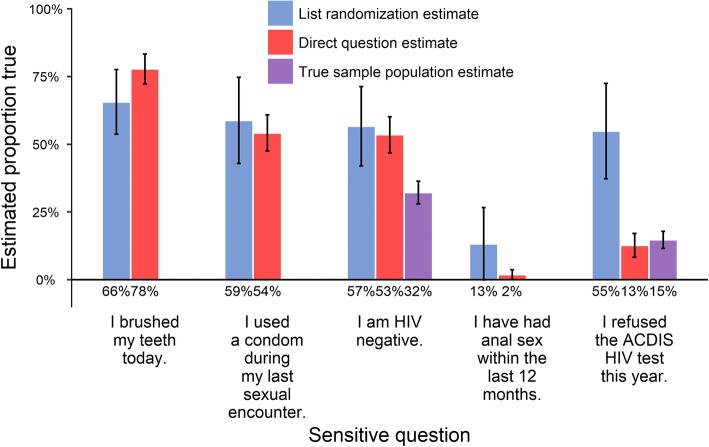
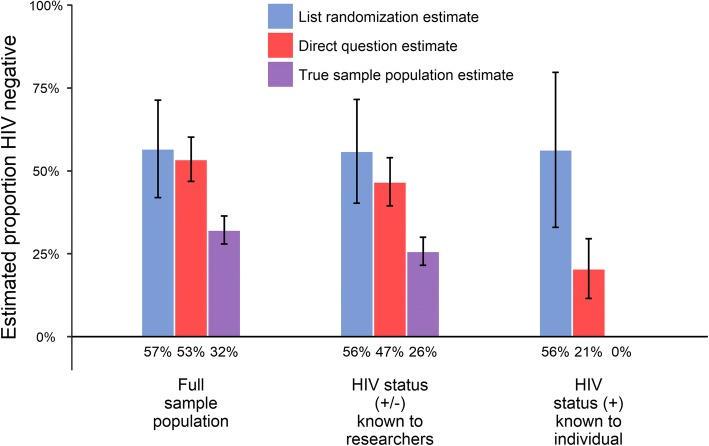
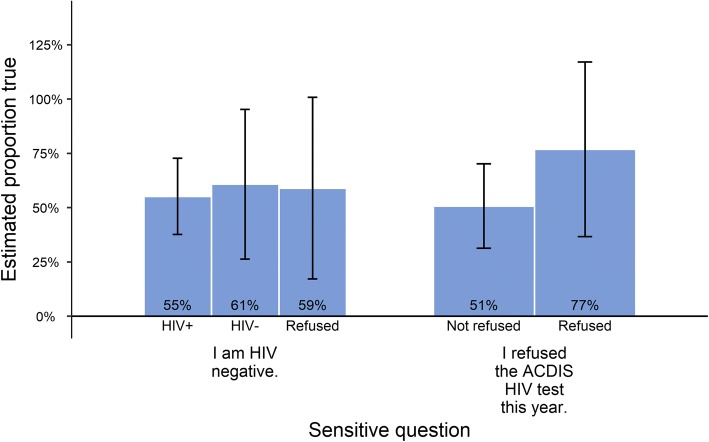
We enrolled 483 participants, 262 (54%) were randomly assigned to Arm A, and 221 (46%) to Arm B. LR estimated 56% (95% CI: 40 to 72%) of the population to be HIV-negative, compared to 47% (95% CI: 39 to 54%) using direct estimates; the population-estimate of the true value was 32% (95% CI: 28 to 36%). LR estimates yielded HIV test refusal percentages of 55% (95% CI: 37 to 73%) compared to 13% (95% CI: 8 to 17%) by direct estimation, and 15% (95% CI: 12 to 18%) based on observed past behavior.
In this context, LR performed poorly when compared to known truth, and did not improve estimates over direct questioning methods when comparing with known truth. These results may reflect difficulties in implementation or comprehension of the LR approach, which is inherently complex. Adjustments to delivery procedures may improve LR's usefulness. Further investigation of the cognitive processes of participants in answering LR surveys is warranted.
列表随机化 (LR) 是一种旨在减轻与敏感的真/假问题相关的偏差的调查方法,最近受到了研究人员的关注。然而,对其有效性的测试有限,没有研究将 LR 得出的结果与个体已知的真相进行比较。我们在夸祖鲁-纳塔尔省一个艾滋病毒感染率较高的地区对与艾滋病毒相关的反应进行了 LR 测试。通过使用研究人员已知的艾滋病毒血清阳性和艾滋病毒检测拒绝数据,我们能够评估 LR 和直接问卷在个体已知真相方面的表现。
参与者是从非洲健康研究所人口监测系统 2016 年一轮的参与名单中招募的,对艾滋病毒阳性的个体进行了超额抽样。参与者被随机分配到两个研究组。在 A 组中,参与者被呈现五个真/假陈述,其中一个是敏感项目,其他的是非敏感项目。然后,参与者被问到他们认为五个陈述中有多少个是真实的。在 B 组中,参与者被逐个问到每个陈述。LR 估计使用了来自两个组的数据,而直接估计仅来自 B 组。我们将引出的对艾滋病毒检测和通过人口监测系统收集的血清阳性数据的反应进行了比较。
我们共招募了 483 名参与者,其中 262 名(54%)被随机分配到 A 组,221 名(46%)被分配到 B 组。LR 估计 56%(95%CI:40 至 72%)的人群为艾滋病毒阴性,而直接估计为 47%(95%CI:39 至 54%);人群对真实值的估计为 32%(95%CI:28 至 36%)。LR 估计的艾滋病毒检测拒绝率为 55%(95%CI:37 至 73%),而直接估计为 13%(95%CI:8 至 17%),根据过去的观察行为,这一比例为 15%(95%CI:12 至 18%)。
在这种情况下,与已知的真相相比,LR 的表现不佳,并且在与已知的真相进行比较时,并没有通过直接询问方法提高估计值。这些结果可能反映了 LR 方法在实施或理解方面的困难,因为它本质上很复杂。调整传递程序可能会提高 LR 的实用性。有必要进一步调查参与者在回答 LR 调查时的认知过程。