Department of Medical Radiological Technology, Division of Public Health, School of Medicine, Addis Ababa University, Addis Ababa, Ethiopia.
Department of Public Health, College of Health Science and Medicine, Ambo University, Ambo, Ethiopia.
Syst Rev. 2018 May 24;7(1):80. doi: 10.1186/s13643-018-0741-6.
Anemia continued to become a major public health problem in developing nations including Ethiopia. Especially, school children are more vulnerable for anemia and consequences of anemia. Generating accurate epidemiological data on anemia in school children is an important step for health policy maker. There are limited evidences on anemia prevalence in school-age children in Ethiopia. This study aimed to synthesize the pooled prevalence of anemia in school-age children in Ethiopia.
This systematic review and meta-analysis was followed the PRISMA guidelines. Comprehensive searched was conducted in PubMed/MEDLINE, Cochrane Library, Google Scholar, HINARI, and Ethiopian Journal of Health Development for studies published before 2016, supplemented by manual searches to identify relevant studies. Two review authors independently selected studies, extracted data, and assessed quality of studies. The Cochrane Q test and I test statistic were used to test heterogeneity through studies. The overall prevalence was calculated using random-effects model of DerSimonian-Laird method.
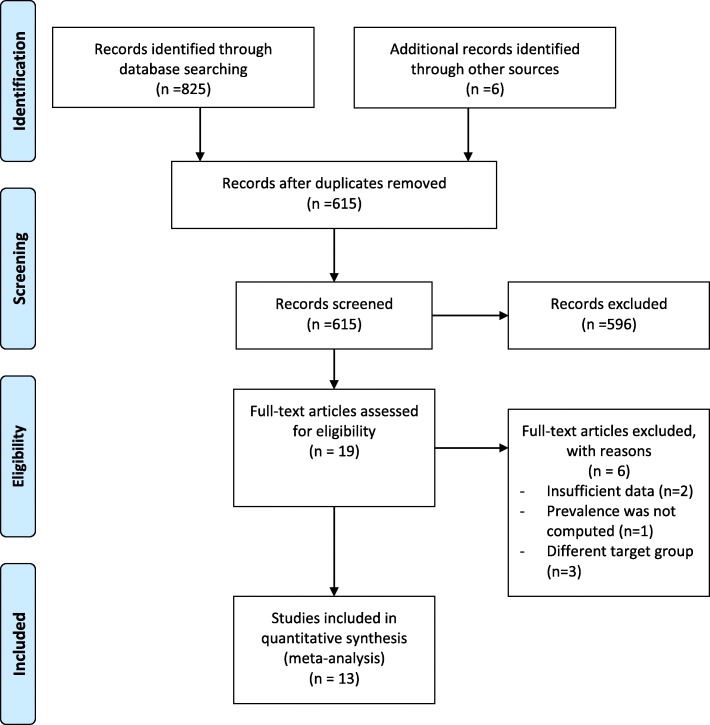
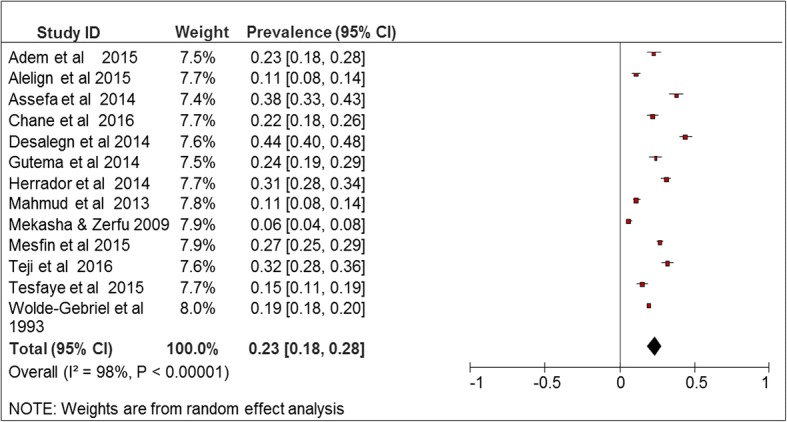
From 831 obtained studies, 13 articles included in the meta-analysis. The pooled prevalence of anemia among school children in Ethiopia was 23% (95% CI 18-28%). The prevalence of anemia in male and female school-age children was 27% (95% CI 20 and 34%) and 24% (95% CI 18 and 30%), respectively.
This study found that prevalence of anemia was a moderate public health problem in school children. Due to the complications of anemia for school children, preventative planning and control of anemia among school children in Ethiopia is necessary.
贫血在包括埃塞俄比亚在内的发展中国家仍然是一个主要的公共卫生问题。特别是,学龄儿童更容易患贫血症及其并发症。为卫生政策制定者提供有关学龄儿童贫血症的准确流行病学数据是重要的一步。关于埃塞俄比亚学龄儿童贫血症的流行率,证据有限。本研究旨在综合评估埃塞俄比亚学龄儿童贫血症的流行率。
本系统评价和荟萃分析遵循 PRISMA 指南。在 2016 年之前,在 PubMed/MEDLINE、Cochrane 图书馆、Google Scholar、HINARI 和埃塞俄比亚卫生发展杂志上进行了全面搜索,并通过手动搜索来识别相关研究。两名综述作者独立选择研究、提取数据并评估研究质量。通过研究使用 Cochrane Q 检验和 I 检验统计量来检验异质性。使用 DerSimonian-Laird 方法的随机效应模型计算总体患病率。
从 831 项获得的研究中,有 13 项研究纳入荟萃分析。埃塞俄比亚学龄儿童贫血症的总患病率为 23%(95%CI 18-28%)。男童和女童的贫血患病率分别为 27%(95%CI 20 和 34%)和 24%(95%CI 18 和 30%)。
本研究发现,贫血的流行率是学龄儿童的一个中度公共卫生问题。由于贫血症对学龄儿童的并发症,需要在埃塞俄比亚对学龄儿童进行贫血症的预防规划和控制。