Department of Neurosurgery, Southern Medical University, Zhujiang Hospital, Guangzhou, China.
Department of Neurosurgery, West China Hospital, Sichuan University, Chengdu, China.
BMJ Open. 2018 May 24;8(5):e019333. doi: 10.1136/bmjopen-2017-019333.
There are two approaches for the treatment of intracranial aneurysm (IA): interventional therapy and craniotomy, both of which have their advantages and disadvantages in terms of treatment efficacy. To avoid overtreatment of unruptured aneurysms (UIA), to save valuable medical resources and to reduce patient mortality and disability rate, it is vital that neurosurgeons select the most appropriate type of treatment to provide the best levels of care. In this study, we propose a refined, prospective, multicentre study for the Chinese population with strictly defined patient inclusion criteria, along with the selection of representative clinical participating centres.
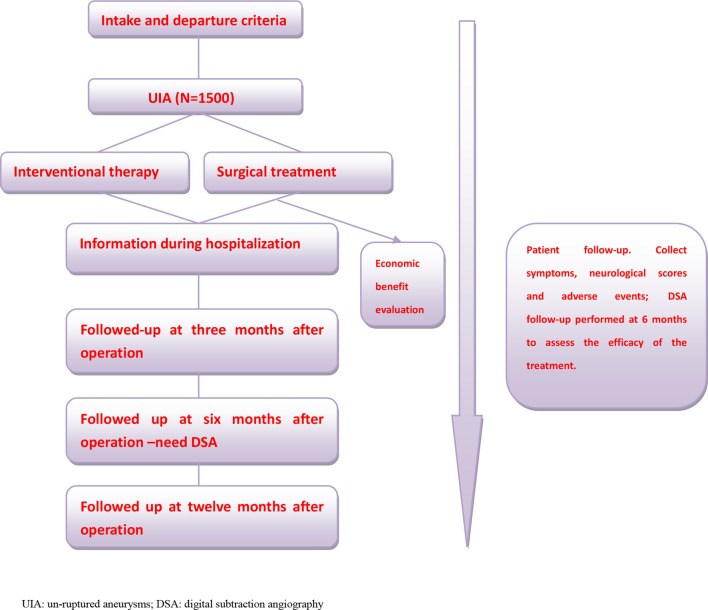
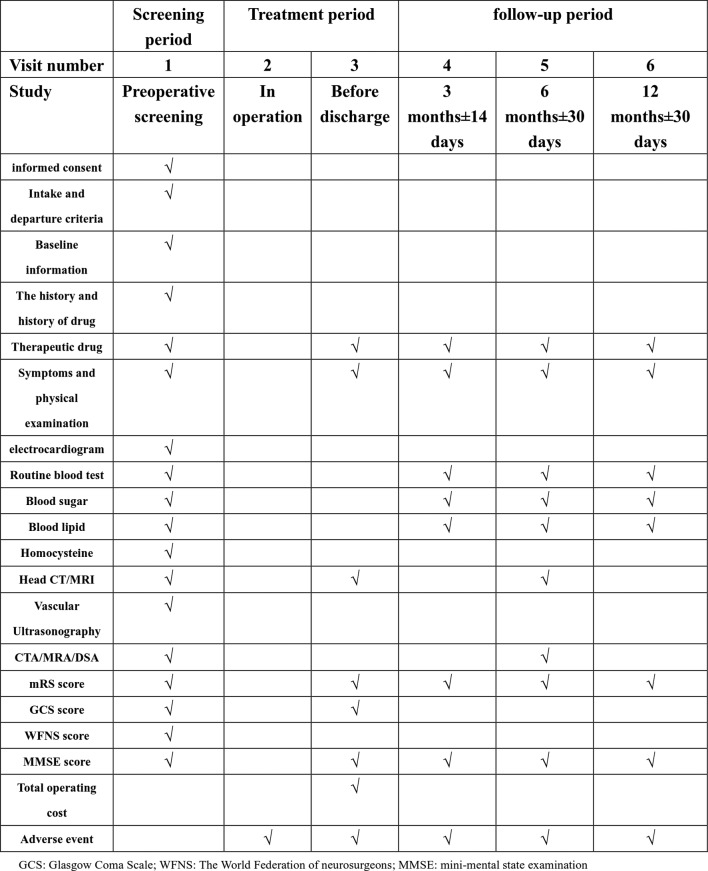
This report describes a multicentre, prospective cohort study. As IA is extremely harmful if it ruptures, ethical issues need to be taken into account with regard to this study. Researchers are therefore not able to use randomised controlled trials. The study will be conducted by 12 clinical centres located in different regions of China. The trial recruitment programme begins in 2016 and is scheduled to be completed in 2020. We expect 1500 participants with UIA to be included. Clinical information relating to the participants will be recorded objectively. The primary endpoints are an evaluation of the safety and efficiency of interventional treatment and craniotomy for 6 months after surgery, with each participant completing at least 1 year of follow-up. The secondary endpoint is the evaluation of safety and efficacy of interventional therapy and craniotomy clipping when participants are treated for 12 months. We also address the success of treatment and the incidence of adverse events.
The research protocol and the informed consent form for participants in this study were approved by the Ethics Committee of Zhujiang Hospital of Southern Medical University (2017-SJWK-001). The results of this study are expected to be disseminated in peer-reviewed journals in 2021.
NCT03133598.
颅内动脉瘤(IA)的治疗方法有两种:介入治疗和开颅手术,这两种方法在治疗效果方面各有优缺点。为避免对未破裂动脉瘤(UIA)的过度治疗,节省宝贵的医疗资源,降低患者的死亡率和残疾率,神经外科医生选择最合适的治疗方法至关重要,以提供最佳的护理水平。在这项研究中,我们针对中国人群提出了一种改良的、前瞻性的、多中心研究,严格定义了患者纳入标准,并选择了有代表性的临床参与中心。
本报告描述了一项多中心前瞻性队列研究。由于 IA 破裂后危害极大,因此需要考虑到这项研究的伦理问题。研究人员因此无法使用随机对照试验。该研究将由中国 12 个不同地区的临床中心进行。试验招募计划于 2016 年开始,预计 2020 年完成。我们预计将纳入 1500 例 UIA 患者。将客观记录参与者的临床信息。主要终点是评估介入治疗和开颅手术治疗后 6 个月的安全性和有效性,每个参与者至少完成 1 年的随访。次要终点是评估介入治疗和开颅夹闭治疗 12 个月时的安全性和有效性。我们还探讨了治疗的成功率和不良事件的发生率。
该研究的研究方案和参与者的知情同意书已获得南方医科大学珠江医院伦理委员会的批准(2017-SJWK-001)。预计该研究的结果将于 2021 年在同行评议期刊上发表。
NCT03133598。