Department of Interventional Neuroradiology, Beijing Neurosurgical Institute, Beijing Tiantan Hospital, Capital Medical University, Beijing, 100050, China.
Department of Neurosurgery, Zhujiang Hospital, Southern Medical University, Guangzhou, Guangdong, China.
J Transl Med. 2018 Sep 26;16(1):263. doi: 10.1186/s12967-018-1641-1.
Ruptured aneurysms, the commonest cause of nontraumatic subarachnoid hemorrhage, can be catastrophic; the mortality and morbidity of affected patients being very high. Some risk factors, such as smoking, hypertension and female sex have been identified, whereas others, such as hemodynamics, imaging, and genomics, remain unclear. Currently, no accurate model that includes all factors for predicting such rupture is available. We plan to use data from a large cohort of Chinese individuals to set up a multidimensional model for predicting risk of rupture of unruptured intracranial aneurysms (UIAs).
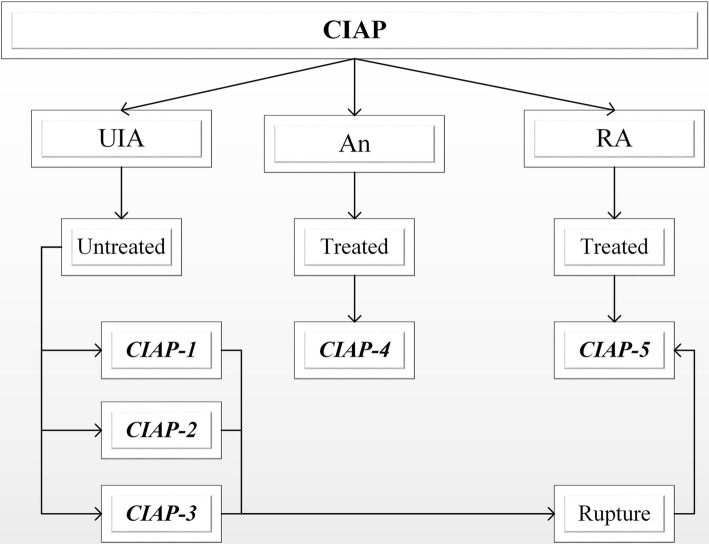
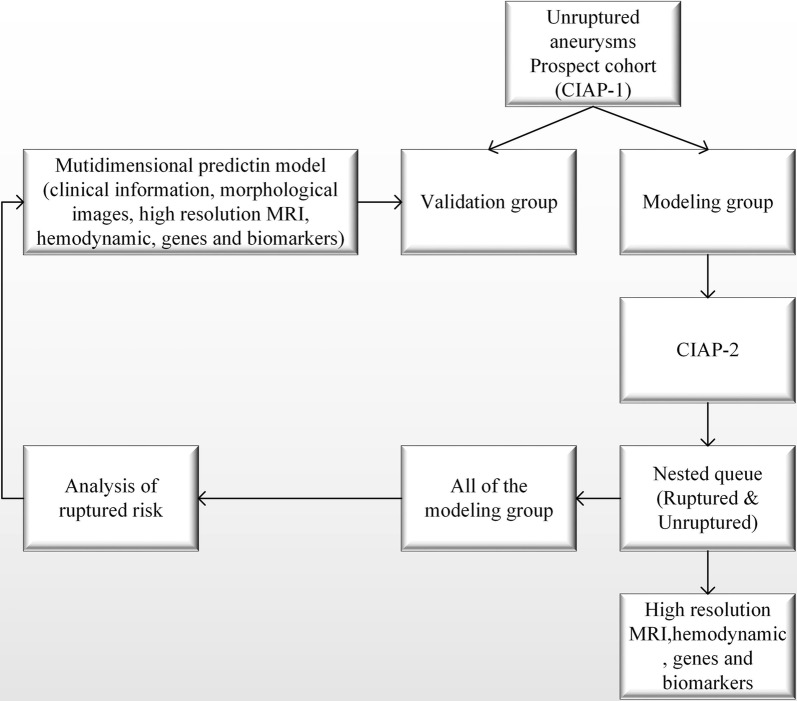
The China Intracranial Aneurysm Project-2 (CIAP-2) will comprise screening of a cohort of 500 patients with UIA (From CIAP-1) and focus on hemodynamic factors, high resolution magnetic resonance imaging (HRMRI) findings, genetic factors, and biomarkers. Possible risk factors for rupture of UIA, including genetic factors, biomarkers, HRMRI, and hemodynamic factors, will be analyzed. The first project of the China Intracranial Aneurysm Project (CIAP-1; chaired by the Department of Neurosurgery, Tangdu Hospital, Fourth Military Medical University, Xi'an, Shaanxi, China) will prospectively collect a cohort of 5000 patients with UIA from 20 centers in China, and collect baseline information for each patient. Multidimensional data will be acquired in follow-up assessments. Statistically significant clinical features in the UIA cohort will also be analyzed and integrated into the model for predicting risk of UIA rupture. After the model has been set up, the resultant evidence-based prediction will provide a preliminary theoretical basis for treating aneurysms at high risk of rupture.
This study will explore the risk of rupture of aneurysms and develop a scientific multidimensional model for predicting rupture of unruptured intracranial aneurysms. Clinical Trials registration A Study on a Multidimensional Prediction Model for Rupture Risk of Unruptured Intracranial Aneurysms (CIAP-2), NCT03133624. Registered: 16 April 2017. https://clinicaltrials.gov/ct2/show/NCT03133624.
破裂的动脉瘤是蛛网膜下腔出血最常见的非外伤性原因,可能是灾难性的;受影响患者的死亡率和发病率非常高。已经确定了一些危险因素,如吸烟、高血压和女性,而其他因素,如血流动力学、影像学和基因组学,仍然不清楚。目前,尚无包括所有预测破裂因素的准确模型。我们计划使用来自中国一大群个体的数据来建立一个用于预测未破裂颅内动脉瘤(UIA)破裂风险的多维模型。
中国颅内动脉瘤计划-2(CIAP-2)将包括对来自 CIAP-1 的 500 例 UIA 患者进行筛查,并重点关注血流动力学因素、高分辨率磁共振成像(HRMRI)发现、遗传因素和生物标志物。将分析 UIA 破裂的可能危险因素,包括遗传因素、生物标志物、HRMRI 和血流动力学因素。中国颅内动脉瘤计划的第一个项目(CIAP-1;由中国第四军医大学唐都医院神经外科领导,西安,陕西,中国)将前瞻性地从中国 20 个中心收集 5000 例 UIA 患者的队列,并为每位患者收集基线信息。在后续评估中,将获得多维数据。还将分析 UIA 队列中具有统计学意义的临床特征,并将其整合到预测 UIA 破裂风险的模型中。建立模型后,基于证据的预测结果将为治疗高破裂风险的动脉瘤提供初步的理论基础。
本研究将探讨动脉瘤破裂的风险,并开发一种科学的多维模型来预测未破裂颅内动脉瘤的破裂风险。临床试验注册 一项关于未破裂颅内动脉瘤破裂风险多维预测模型的研究(CIAP-2),NCT03133624。注册:2017 年 4 月 16 日。https://clinicaltrials.gov/ct2/show/NCT03133624。