Gaspar Pâmela Cristina, Wohlke Bruna Lovizutto Protti, Brunialti Milena Karina Coló, Pires Ana Flávia, Kohiyama Igor Massaki, Salomão Reinaldo, Alonso Neto José Boullosa, Júnior Orlando da Costa Ferreira, Franchini Miriam, Bazzo Maria Luiza, Benzaken Adele Schwartz
Department of Surveillance, Prevention and Control of Sexually Transmitted Infections, HIV/AIDS and Viral Hepatitis (DIAHV), Secretariat of Health Surveillance, Ministry of Health, Brasília, Distrito Federal Immunology Laboratory/Division of Infectious Diseases/Escola Paulista de Medicina/Federal University of São Paulo, São Paulo Laboratory of Molecular Virology, Institute of Biology, Federal University of Rio de Janeiro, Rio de Janeiro, Rio de Janeiro Laboratory of Molecular Biology, Microbiology and Serology, Department of Clinical Analysis, Health Sciences Center, Federal University of Santa Catarina, Florianópolis, Santa Catarina, Brazil.
Medicine (Baltimore). 2018 May;97(1S Suppl 1):S32-S37. doi: 10.1097/MD.0000000000010125.
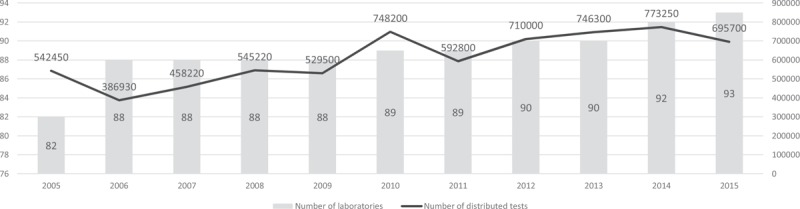
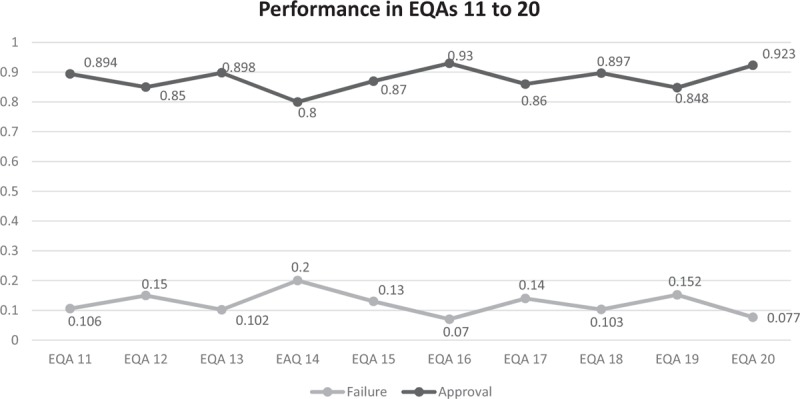
The National Network for CD4+ T-lymphocyte counting of Brazil comprises 93 laboratories. This study reports the laboratory performances achieved in external quality assessment (EQA) rounds provides by Ministry of Health to evaluate the quality of the kits used and the performance of test by the technicians.Ten EQA rounds were analyzed according the EQA criteria aimed to evaluate individual laboratory performance on the basis of the accuracy of their results compared to the general mean obtained by all participating laboratories and the reproducibility of the results obtained between 2 samples from the same donor.The percentage of approved and failed laboratories in the EQAs tends to follow a uniform pattern. Since 2011, approval has remained above 80% and the failure rate has never exceeded 15%.EQA is very important to evaluate the performance of the laboratories, to identify monitor, and to resolve errors as quickly as possible.
巴西国家CD4+ T淋巴细胞计数网络由93个实验室组成。本研究报告了卫生部组织的外部质量评估(EQA)轮次中取得的实验室检测结果,这些评估旨在评估所使用试剂盒的质量以及技术人员的检测性能。根据EQA标准分析了十轮EQA,这些标准旨在根据各实验室结果与所有参与实验室获得的总体均值相比的准确性以及来自同一捐赠者的两个样本之间结果的可重复性来评估单个实验室的性能。EQA中获批和未获批实验室的百分比往往呈现出统一的模式。自2011年以来,获批率一直保持在80%以上,失败率从未超过15%。EQA对于评估实验室性能、识别监测问题以及尽快解决错误非常重要。