Shanghai Key Laboratory of Ocular Fundus Diseases, Shanghai, China.
Department of Ophthalmology, Shanghai General Hospital, Shanghai, China.
Eye (Lond). 2018 Sep;32(9):1463-1471. doi: 10.1038/s41433-018-0110-7. Epub 2018 May 23.
Ciliary neurotrophic factor (CNTF) has been evaluated as a candidate therapeutic agent for diabetes and its neural complications. However, its role in diabetic retinopathy has not been fully elucidated.
This is a randomized unblinded animal experiment. Wistar rats with streptozocin (STZ)-induced diabetes were regularly injected with CNTF or vehicle control in their vitreous bodies beginning at 2 weeks after STZ injection. A total of five injections were used. In diabetic rats, the levels of CNTF and neurotrophin-3 (NT-3) were evaluated by enzyme-linked immunosorbent assays (ELISA) and real-time PCR. The abundance of tyrosine hydroxylase (TH) and β-III tubulin was detected by western blot. Transferase-mediated dUTP nick-end labeling staining (TUNEL) was used to detect cell apoptosis in the retinal tissue. The activation of caspase-3 was also measured.
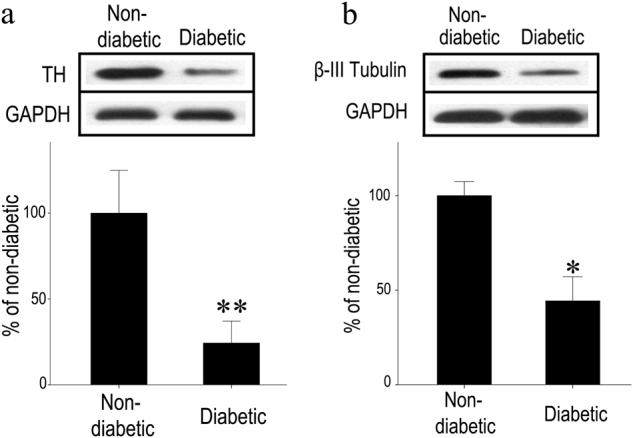
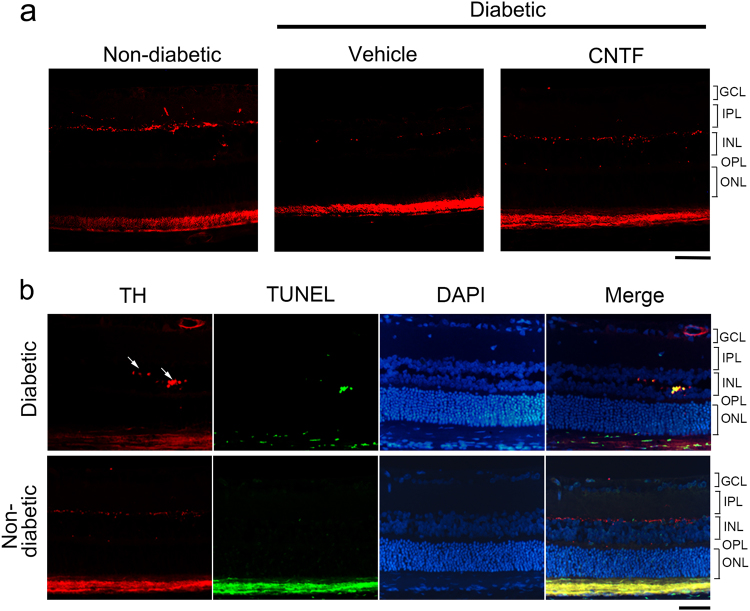
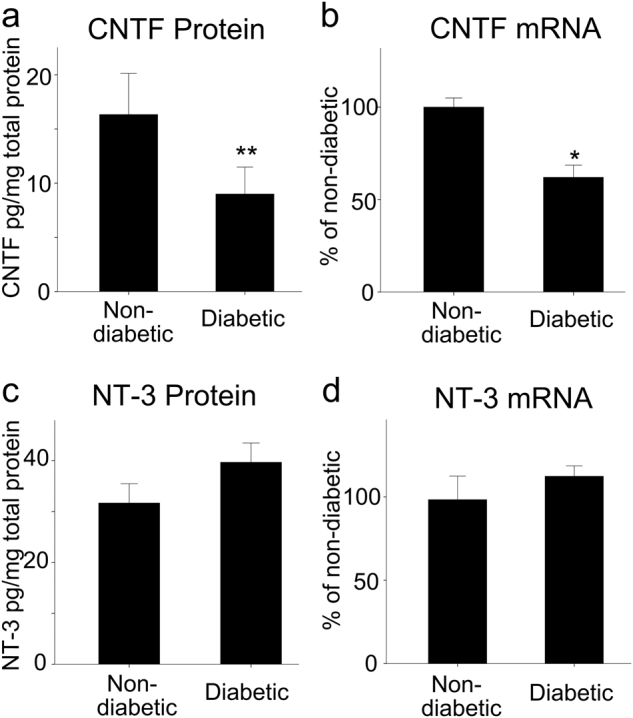
The protein and mRNA levels of CNTF in diabetic rat retinas were reduced compared to control rats. In addition, retinal ganglion cells (RGCs) and dopaminergic amacrine cells appeared to undergo degeneration in diabetic rat retinas, as revealed by transferase-mediated dUTP nick-end labeling staining (TUNEL). Tyrosine hydroxylase (TH) and β-III tubulin protein levels also decreased significantly. Intraocular administration of CNTF rescued RGCs and dopaminergic amacrine cells from neurodegeneration and counteracted the downregulation of β-III tubulin and TH expression, thus demonstrating its therapeutic potential.
Our study suggests that early diabetic retinal neuropathy involves the reduced expression of CNTF and can be ameliorated by an exogenous supply of this neurotrophin.
睫状神经营养因子(CNTF)已被评估为糖尿病及其神经并发症的候选治疗药物。然而,其在糖尿病性视网膜病变中的作用尚未完全阐明。
这是一项随机、非盲的动物实验。链脲佐菌素(STZ)诱导的糖尿病 Wistar 大鼠在 STZ 注射后 2 周开始定期向玻璃体腔内注射 CNTF 或载体对照物。共使用 5 次注射。在糖尿病大鼠中,通过酶联免疫吸附试验(ELISA)和实时 PCR 评估 CNTF 和神经营养因子-3(NT-3)的水平。通过 Western blot 检测酪氨酸羟化酶(TH)和β-III 微管蛋白的丰度。使用转移酶介导的 dUTP 缺口末端标记染色(TUNEL)检测视网膜组织中的细胞凋亡。还测量了半胱天冬酶-3 的激活。
与对照组大鼠相比,糖尿病大鼠视网膜中 CNTF 的蛋白和 mRNA 水平降低。此外,通过 TUNEL 染色显示,糖尿病大鼠视网膜中的神经节细胞(RGCs)和多巴胺能无长突细胞似乎发生了变性。酪氨酸羟化酶(TH)和β-III 微管蛋白的蛋白水平也显著下降。眼内给予 CNTF 可挽救 RGCs 和多巴胺能无长突细胞免受神经退行性变,并对抗β-III 微管蛋白和 TH 表达的下调,从而证明其治疗潜力。
我们的研究表明,早期糖尿病性视网膜神经病变涉及 CNTF 的表达减少,可以通过外源性供应这种神经营养因子来改善。