Department of Biostatistics, University of Washington, Seattle, WA, United States of America.
Division of Medical Genetics, Department of Medicine, University of Washington, Seattle, WA, United States of America.
PLoS Genet. 2018 May 24;14(5):e1007385. doi: 10.1371/journal.pgen.1007385. eCollection 2018 May.
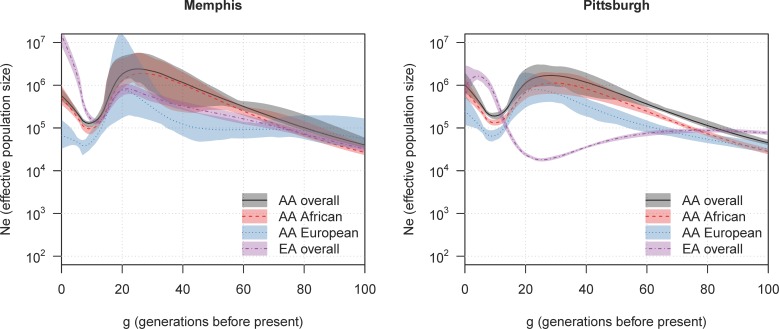
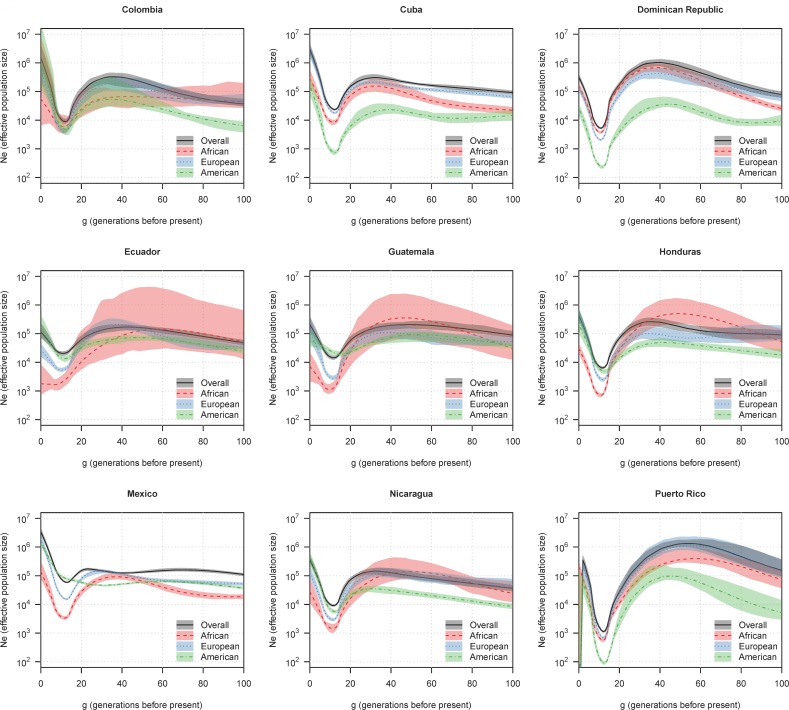
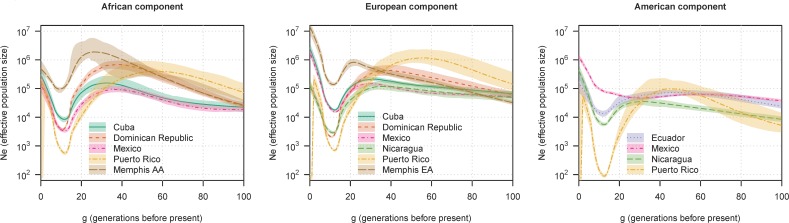
Populations change in size over time due to factors such as population growth, migration, bottleneck events, natural disasters, and disease. The historical effective size of a population affects the power and resolution of genetic association studies. For admixed populations, it is not only the overall effective population size that is of interest, but also the effective sizes of the component ancestral populations. We use identity by descent and local ancestry inferred from genome-wide genetic data to estimate overall and ancestry-specific effective population size during the past hundred generations for nine admixed American populations from the Hispanic Community Health Study/Study of Latinos, and for African-American and European-American populations from two US cities. In these populations, the estimated pre-admixture effective sizes of the ancestral populations vary by sampled population, suggesting that the ancestors of different sampled populations were drawn from different sub-populations. In addition, we estimate that overall effective population sizes dropped substantially in the generations immediately after the commencement of European and African immigration, reaching a minimum around 12 generations ago, but rebounded within a small number of generations afterwards. Of the populations that we considered, the population of individuals originating from Puerto Rico has the smallest bottleneck size of one thousand, while the Pittsburgh African-American population has the largest bottleneck size of two hundred thousand.
由于人口增长、迁移、瓶颈事件、自然灾害和疾病等因素,人口的规模会随时间而变化。一个种群的历史有效大小会影响遗传关联研究的力度和分辨率。对于混合人群,不仅整体有效种群大小是人们关注的焦点,而且组成祖先种群的有效大小也是人们关注的焦点。我们使用来自全基因组遗传数据推断的亲缘关系和局部亲缘关系,来估计过去一百代中来自西班牙裔社区健康研究/拉丁裔研究的九个混合美国人群体以及来自两个美国城市的非裔美国人和欧裔美国人的整体和祖先特定的有效种群大小。在这些人群中,祖先种群的估计混合前有效大小因抽样人群而异,这表明不同抽样人群的祖先来自不同的亚群。此外,我们估计在欧洲和非洲移民开始后的几代中,整体有效种群大小大幅下降,在大约 12 代前达到最小值,但随后在少数几代内反弹。在我们考虑的人群中,来自波多黎各的个体的种群的瓶颈大小最小,为一千,而匹兹堡非裔美国人的种群的瓶颈大小最大,为二十万。