Hörnlein Christine, Confurius-Guns Veronique, Stal Lucas J, Bolhuis Henk
Department of Marine Microbiology and Biogeochemistry, Royal Netherlands Institute for Sea Research, and Utrecht University, Den Hoorn, The Netherlands.
2Department of Freshwater and Marine Ecology, Institute for Biodiversity and Ecosystem Dynamics, University of Amsterdam, Amsterdam, The Netherlands.
NPJ Biofilms Microbiomes. 2018 May 15;4:11. doi: 10.1038/s41522-018-0054-5. eCollection 2018.
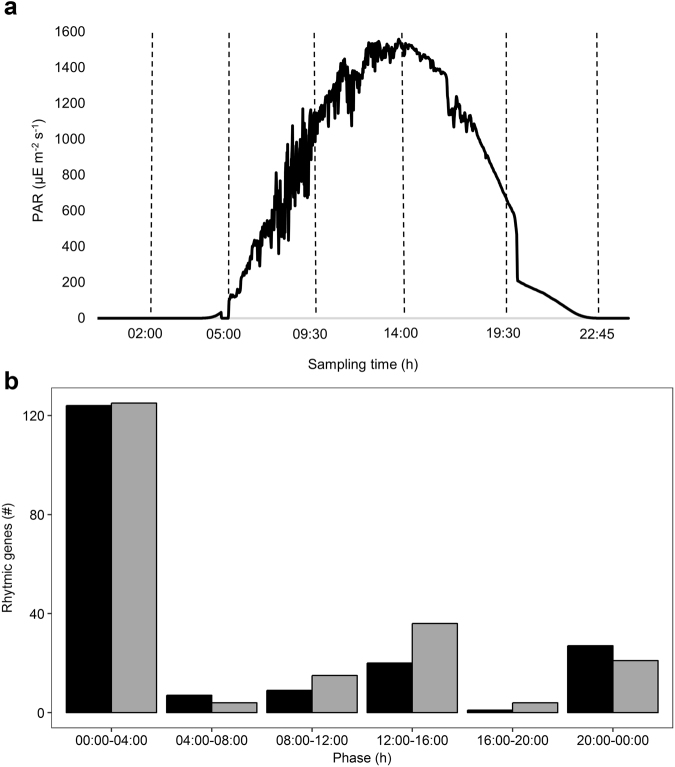
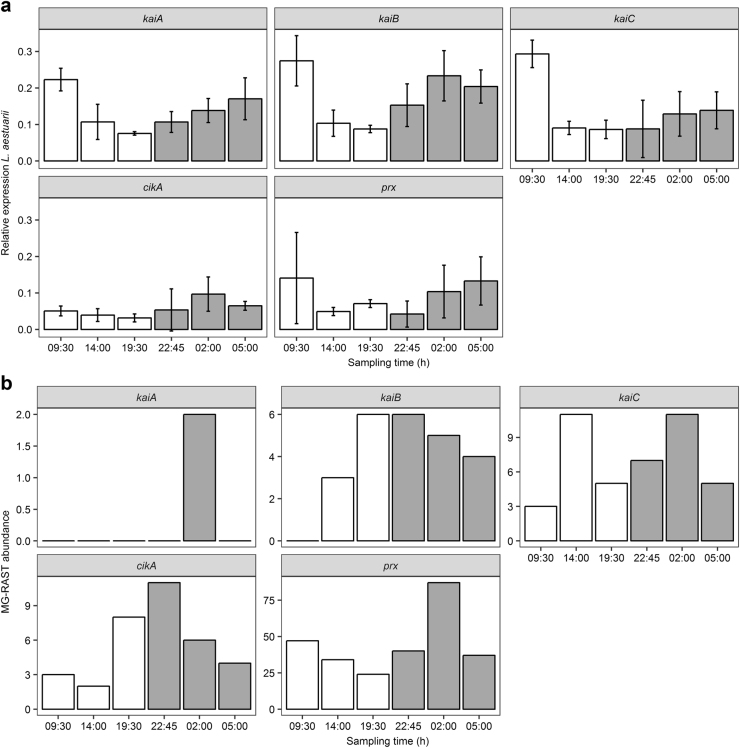
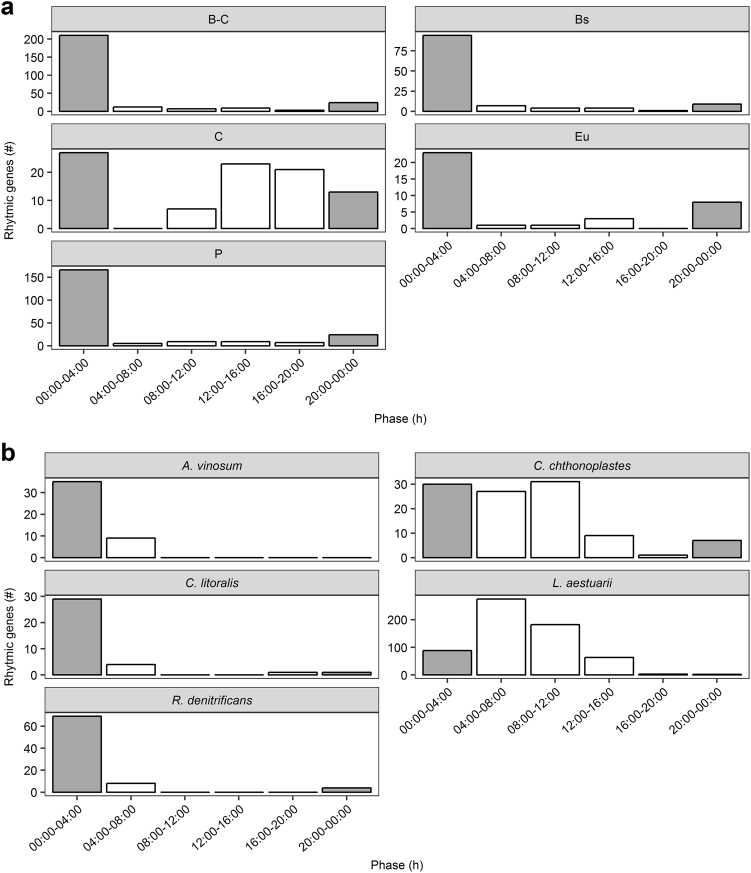
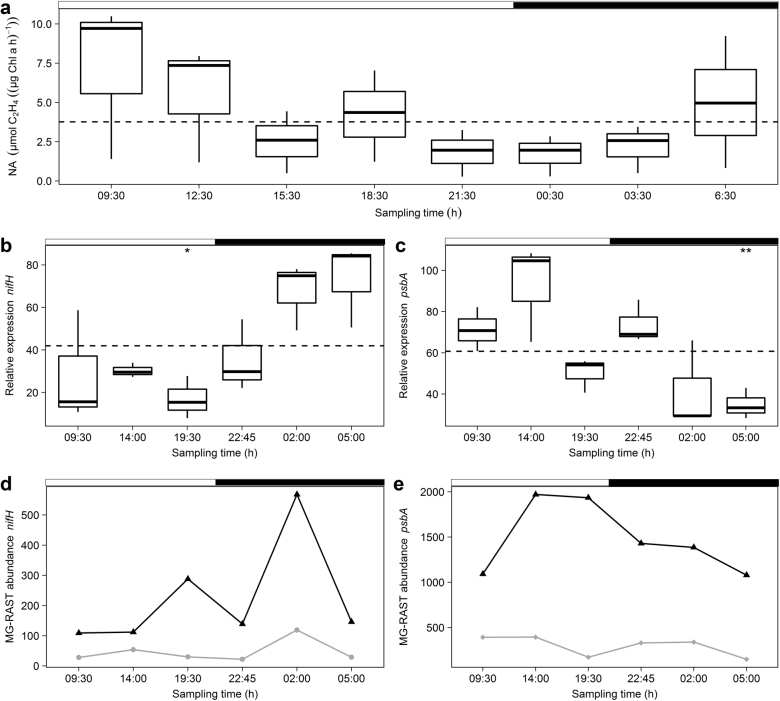
Cyanobacteria are major primary producers in coastal microbial mats and provide biochemical energy, organic carbon, and bound nitrogen to the mat community through oxygenic photosynthesis and dinitrogen fixation. In order to anticipate the specific requirements to optimize their metabolism and growth during a day-and-night cycle, Cyanobacteria possess a unique molecular timing mechanism known as the circadian clock that is well-studied under laboratory conditions but little is known about its function in a natural complex community. Here, we investigated daily rhythmicity of gene expression in a coastal microbial mat community sampled at 6 time points during a 24-h period. In order to identify diel expressed genes, meta-transcriptome data was fitted to periodic functions. Out of 24,035 conserved gene transcript clusters, approximately 7% revealed a significant rhythmic expression pattern. These rhythmic genes were assigned to phototrophic micro-eukaryotes, Cyanobacteria but also to Proteobacteria and Bacteroidetes. Analysis of MG-RAST annotated genes and mRNA recruitment analysis of two cyanobacterial and three proteobacterial microbial mat members confirmed that homologs of the cyanobacterial circadian clock genes were also found in other bacterial members of the microbial mat community. These results suggest that various microbial mat members other than Cyanobacteria have their own molecular clock, which can be entrained by a cocktail of Zeitgebers such as light, temperature or metabolites from neighboring species. Hence, microbial mats can be compared to a complex organism consisting of multiple sub-systems that have to be entrained in a cooperative way such that the corpus functions optimally.
蓝细菌是沿海微生物席中的主要初级生产者,通过光合放氧作用和固氮作用为微生物席群落提供生化能量、有机碳和结合态氮。为了预测在昼夜循环中优化其代谢和生长的特定需求,蓝细菌拥有一种独特的分子计时机制,即生物钟,该机制在实验室条件下已得到充分研究,但对其在自然复杂群落中的功能却知之甚少。在此,我们研究了在24小时内6个时间点采集的沿海微生物席群落中基因表达的每日节律性。为了识别昼夜表达的基因,将宏转录组数据拟合到周期函数中。在24035个保守基因转录簇中,约7%呈现出显著的节律性表达模式。这些节律性基因被归属于光合微真核生物、蓝细菌,也包括变形菌门和拟杆菌门。对MG-RAST注释基因的分析以及对两个蓝细菌和三个变形菌门微生物席成员的mRNA募集分析证实,在微生物席群落的其他细菌成员中也发现了蓝细菌生物钟基因的同源物。这些结果表明,除蓝细菌外,各种微生物席成员都有自己的分子时钟,它可以被诸如光、温度或来自邻近物种的代谢产物等多种授时因子所调节。因此,微生物席可以被比作一个由多个子系统组成的复杂生物体,这些子系统必须以协同的方式被调节,以使整体功能达到最佳状态。