Lannin Natasha A, Ada Louise, Levy Tamina, English Coralie, Ratcliffe Julie, Sindhusake Doungkamol, Crotty Maria
1School of Allied Health (Occupational Therapy), La Trobe University, Melbourne, Australia.
2Occupational Therapy Department, The Alfred, 55 Commercial Road, Prahran, Victoria Australia.
Pilot Feasibility Stud. 2018 May 22;4:82. doi: 10.1186/s40814-018-0276-6. eCollection 2018.
Botulinum toxin-A is provided for adults with post-stroke spasticity. Following injection, there is a variation in the rehabilitation therapy type and amount provided. The purpose of this study was to determine if it is feasible to add intensive therapy to botulinum toxin-A injections for adults with spasticity and whether it is likely to be beneficial.
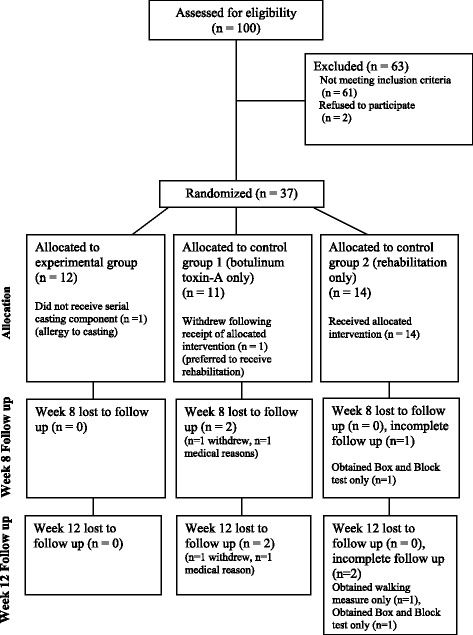
Randomized trial with concealed allocation, assessor blinding, and intention to treat analysis. Thirty-seven adults ( = 3 incomplete or lost follow-up) with spasticity in the upper or lower limb were allocated to one of three groups: experimental group received a single dose of botulinum toxin-A plus an intensive therapy for 8 weeks, control group 1 received a single dose of botulinum toxin-A only, and control group 2 received intensive therapy only for 8 weeks. Feasibility was measured by examining recruitment, intervention (adherence, acceptability, safety), and measurement. Benefit was measured as goal achievement (Goal Attainment Scale), upper limb activity (Box and Block Test), walking (6-min walk test) and spasticity (Tardieu scale), at baseline (week 0), immediately after (week 8), and at three months (week 12).
Overall recruitment fraction for the trial was 37% (eligibility fraction 39%, enrolment fraction 95%). The 26 participants allocated to receive intensive rehabilitation attended 97% of clinic-based sessions (mean 11 ± 2 h) and an averaged 58% (mean 52 ± 32 h) of prescribed 90 h of independent practice. There were no study-related adverse events reported. Although participants in all groups increased their goal attainment, there were no between-group differences for this or other outcomes at week 8 or 12.
Providing intensive therapy following botulinum toxin-A is feasible for adults with neurological spasticity. The study methods are appropriate for a future trial. A future trial would require 134 participants to detect a between-group difference of 7 points on Goal Attainment Scale -scores with an alpha of 0.05 and power of 80%.
ACTRN12612000091808. Registered 18/01/2012, retrospective.
肉毒杆菌毒素A用于治疗成人中风后痉挛。注射后,所提供的康复治疗类型和量存在差异。本研究的目的是确定对痉挛成人在肉毒杆菌毒素A注射基础上增加强化治疗是否可行以及是否可能有益。
采用随机试验,实施分配隐匿、评估者盲法及意向性分析。37名上肢或下肢痉挛的成人(3名未完成或失访)被分配到三组之一:试验组接受单剂量肉毒杆菌毒素A加8周强化治疗,对照组1仅接受单剂量肉毒杆菌毒素A,对照组2仅接受8周强化治疗。通过检查招募情况、干预措施(依从性、可接受性、安全性)及测量来评估可行性。益处通过目标达成情况(目标达成量表)、上肢活动能力(箱框测试)、步行能力(6分钟步行试验)和痉挛程度(塔迪厄量表)来衡量,分别在基线(第0周)、治疗后即刻(第8周)和三个月(第12周)进行评估。
该试验的总体招募比例为37%(符合条件比例为39%,入组比例为95%)。分配接受强化康复治疗的26名参与者参加了97%的门诊治疗(平均11±2小时),并平均完成了规定的90小时独立练习的58%(平均52±32小时)。未报告与研究相关的不良事件。尽管所有组的参与者目标达成情况均有所改善,但在第8周或第12周时,该指标及其他结果在组间并无差异。
对患有神经源性痉挛的成人在肉毒杆菌毒素A注射后提供强化治疗是可行的。本研究方法适用于未来的试验。未来的试验需要134名参与者,以在α为0.05和检验效能为80%的情况下检测出目标达成量表得分在组间有7分的差异。
ACTRN12612000091808。于2012年1月18日注册,回顾性注册。