Sahlgrenska Academy, Medicinaregatan 3, 41390, Gothenburg, Sweden.
Institute of Physiology and Neuroscience, Sahlgrenska Academy, Gothenburg, Sweden.
Acta Neurochir (Wien). 2018 Jul;160(7):1451-1460. doi: 10.1007/s00701-018-3563-3. Epub 2018 May 24.
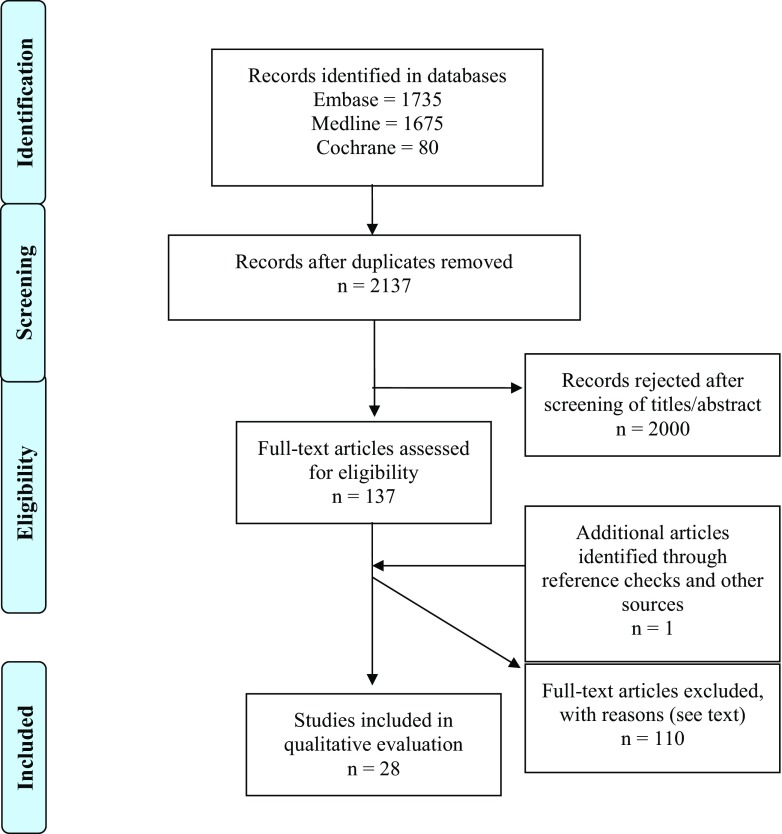
Positron emission tomography (PET) imaging using amino acid tracers has in recent years become widely used in the diagnosis and prediction of disease course in diffuse low-grade gliomas (LGG). However, implications of preoperative PET for treatment and prognosis in this patient group have not been systematically studied. The aim of this systematic review was to evaluate the preoperative diagnostic and prognostic value of amino acid PET in suspected diffuse LGG. Medline, Cochrane Library, and Embase databases were systematically searched using keywords "PET," "low-grade glioma," and "amino acids tracers" with their respective synonyms. Out of 2137 eligible studies, 28 met the inclusion criteria. Increased amino acid uptake (lesion/brain) was consistently reported among included studies; in 25-92% of subsequently histopathology-verified LGG, in 83-100% of histopathology-verified HGG, and also in some non-neoplastic lesions. No consistent results were found in studies reporting hot spot areas on PET in MRI-suspected LGG. Thus, the diagnostic value of amino acid PET imaging in suspected LGG has proven difficult to interpret, showing clear overlap and inconsistencies among reported results. Similarly, the results regarding the prognostic value of PET in suspected LGG and the correlation between uptake ratios and the molecular tumor status of LGG were conflicting. This systematic review illustrates the difficulties with prognostic studies presenting data on group-level without adjustment for established clinical prognostic factors, leading to a loss of additional prognostic information. We conclude that the prognostic value of PET is limited to analysis of histological subgroups of LGG and is probably strongest when using kinetic analysis of dynamic FET uptake parameters.
正电子发射断层扫描(PET)成像使用氨基酸示踪剂近年来已广泛用于弥漫性低级别胶质瘤(LGG)的诊断和疾病进程预测。然而,术前 PET 对该患者群体的治疗和预后的影响尚未进行系统研究。本系统评价的目的是评估氨基酸 PET 在疑似弥漫性 LGG 中的术前诊断和预后价值。使用关键词“PET”、“低级别胶质瘤”和“氨基酸示踪剂”及其各自的同义词,系统地搜索了 Medline、Cochrane 图书馆和 Embase 数据库。在 2137 项合格的研究中,有 28 项符合纳入标准。包括的研究报告了氨基酸摄取增加(病变/大脑);在随后经组织病理学证实的 LGG 中,有 25-92%,在经组织病理学证实的 HGG 中,有 83-100%,也有一些非肿瘤性病变。在报告 MRI 疑似 LGG 上的 PET 热点区域的研究中,没有发现一致的结果。因此,氨基酸 PET 成像在疑似 LGG 中的诊断价值难以解释,报告结果之间存在明显的重叠和不一致。同样,关于 PET 在疑似 LGG 中的预后价值以及摄取率与 LGG 分子肿瘤状态之间的相关性的研究结果也存在冲突。本系统评价说明了在没有对既定临床预后因素进行调整的情况下,以群组水平呈现数据的预后研究存在困难,导致丧失了额外的预后信息。我们得出结论,PET 的预后价值仅限于对 LGG 的组织学亚组进行分析,并且当使用动态 FET 摄取参数的动力学分析时,可能最强。