La Jolla, CA, USA.
Leuven, Belgium.
Aliment Pharmacol Ther. 2018 Jul;48(1):65-77. doi: 10.1111/apt.14794. Epub 2018 May 24.
In Phase 3 studies of ustekinumab, a fully human monoclonal IL-12/23p40 antibody approved for moderate-to-severe Crohn's disease, patients entered a long-term extension after completing 8 weeks of induction and 44 weeks of maintenance treatment. Efficacy through 92 weeks and safety through 96 weeks of IM-UNITI maintenance are reported.
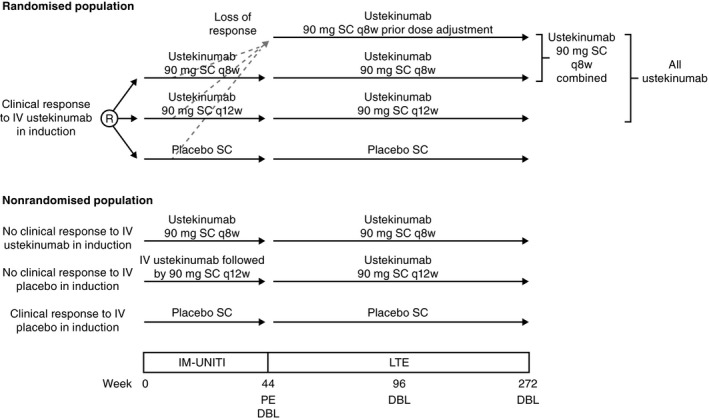
UNITI-1 (TNF-antagonist failures) and UNITI-2 (conventional therapy failures) patients (N = 1281) entered IM-UNITI, including 397 ustekinumab intravenous induction responders randomised to subcutaneous ustekinumab 90 mg every 12 weeks, every 8 weeks, or placebo and 884 nonrandomised patients. Dose-adjustment to 90 mg every 8 weeks occurred in patients randomised to 90 mg every 12 weeks and placebo patients with loss of response (Weeks 8-32). All Week 44 completers could enter the long-term extension without further dose adjustment. Placebo patients discontinued following study unblinding.
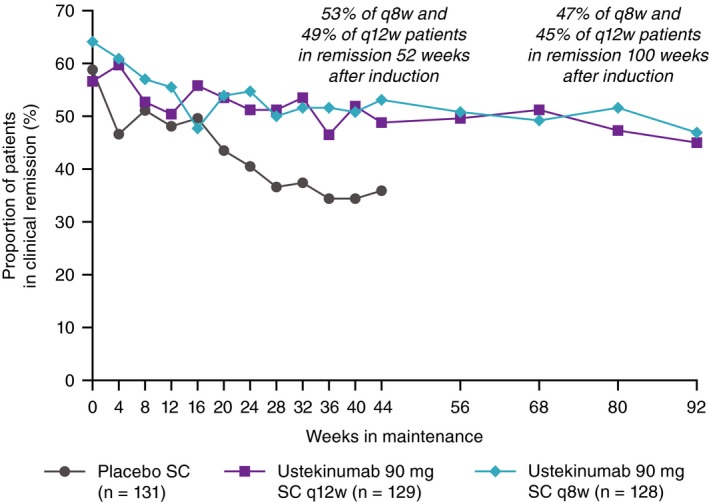
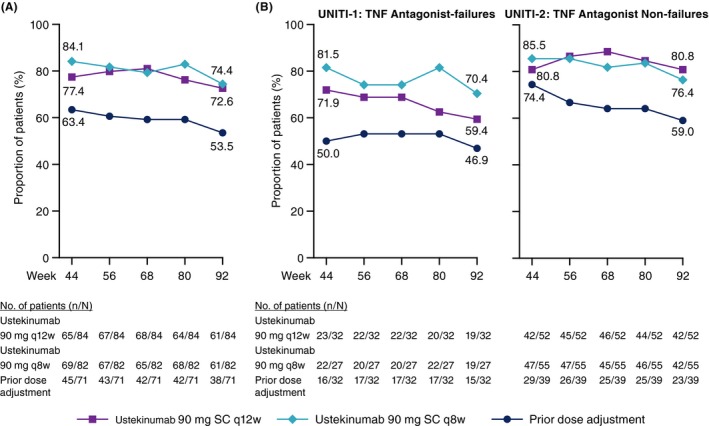
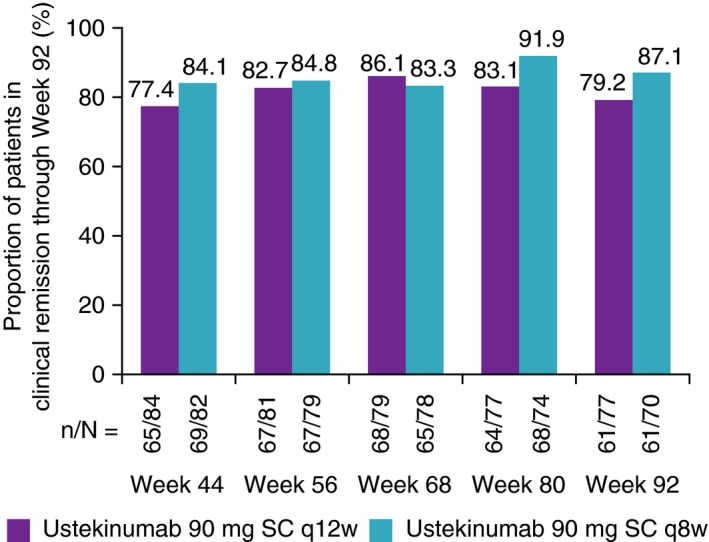
A total of 718 patients (all treated) entered the long-term extension (298 randomised and 420 not randomised). Overall, 86.5% (621/718) completed Week 96. The proportions of randomised patients in clinical remission were generally maintained from Week 44 through 92 in ustekinumab 90 mg every 12 weeks (77.4% to 72.6%), every 8 weeks (84.1% to 74.4%), and prior dose adjustment groups (63.4% to 53.5%). At Week 92, the proportions of patients in clinical remission were similar in the ustekinumab 90 mg every 12 weeks and every 8 weeks groups and lower in patients with prior dose adjustment. Proportions of patients in clinical remission at Week 92 for all treated every 8 weeks (64.4%) and every 12 weeks (64.3%) groups were lower than randomised every 8 weeks (74.4%) and every 12 weeks (72.6%) groups, but similarly maintained. Safety events (per hundred patient-years) were similar among all placebo and ustekinumab patients (Week 0-96), including adverse events (484.39 vs 447.76), serious adverse events (19.24 vs 18.82), and serious infections (4.09 vs 4.02). No dose effect was observed.
Subcutaneous ustekinumab maintained clinical response and remission through Week 92. No new safety signals were observed. ClinicalTrials.gov number NCT01369355.
在乌司奴单抗的 3 期研究中,乌司奴单抗是一种全人源单克隆白细胞介素-12/23p40 抗体,已被批准用于中度至重度克罗恩病,患者在完成 8 周诱导期和 44 周维持治疗后进入长期扩展期。报告了 92 周的疗效和 96 周的 IM-UNITI 维持安全性。
UNITI-1(TNF 拮抗剂失败)和 UNITI-2(常规治疗失败)患者(N=1281)进入 IM-UNITI,包括 397 名乌司奴单抗静脉诱导应答者随机分为皮下乌司奴单抗 90mg 每 12 周、每 8 周或安慰剂组,884 名非随机患者。在随机分配至 90mg 每 12 周和安慰剂组的患者出现应答丧失(第 8-32 周)时,对这些患者进行剂量调整至 90mg 每 8 周。所有在第 44 周完成治疗的患者均可在不进行进一步剂量调整的情况下进入长期扩展期。安慰剂组患者在研究揭盲后停药。
共有 718 名患者(所有治疗)进入长期扩展期(298 名随机和 420 名非随机)。总体而言,86.5%(621/718)完成了第 96 周。在乌司奴单抗 90mg 每 12 周(77.4%至 72.6%)、每 8 周(84.1%至 74.4%)和先前剂量调整组(63.4%至 53.5%)中,随机患者的临床缓解比例通常从第 44 周维持至第 92 周。在第 92 周时,乌司奴单抗 90mg 每 12 周和每 8 周组的临床缓解患者比例与先前剂量调整组相似,且低于先前剂量调整组。在第 92 周时,所有接受每 8 周治疗的患者(64.4%)和每 12 周治疗的患者(64.3%)的临床缓解比例均低于随机分配的每 8 周(74.4%)和每 12 周(72.6%)组,但相似。所有安慰剂和乌司奴单抗患者(第 0-96 周)的安全性事件(每百患者年)相似,包括不良事件(484.39 与 447.76)、严重不良事件(19.24 与 18.82)和严重感染(4.09 与 4.02)。未观察到剂量效应。
皮下乌司奴单抗可维持第 92 周的临床应答和缓解。未观察到新的安全性信号。临床试验注册号 NCT01369355。