Institute of Ecology, University of Innsbruck, Innsbruck, Tirol, Austria.
Department for Internal Medicine IV, Hospital Wels Grieskirchen GmbH, Wels, Austria.
J Basic Microbiol. 2018 Aug;58(8):712-716. doi: 10.1002/jobm.201800136. Epub 2018 May 24.
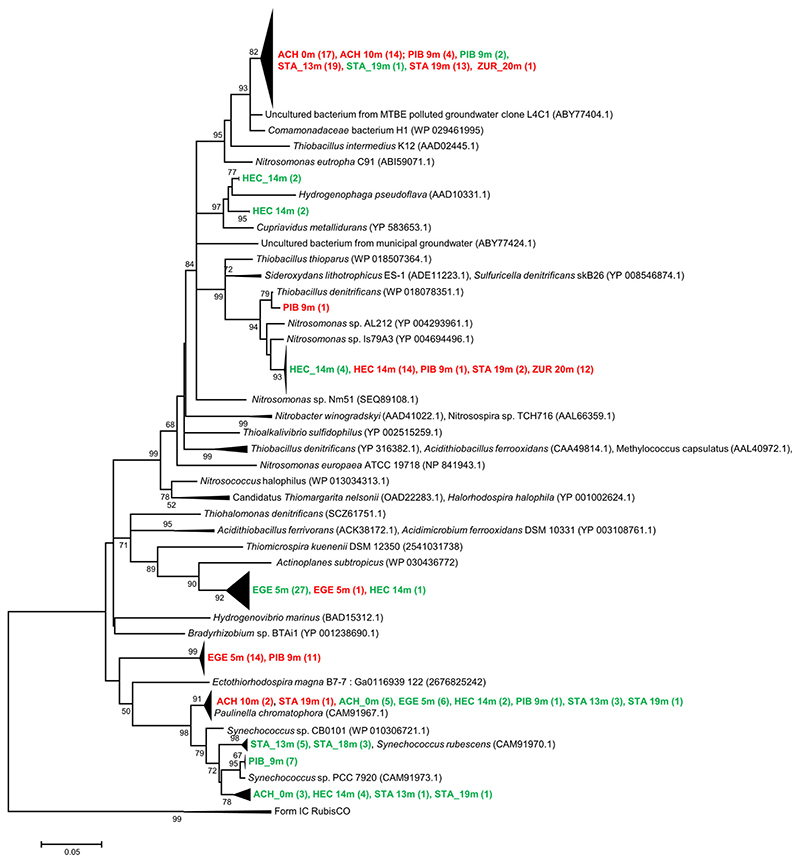
The analysis of RubisCO genes is a highly useful instrument to explore the diversity of chemoautotrophic bacteria using the Calvin-Benson-Bassham cycle for CO fixation. However, because of the wide taxonomic distribution of phylogenetically related RubisCO forms, environmental studies targeting chemoautotrophs are hampered in habitats dominated by phototrophs. Here, we report the development of a gene marker that specifically detects form IA RubisCO genes in bacteria, excluding photoautotrophic representatives. The high specificity of the PCR assay was confirmed by sequence analysis of DNA obtained from the photic zone of six lakes, were chemoautotrophs are outnumbered by Cyanobacteria also using form IA RubisCO for CO assimilation.
分析 RubisCO 基因是一种非常有用的工具,可用于探索使用卡尔文-本森-巴斯汉姆循环进行 CO 固定的化能自养细菌的多样性。然而,由于与系统发育相关的 RubisCO 形式在分类学上分布广泛,因此在以光合生物为主的生境中,针对化能自养生物的环境研究受到了阻碍。在这里,我们报告了一种基因标记物的开发,该标记物专门用于检测细菌中的 IA 型 RubisCO 基因,排除了光自养生物的代表。通过对六个湖泊光区获得的 DNA 进行序列分析,证实了 PCR 检测方法具有很高的特异性,在这些湖泊中,化能自养生物的数量超过了同样使用 IA 型 RubisCO 进行 CO 同化的蓝细菌。