Mori Ryosuke, Matsuya Yusuke, Yoshii Yuji, Date Hiroyuki
Graduate School of Health Sciences, Hokkaido University, Kita-12, Nishi-5, Kita-ku, Sapporo 060-0812, Japan.
Biological Research, Education and Instrumentation Center, Sapporo Medical University, Minami-1, Nichi-17, Chuo-ku, Sapporo 060-8556, Japan.
J Radiat Res. 2018 May 1;59(3):253-260. doi: 10.1093/jrr/rrx097.
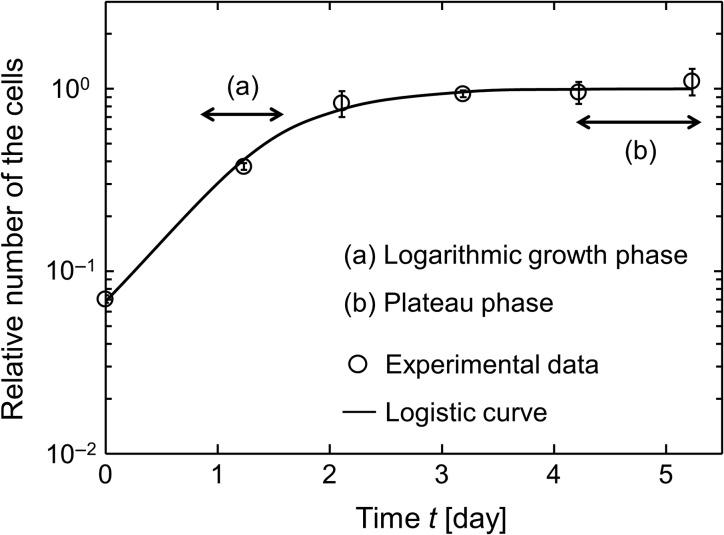
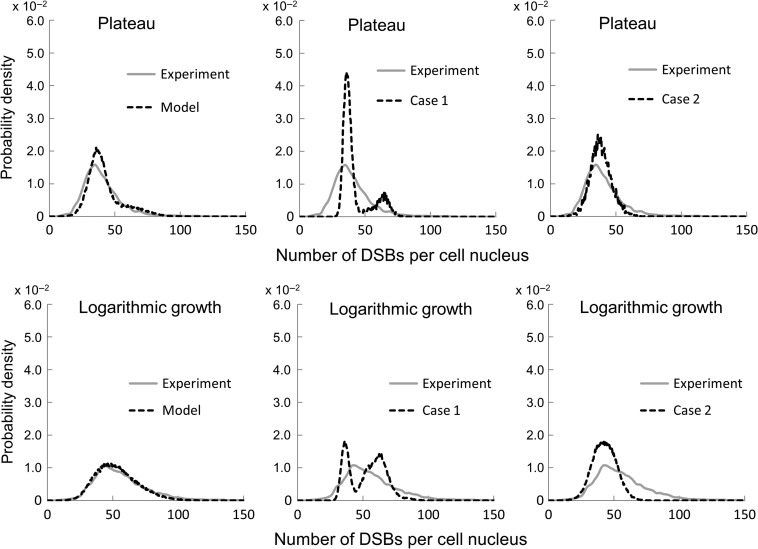
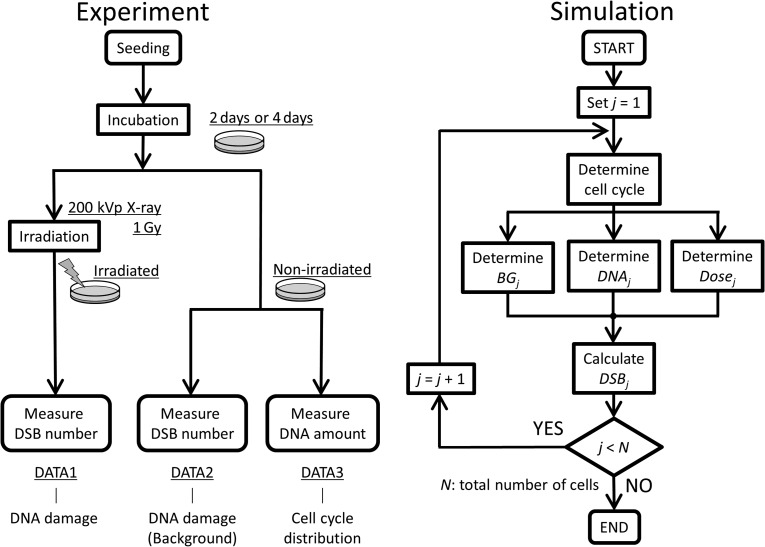
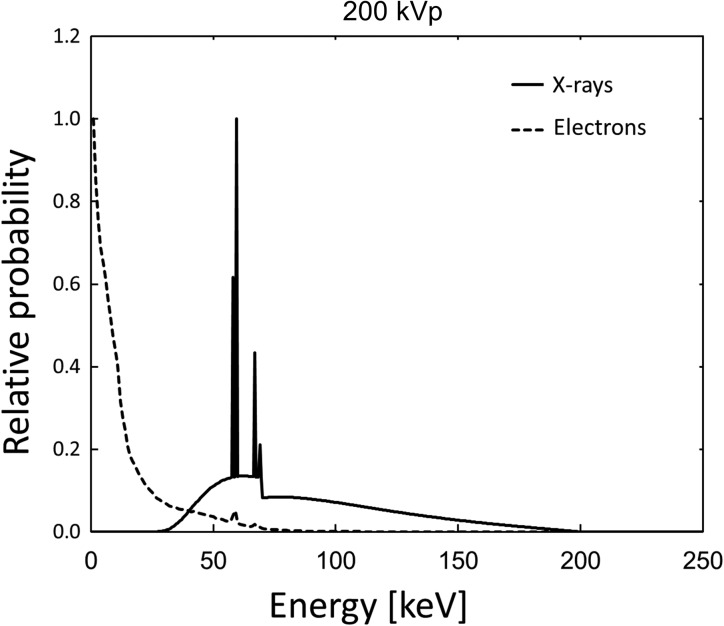
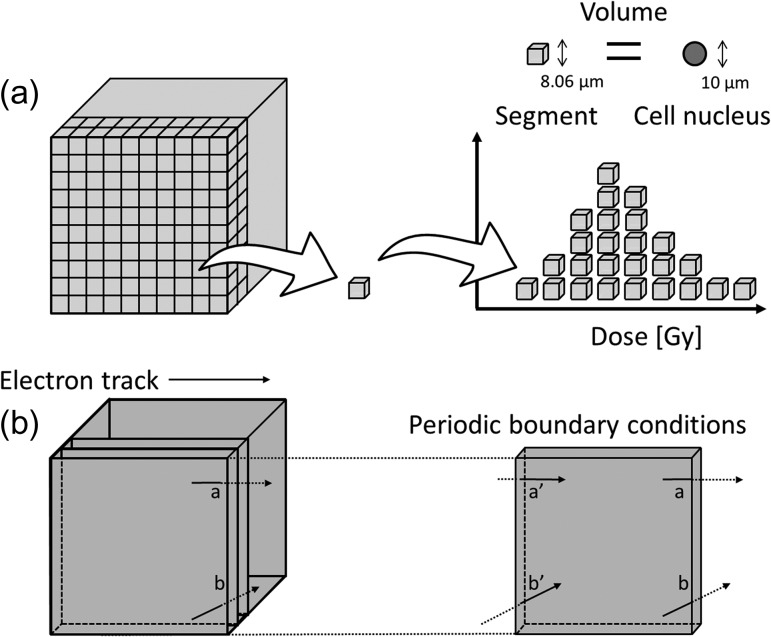
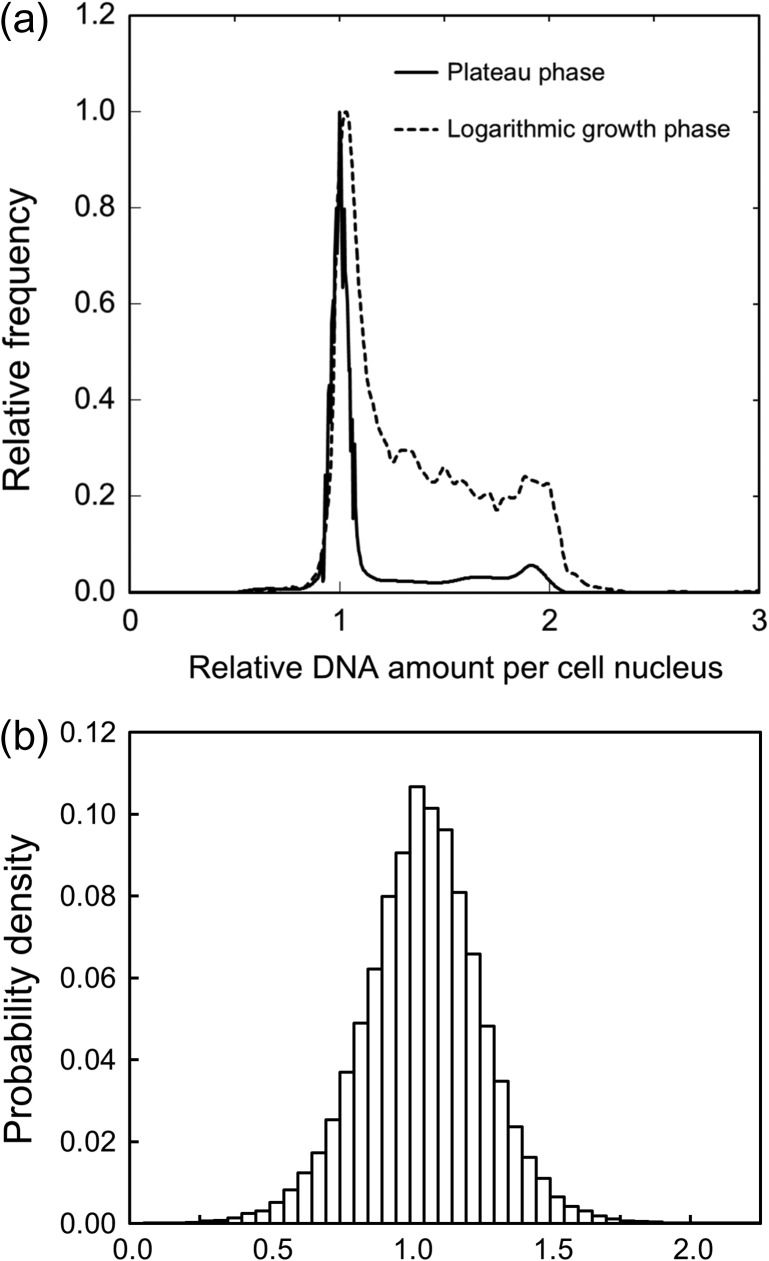
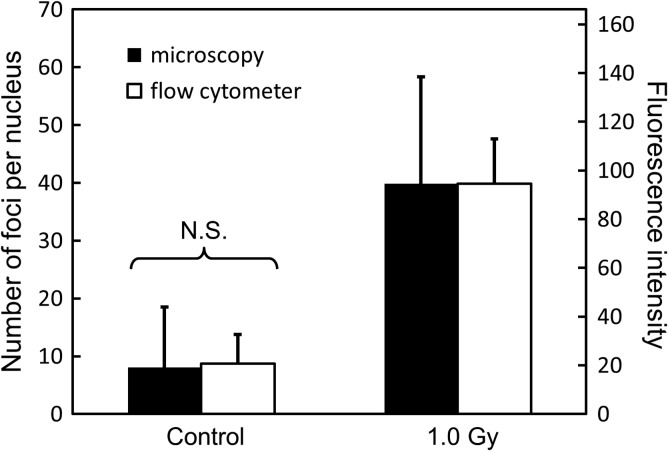
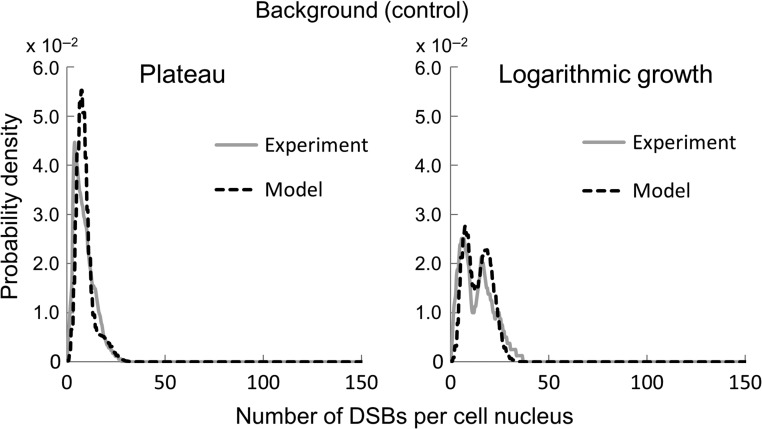
DNA double-strand breaks (DSBs) are thought to be the main cause of cell death after irradiation. In this study, we estimated the probability distribution of the number of DSBs per cell nucleus by considering the DNA amount in a cell nucleus (which depends on the cell cycle) and the statistical variation in the energy imparted to the cell nucleus by X-ray irradiation. The probability estimation of DSB induction was made following these procedures: (i) making use of the Chinese Hamster Ovary (CHO)-K1 cell line as the target example, the amounts of DNA per nucleus in the logarithmic and the plateau phases of the growth curve were measured by flow cytometry with propidium iodide (PI) dyeing; (ii) the probability distribution of the DSB number per cell nucleus for each phase after irradiation with 1.0 Gy of 200 kVp X-rays was measured by means of γ-H2AX immunofluorescent staining; (iii) the distribution of the cell-specific energy deposition via secondary electrons produced by the incident X-rays was calculated by WLTrack (in-house Monte Carlo code); (iv) according to a mathematical model for estimating the DSB number per nucleus, we deduced the induction probability density of DSBs based on the measured DNA amount (depending on the cell cycle) and the calculated dose per nucleus. The model exhibited DSB induction probabilities in good agreement with the experimental results for the two phases, suggesting that the DNA amount (depending on the cell cycle) and the statistical variation in the local energy deposition are essential for estimating the DSB induction probability after X-ray exposure.
DNA双链断裂(DSBs)被认为是辐射后细胞死亡的主要原因。在本研究中,我们通过考虑细胞核中的DNA含量(这取决于细胞周期)以及X射线照射赋予细胞核的能量的统计变化,估计了每个细胞核中DSB数量的概率分布。DSB诱导的概率估计按照以下步骤进行:(i)以中国仓鼠卵巢(CHO)-K1细胞系作为目标示例,通过碘化丙啶(PI)染色的流式细胞术测量生长曲线对数期和平稳期每个细胞核中的DNA量;(ii)通过γ-H2AX免疫荧光染色测量用1.0 Gy的200 kVp X射线照射后每个阶段每个细胞核中DSB数量的概率分布;(iii)通过WLTrack(内部蒙特卡罗代码)计算入射X射线产生的二次电子引起的细胞特异性能量沉积分布;(iv)根据估计每个细胞核中DSB数量的数学模型,我们基于测量的DNA量(取决于细胞周期)和计算的每个细胞核剂量推导出DSB的诱导概率密度。该模型显示的DSB诱导概率与两个阶段的实验结果高度一致,表明DNA量(取决于细胞周期)和局部能量沉积的统计变化对于估计X射线照射后的DSB诱导概率至关重要。