
通过 IL-2/抗 IL-2 单克隆抗体复合物和肽/MHC 四聚体优化诱导的抗原特异性 Treg 的扩增来治疗 T1D。
Treatment of T1D via optimized expansion of antigen-specific Tregs induced by IL-2/anti-IL-2 monoclonal antibody complexes and peptide/MHC tetramers.
机构信息
Department of Cell Biology, Physiology and Immunology, Faculty of Biology, University of Barcelona, 08028, Barcelona, Spain.
Otsuka Pharmaceutical, S.A, Barcelona, Spain.
出版信息
Sci Rep. 2018 May 25;8(1):8106. doi: 10.1038/s41598-018-26161-6.
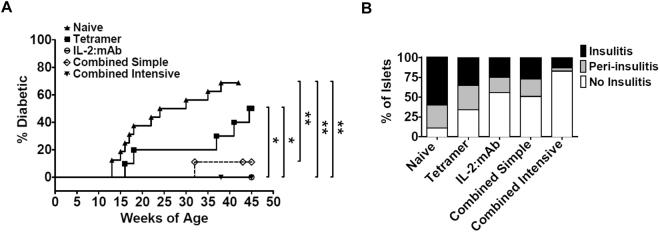
Type 1 diabetes can be overcome by regulatory T cells (Treg) in NOD mice yet an efficient method to generate and maintain antigen-specific Treg is difficult to come by. Here, we devised a combination therapy of peptide/MHC tetramers and IL-2/anti-IL-2 monoclonal antibody complexes to generate antigen-specific Treg and maintain them over extended time periods. We first optimized treatment protocols conceived to obtain an improved islet-specific Treg/effector T cell ratio that led to the in vivo expansion and activation of these Treg as well as to an improved suppressor function. Optimized protocols were applied to treatment for testing diabetes prevention in NOD mice as well as in an accelerated T cell transfer model of T1D. The combined treatment led to robust protection against diabetes, and in the NOD model, to a close to complete prevention of insulitis. Treatment was accompanied with increased secretion of IL-10, detectable in total splenocytes and in Foxp3 CD4 T cells. Our data suggest that a dual protection mechanism takes place by the collaboration of Foxp3 and Foxp3 regulatory cells. We conclude that antigen-specific Treg are an important target to improve current clinical interventions against this disease.
1 型糖尿病可以被 NOD 小鼠中的调节性 T 细胞(Treg)克服,但生成和维持抗原特异性 Treg 的有效方法却难以实现。在这里,我们设计了一种肽/MHC 四聚体和 IL-2/抗 IL-2 单克隆抗体复合物的联合治疗方法,以生成抗原特异性 Treg 并在延长的时间内维持它们。我们首先优化了治疗方案,旨在获得改善的胰岛特异性 Treg/效应 T 细胞比值,从而导致这些 Treg 的体内扩增和激活,以及改善的抑制功能。优化的方案应用于治疗,以测试 NOD 小鼠的糖尿病预防以及 T1D 的加速 T 细胞转移模型。联合治疗导致对糖尿病的强烈保护,并且在 NOD 模型中,几乎完全预防胰岛炎。治疗伴随着 IL-10 的分泌增加,可在总脾细胞和 Foxp3 CD4 T 细胞中检测到。我们的数据表明,通过 Foxp3 和 Foxp3 调节性细胞的协作,发生了双重保护机制。我们得出结论,抗原特异性 Treg 是改善针对这种疾病的当前临床干预的重要目标。


 Zotero 插件