Nishikawa Kazuhiro, Aoyama Toru, Oba Mari S, Yoshikawa Takaki, Matsuda Chu, Munemoto Yoshinori, Takiguchi Nobuhiro, Tanabe Kazuaki, Nagata Naoki, Imano Motohiro, Oshiro Mitsuru, Fukushima Ryoji, Kataoka Masato, Morita Satoshi, Tsuburaya Akira, Mishima Hideyuki, Kono Toru, Sakamoto Junichi
Department of Surgery, Osaka National Hospital.
Department of Gastrointestinal Surgery, Kanagawa Cancer Center.
J Cancer. 2018 Apr 19;9(10):1725-1730. doi: 10.7150/jca.24733. eCollection 2018.
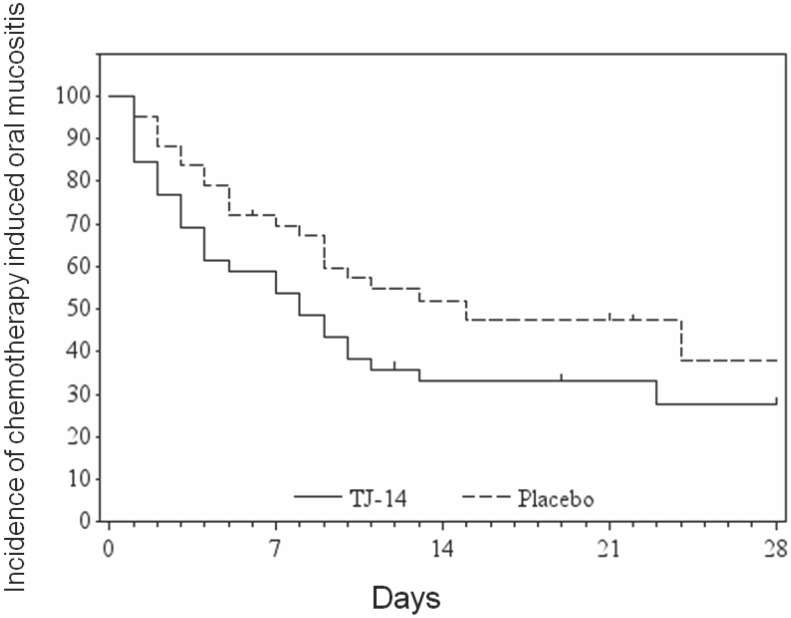
: The current pooled analysis evaluated the efficacy of Hangeshashinto (TJ-14) in the prevention and/or treatment of chemotherapy-induced oral mucositis (COM) in gastric cancer and colorectal cancer using two prospective, multi-institutional, randomized, double-blind, placebo-controlled phase II trials. : HANGESHA-G and HANGESHA-C randomly assigned patients with gastric cancer or colorectal cancer who developed moderate to severe COM (grade ≥1) during any cycle of chemotherapy to receive either TJ-14 or a placebo as a double-blind trial. The patients received a placebo or TJ-14 for four to six weeks, according to the chemotherapy regimen, from the start of their next course of chemotherapy. The primary endpoint was the incidence of grade ≥2 COM in the protocol treatment course, and the secondary endpoints were the time to disappearance of COM and the incidence of adverse events. : The pooled population included 181 patients. The incidence of grade ≥2 COM in the TJ-14 group was 55.7% (49 patients), while that in the placebo group was 53.8% (50 patients); there was no significant difference between the two groups (p=0.796). The median time to remission of grade ≥2 COM to grade <1 was 8 days in the TJ-14 group and 15 days in the placebo group (p= 0.072). The hazard ratio was 1.54 [1.02 to 2.31] in favor of TJ-14. Treatment with TJ-14 was associated with marginally significant reduction in the duration of severe grade ≥2 COM in comparison to patients receiving placebo indicating the effect of TJ-14 in reducing the severity of COM. The present-pooled analysis showed that TJ-14 had a treatment effect in gastric cancer and colorectal cancer patients with COM in comparison to a placebo. Further phase III studies with a larger sample size are needed to clarify the protective effects of TJ-14 against COM.
本汇总分析使用两项前瞻性、多机构、随机、双盲、安慰剂对照的II期试验,评估了半夏泻心汤(TJ-14)在预防和/或治疗胃癌和结直肠癌化疗引起的口腔黏膜炎(COM)方面的疗效。HANGESHA-G和HANGESHA-C双盲试验将在化疗任何周期出现中度至重度COM(≥1级)的胃癌或结直肠癌患者随机分为两组,分别接受TJ-14或安慰剂治疗。根据化疗方案,患者从下一个化疗疗程开始接受4至6周的安慰剂或TJ-14治疗。主要终点是方案治疗疗程中≥2级COM的发生率,次要终点是COM消失的时间和不良事件的发生率。汇总人群包括181例患者。TJ-14组≥2级COM的发生率为55.7%(49例患者),而安慰剂组为53.8%(50例患者);两组之间无显著差异(p = 0.796)。TJ-14组≥2级COM缓解至<1级的中位时间为8天,安慰剂组为15天(p = 0.072)。风险比为1.54[1.02至2.31],支持TJ-14。与接受安慰剂的患者相比,TJ-14治疗使≥2级严重COM的持续时间略有显著缩短,表明TJ-14对降低COM严重程度有作用。本汇总分析表明,与安慰剂相比,TJ-14对患有COM的胃癌和结直肠癌患者有治疗效果。需要进一步开展更大样本量的III期研究,以阐明TJ-14对COM的保护作用。