Ràfols-Ribé Joan, Will Paul-Anton, Hänisch Christian, Gonzalez-Silveira Marta, Lenk Simone, Rodríguez-Viejo Javier, Reineke Sebastian
Group of Nanomaterials and Microsystems, Universitat Autònoma de Barcelona, 08193 Bellaterra, Spain.
Dresden Integrated Center for Applied Physics and Photonic Materials and Institute for Applied Physics, Technische Universität Dresden (IAPP), 01187 Dresden, Germany.
Sci Adv. 2018 May 25;4(5):eaar8332. doi: 10.1126/sciadv.aar8332. eCollection 2018 May.
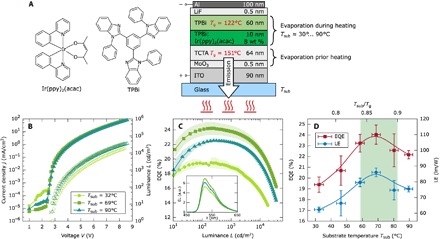
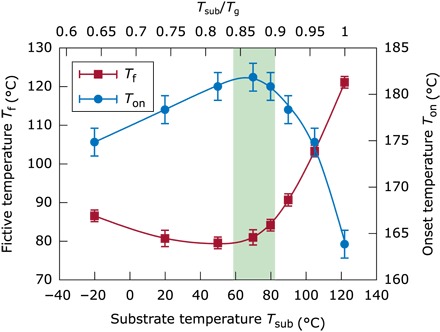
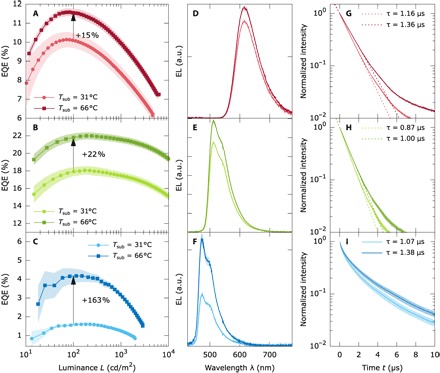
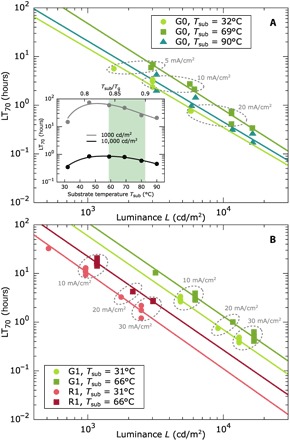
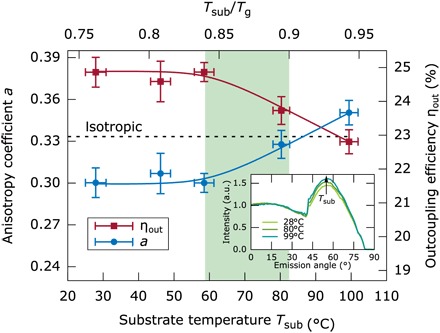
Organic light-emitting diodes (OLEDs) are one of the key solid-state light sources for various applications including small and large displays, automotive lighting, solid-state lighting, and signage. For any given commercial application, OLEDs need to perform at their best, which is judged by their device efficiency and operational stability. We present OLEDs that comprise functional layers fabricated as ultrastable glasses, which represent the thermodynamically most favorable and, thus, stable molecular conformation achievable nowadays in disordered solids. For both external quantum efficiencies and LT lifetimes, OLEDs with four different phosphorescent emitters show >15% enhancements over their respective reference devices. The only difference to the latter is the growth condition used for ultrastable glass layers that is optimal at about 85% of the materials' glass transition temperature. These improvements are achieved through neither material refinements nor device architecture optimization, suggesting a general applicability of this concept to maximize the OLED performance, no matter which specific materials are used.
有机发光二极管(OLED)是用于各种应用的关键固态光源之一,这些应用包括小型和大型显示器、汽车照明、固态照明及标识。对于任何给定的商业应用,OLED都需要发挥出最佳性能,这由其器件效率和运行稳定性来评判。我们展示了一种OLED,其功能层是作为超稳定玻璃制造的,这代表了如今在无序固体中可实现的热力学上最有利且因此稳定的分子构象。对于外部量子效率和长寿命(LT),具有四种不同磷光发射体的OLED相较于各自的参考器件显示出超过15%的提升。与后者的唯一区别在于用于超稳定玻璃层的生长条件,该条件在约85%的材料玻璃化转变温度时最为理想。这些改进既不是通过材料优化也不是通过器件架构优化实现的,这表明无论使用哪种特定材料,该概念在最大化OLED性能方面具有普遍适用性。