Department of Veterinary Public Health and Preventive Medicine, University of Jos, PMB, 2084, Jos, Nigeria.
Department of Veterinary Public Health and Preventive Medicine, Ahmadu Bello University, PMB, 1045, Zaria, Nigeria.
Infect Dis Poverty. 2018 May 29;7(1):52. doi: 10.1186/s40249-018-0438-z.
The livestock industry plays a vital role in the economy of Nigeria. It serves as a major source of income and livelihood for majority of Nigerians who are rural settlers and contributes about 5.2% to the National Gross Domestic Product (GDP). Helminths however, cause economic losses due to reductions in milk production, weight gain, fertility and carcass quality. Zoonotic helminths of livestock origin cause health problems in humans.
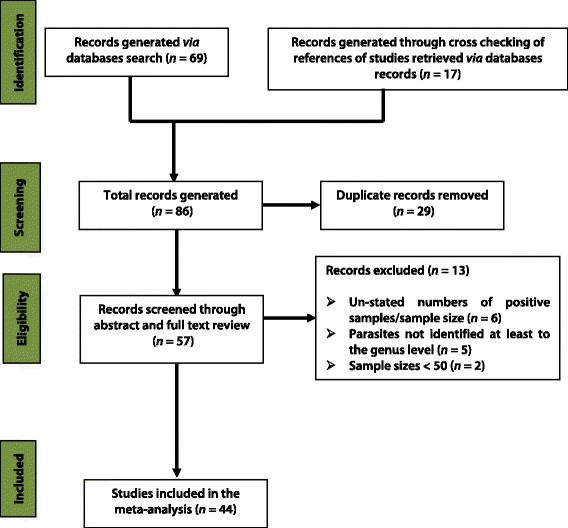
Using the Preferred Reporting Items for Systematic Review and Meta-Analysis (PRISMA) guidelines, the prevalence and distribution of helminths of veterinary and zoonotic importance in Nigerian ruminants were determined in a meta-analysis of data published between 1970 and 2016. Data were stratified based on regions, hosts, study periods, sample sizes and study types while helminths were phylogenetically grouped into cestodes, nematodes and trematodes.
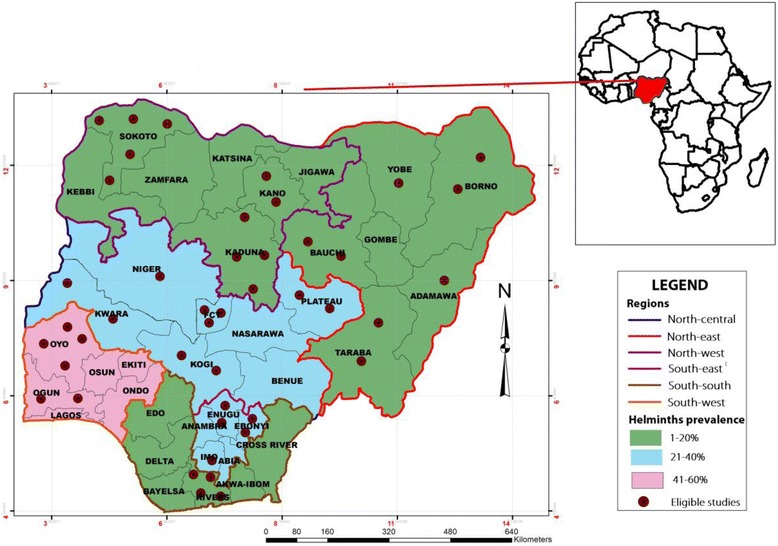
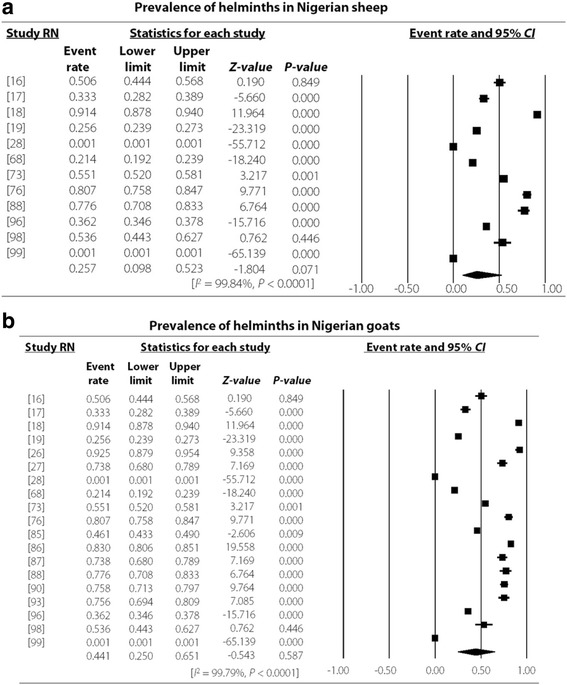
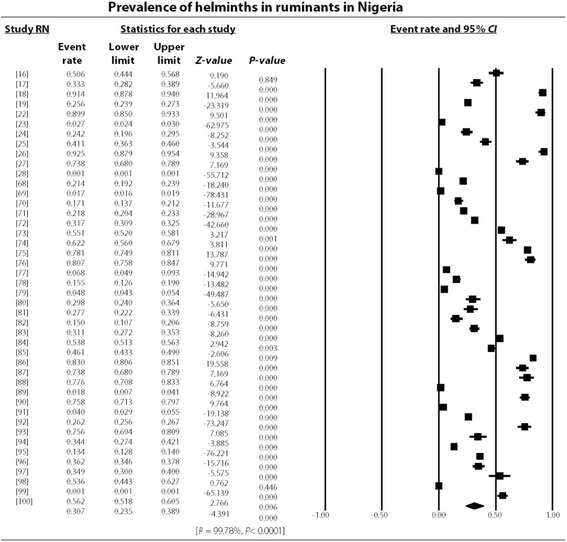
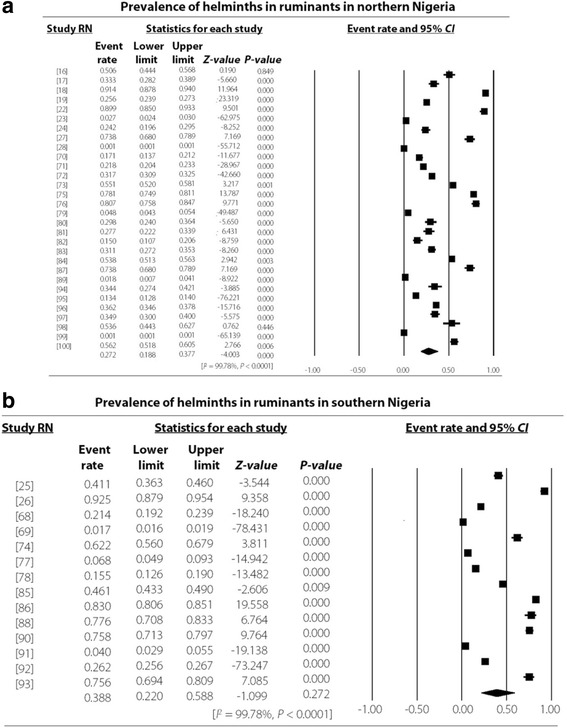
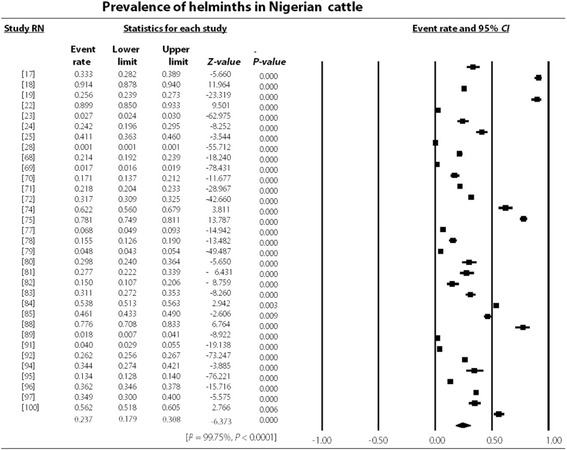
Data from 44 studies reported across 19 Nigerian states revealed an overall pooled prevalence estimate (PPE) of 7.48% (95% CI: 7.38-7.57) for helminths of veterinary and zoonotic importance from a total of 320 208 ruminants. We observed a significant variation (P < 0.001) between the PPEs range of 1.90% (95% CI: 1.78-2.02) and 60.98% (95% CI: 58.37-63.55) reported across different strata. High heterogeneity (99.78, 95% CI: 7.38-7.57) was observed. Strongyloides papillosus was the most prevalent (Prev: 32.02%, 95% CI: 31.01-33.11), while, Fasciola gigantica had the widest geographical distribution.
Helminths of veterinary and zoonotic importance are prevalent in ruminants and well distributed across Nigeria. Our findings show that helminths of ruminants may also be possible causes of morbidity in humans and economic losses in the livestock industry in Nigeria. High heterogeneity was observed within studies and the different strata. Good agricultural practices on farms, standard veterinary meat inspection and adequate hygiene and sanitation in abattoirs, farms and livestock markets need to be implemented in Nigeria in order to reduce the economic, public health and veterinary threats due to these helminths.
畜牧业在尼日利亚经济中发挥着至关重要的作用。它是大多数农村居民的主要收入和生计来源,为尼日利亚国民生产总值(GDP)贡献了约 5.2%。然而,寄生虫会导致产奶量、体重增加、繁殖力和胴体质量下降,从而造成经济损失。动物源的人畜共患寄生虫会给人类健康带来问题。
使用系统评价和荟萃分析(PRISMA)首选报告项目,对 1970 年至 2016 年期间发表的文献进行荟萃分析,确定了尼日利亚反刍动物中具有兽医和人畜共患重要性的寄生虫的流行率和分布情况。数据基于地区、宿主、研究时间、样本量和研究类型进行分层,寄生虫则按照绦虫、线虫和吸虫进行系统发育分组。
来自尼日利亚 19 个州的 44 项研究的数据显示,在总共 320208 头反刍动物中,具有兽医和人畜共患重要性的寄生虫的总流行率估计值(PPE)为 7.48%(95%CI:7.38-7.57)。我们观察到不同分层之间的 PPE 范围(1.90%(95%CI:1.78-2.02)至 60.98%(95%CI:58.37-63.55))存在显著差异(P<0.001)。观察到高度异质性(99.78,95%CI:7.38-7.57)。强棘球蚴是最常见的(Prev:32.02%,95%CI:31.01-33.11),而大片形吸虫的地理分布最广。
具有兽医和人畜共患重要性的寄生虫在反刍动物中普遍存在,在尼日利亚分布广泛。我们的研究结果表明,反刍动物的寄生虫也可能是人类发病和尼日利亚畜牧业经济损失的原因。研究之间以及不同分层之间存在高度异质性。尼日利亚需要在农场实施良好的农业实践、标准的兽医肉类检验以及屠宰场、农场和牲畜市场的充分卫生和环境卫生措施,以减少这些寄生虫造成的经济、公共卫生和兽医威胁。