• 文献检索
  • 文档翻译
  • 深度研究
  • 学术资讯
  • Suppr Zotero 插件Zotero 插件
  • 邀请有礼
  • 套餐&价格
  • 历史记录
应用&插件
Suppr Zotero 插件Zotero 插件浏览器插件Mac 客户端Windows 客户端微信小程序
定价
高级版会员购买积分包购买API积分包
服务
文献检索文档翻译深度研究API 文档MCP 服务
关于我们
关于 Suppr公司介绍联系我们用户协议隐私条款
关注我们

Suppr 超能文献

核心技术专利:CN118964589B侵权必究
粤ICP备2023148730 号-1Suppr @ 2026

文献检索

告别复杂PubMed语法,用中文像聊天一样搜索,搜遍4000万医学文献。AI智能推荐,让科研检索更轻松。

立即免费搜索

文件翻译

保留排版,准确专业,支持PDF/Word/PPT等文件格式,支持 12+语言互译。

免费翻译文档

深度研究

AI帮你快速写综述,25分钟生成高质量综述,智能提取关键信息,辅助科研写作。

立即免费体验

医院中的网络安全:系统的组织视角

Cybersecurity in Hospitals: A Systematic, Organizational Perspective.

作者信息

Jalali Mohammad S, Kaiser Jessica P

机构信息

MIT Sloan School of Management, Massachusetts Institute of Technology, Cambridge, MA, United States.

出版信息

J Med Internet Res. 2018 May 28;20(5):e10059. doi: 10.2196/10059.

DOI:10.2196/10059
PMID:29807882
原文链接:https://pmc.ncbi.nlm.nih.gov/articles/PMC5996174/
Abstract

BACKGROUND

Cybersecurity incidents are a growing threat to the health care industry in general and hospitals in particular. The health care industry has lagged behind other industries in protecting its main stakeholder (ie, patients), and now hospitals must invest considerable capital and effort in protecting their systems. However, this is easier said than done because hospitals are extraordinarily technology-saturated, complex organizations with high end point complexity, internal politics, and regulatory pressures.

OBJECTIVE

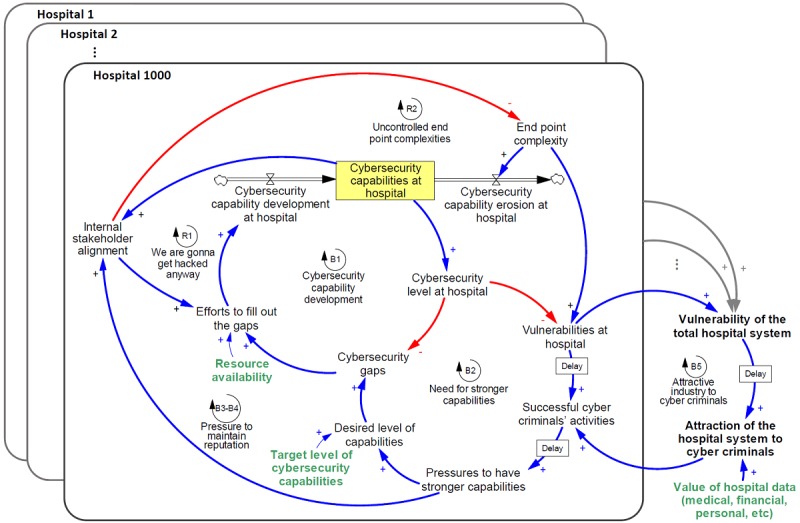
The purpose of this study was to develop a systematic and organizational perspective for studying (1) the dynamics of cybersecurity capability development at hospitals and (2) how these internal organizational dynamics interact to form a system of hospital cybersecurity in the United States.

METHODS

We conducted interviews with hospital chief information officers, chief information security officers, and health care cybersecurity experts; analyzed the interview data; and developed a system dynamics model that unravels the mechanisms by which hospitals build cybersecurity capabilities. We then use simulation analysis to examine how changes to variables within the model affect the likelihood of cyberattacks across both individual hospitals and a system of hospitals.

RESULTS

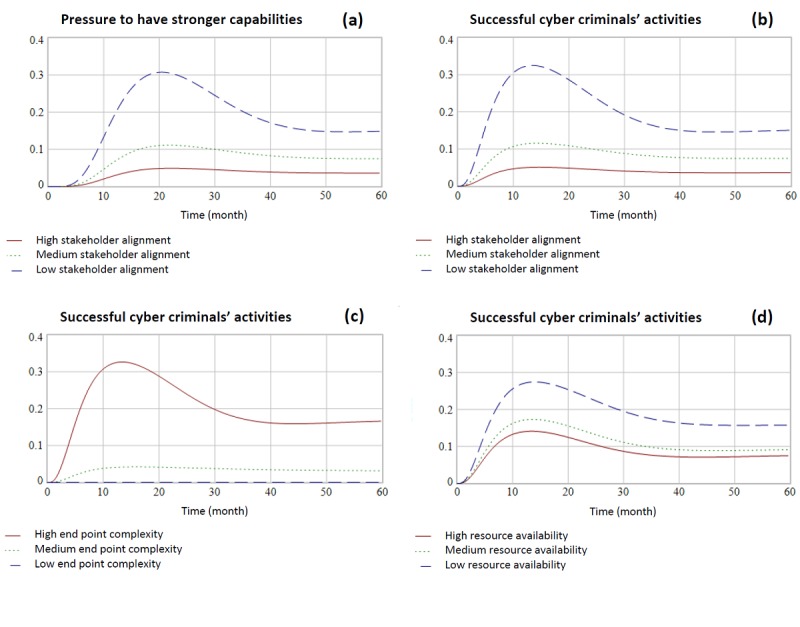
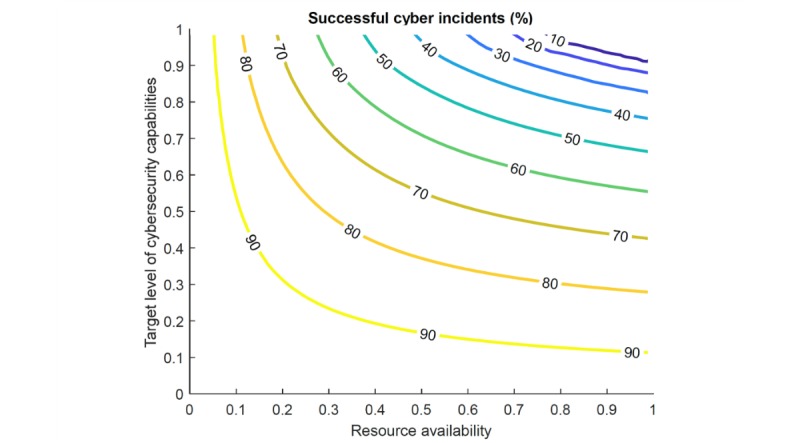
We discuss several key mechanisms that hospitals use to reduce the likelihood of cybercriminal activity. The variable that most influences the risk of cyberattack in a hospital is end point complexity, followed by internal stakeholder alignment. Although resource availability is important in fueling efforts to close cybersecurity capability gaps, low levels of resources could be compensated for by setting a high target level of cybersecurity.

CONCLUSIONS

To enhance cybersecurity capabilities at hospitals, the main focus of chief information officers and chief information security officers should be on reducing end point complexity and improving internal stakeholder alignment. These strategies can solve cybersecurity problems more effectively than blindly pursuing more resources. On a macro level, the cyber vulnerability of a country's hospital infrastructure is affected by the vulnerabilities of all individual hospitals. In this large system, reducing variation in resource availability makes the whole system less vulnerable-a few hospitals with low resources for cybersecurity threaten the entire infrastructure of health care. In other words, hospitals need to move forward together to make the industry less attractive to cybercriminals. Moreover, although compliance is essential, it does not equal security. Hospitals should set their target level of cybersecurity beyond the requirements of current regulations and policies. As of today, policies mostly address data privacy, not data security. Thus, policy makers need to introduce policies that not only raise the target level of cybersecurity capabilities but also reduce the variability in resource availability across the entire health care system.

摘要

背景

网络安全事件对整个医疗行业,尤其是医院构成了日益严重的威胁。在保护其主要利益相关者(即患者)方面,医疗行业落后于其他行业,现在医院必须投入大量资金和精力来保护其系统。然而,说起来容易做起来难,因为医院是技术高度饱和、极其复杂的组织,具有高端点复杂性、内部政治因素和监管压力。

目的

本研究的目的是从系统和组织的角度来研究:(1)医院网络安全能力发展的动态过程;(2)这些内部组织动态如何相互作用,从而在美国形成一个医院网络安全系统。

方法

我们采访了医院的首席信息官、首席信息安全官以及医疗网络安全专家;分析了访谈数据;并开发了一个系统动力学模型,以揭示医院建立网络安全能力的机制。然后,我们使用模拟分析来研究模型中的变量变化如何影响单个医院以及医院系统遭受网络攻击的可能性。

结果

我们讨论了医院用来降低网络犯罪活动可能性的几个关键机制。对医院网络攻击风险影响最大的变量是端点复杂性,其次是内部利益相关者的一致性。虽然资源可用性对于弥补网络安全能力差距的努力很重要,但通过设定较高的网络安全目标水平,可以弥补资源水平较低的问题。

结论

为了增强医院的网络安全能力,首席信息官和首席信息安全官的主要重点应放在降低端点复杂性和改善内部利益相关者的一致性上。与盲目追求更多资源相比,这些策略能更有效地解决网络安全问题。在宏观层面上,一个国家医院基础设施的网络脆弱性受到所有单个医院脆弱性的影响。在这个大系统中,减少资源可用性的差异会使整个系统更不易受攻击——一些网络安全资源匮乏的医院会威胁到整个医疗基础设施。换句话说,医院需要共同努力,使该行业对网络犯罪分子的吸引力降低。此外,虽然合规至关重要,但合规并不等同于安全。医院设定的网络安全目标水平应高于当前法规和政策的要求。截至目前,政策大多关注数据隐私,而非数据安全。因此,政策制定者需要出台不仅能提高网络安全能力目标水平,还能减少整个医疗系统资源可用性差异的政策。

https://cdn.ncbi.nlm.nih.gov/pmc/blobs/c911/5996174/0f57ee44cbef/jmir_v20i5e10059_fig8.jpg
https://cdn.ncbi.nlm.nih.gov/pmc/blobs/c911/5996174/0543fb59aeac/jmir_v20i5e10059_fig1.jpg
https://cdn.ncbi.nlm.nih.gov/pmc/blobs/c911/5996174/913f179c3a55/jmir_v20i5e10059_fig2.jpg
https://cdn.ncbi.nlm.nih.gov/pmc/blobs/c911/5996174/1d2436eb14fa/jmir_v20i5e10059_fig3.jpg
https://cdn.ncbi.nlm.nih.gov/pmc/blobs/c911/5996174/d9e52cf5d14d/jmir_v20i5e10059_fig4.jpg
https://cdn.ncbi.nlm.nih.gov/pmc/blobs/c911/5996174/56902e6745f1/jmir_v20i5e10059_fig5.jpg
https://cdn.ncbi.nlm.nih.gov/pmc/blobs/c911/5996174/d52b3aaea4fa/jmir_v20i5e10059_fig6.jpg
https://cdn.ncbi.nlm.nih.gov/pmc/blobs/c911/5996174/6d6491fa450f/jmir_v20i5e10059_fig7.jpg
https://cdn.ncbi.nlm.nih.gov/pmc/blobs/c911/5996174/0f57ee44cbef/jmir_v20i5e10059_fig8.jpg
https://cdn.ncbi.nlm.nih.gov/pmc/blobs/c911/5996174/0543fb59aeac/jmir_v20i5e10059_fig1.jpg
https://cdn.ncbi.nlm.nih.gov/pmc/blobs/c911/5996174/913f179c3a55/jmir_v20i5e10059_fig2.jpg
https://cdn.ncbi.nlm.nih.gov/pmc/blobs/c911/5996174/1d2436eb14fa/jmir_v20i5e10059_fig3.jpg
https://cdn.ncbi.nlm.nih.gov/pmc/blobs/c911/5996174/d9e52cf5d14d/jmir_v20i5e10059_fig4.jpg
https://cdn.ncbi.nlm.nih.gov/pmc/blobs/c911/5996174/56902e6745f1/jmir_v20i5e10059_fig5.jpg
https://cdn.ncbi.nlm.nih.gov/pmc/blobs/c911/5996174/d52b3aaea4fa/jmir_v20i5e10059_fig6.jpg
https://cdn.ncbi.nlm.nih.gov/pmc/blobs/c911/5996174/6d6491fa450f/jmir_v20i5e10059_fig7.jpg
https://cdn.ncbi.nlm.nih.gov/pmc/blobs/c911/5996174/0f57ee44cbef/jmir_v20i5e10059_fig8.jpg

相似文献

1
Cybersecurity in Hospitals: A Systematic, Organizational Perspective.医院中的网络安全:系统的组织视角
J Med Internet Res. 2018 May 28;20(5):e10059. doi: 10.2196/10059.
2
Influence of Human Factors on Cyber Security within Healthcare Organisations: A Systematic Review.人为因素对医疗机构网络安全的影响:系统综述。
Sensors (Basel). 2021 Jul 28;21(15):5119. doi: 10.3390/s21155119.
3
Maybe If We Turn It Off and Then Turn It Back On Again? Exploring Health Care Reform as a Means to Curb Cyber Attacks.也许我们可以关闭它,然后再重新打开它?探索医疗改革以遏制网络攻击。
J Law Med Ethics. 2019 Dec;47(4_suppl):91-102. doi: 10.1177/1073110519898046.
4
We need to aim at the top: Factors associated with cybersecurity awareness of cyber and information security decision-makers.我们需要瞄准高端:与网络和信息安全决策者的网络安全意识相关的因素。
PLoS One. 2024 Oct 18;19(10):e0312266. doi: 10.1371/journal.pone.0312266. eCollection 2024.
5
The future of Cochrane Neonatal.考克兰新生儿协作网的未来。
Early Hum Dev. 2020 Nov;150:105191. doi: 10.1016/j.earlhumdev.2020.105191. Epub 2020 Sep 12.
6
Vulnerability to Cyberattacks and Sociotechnical Solutions for Health Care Systems: Systematic Review.医疗保健系统易受网络攻击及相关社会技术解决方案:系统评价。
J Med Internet Res. 2024 May 31;26:e46904. doi: 10.2196/46904.
7
Hospital cybersecurity risks and gaps: Review (for the non-cyber professional).医院网络安全风险与差距:综述(面向非网络专业人员)
Front Digit Health. 2022 Aug 11;4:862221. doi: 10.3389/fdgth.2022.862221. eCollection 2022.
8
Information security and privacy in hospitals: a literature mapping and review of research gaps.医院的信息安全和隐私:文献研究和研究空白的综述。
Inform Health Soc Care. 2023 Jan 2;48(1):30-46. doi: 10.1080/17538157.2022.2049274. Epub 2022 Mar 17.
9
Economic Impact of a Hospital Cyberattack in a National Health System: Descriptive Case Study.国家卫生系统中医院网络攻击的经济影响:描述性案例研究
JMIR Form Res. 2023 Jun 30;7:e41738. doi: 10.2196/41738.
10
Assessing the impact of health information exchange on hospital data breach risk.评估健康信息交换对医院数据泄露风险的影响。
Int J Med Inform. 2023 Sep;177:105149. doi: 10.1016/j.ijmedinf.2023.105149. Epub 2023 Jul 8.

引用本文的文献

1
The impact of data breach on IT investment at neighboring hospitals: Evidence from California Hospitals.数据泄露对周边医院信息技术投资的影响:来自加利福尼亚州医院的证据。
Digit Health. 2025 Sep 4;11:20552076251375930. doi: 10.1177/20552076251375930. eCollection 2025 Jan-Dec.
2
Prompt injection attacks on vision-language models for surgical decision support.针对用于手术决策支持的视觉语言模型的提示注入攻击。
medRxiv. 2025 Jul 23:2025.07.16.25331645. doi: 10.1101/2025.07.16.25331645.
3
Digital health technologies/interventions in smart ward development for elderly patients with diabetes: A perspective from China and beyond.

本文引用的文献

1
Cybersecurity-A Serious Patient Care Concern.网络安全——患者护理的重大关切。
JAMA. 2017 Oct 10;318(14):1319-1320. doi: 10.1001/jama.2017.11986.
2
Dynamics of Implementation and Maintenance of Organizational Health Interventions.组织健康干预措施的实施与维持动态
Int J Environ Res Public Health. 2017 Aug 15;14(8):917. doi: 10.3390/ijerph14080917.
3
Indirect effect of management support on users' compliance behaviour towards information security policies.管理支持对用户遵守信息安全策略的间接影响。
数字健康技术/干预措施在老年糖尿病患者智能病房建设中的应用:来自中国及其他国家的视角
World J Diabetes. 2025 Apr 15;16(4):103002. doi: 10.4239/wjd.v16.i4.103002.
4
The Role of the Organization in Promoting Information Security-Related Behavior Among Resident Physicians in Hospitals in Germany: Cross-Sectional Questionnaire Study.组织在促进德国医院住院医师信息安全相关行为中的作用:横断面问卷调查研究
J Med Internet Res. 2025 Jan 7;27:e46257. doi: 10.2196/46257.
5
Strengthening a Weak Link: Transparency of Causal Loop Diagrams, Current State and Recommendation.强化薄弱环节:因果循环图的透明度、现状与建议
Syst Dyn Rev. 2023 Nov;40(4). doi: 10.1002/sdr.1753.
6
Progress Achieved, Landmarks, and Future Concerns in Biomedical and Health Informatics.生物医学与健康信息学的进展、里程碑及未来关注点
Healthcare (Basel). 2024 Oct 15;12(20):2041. doi: 10.3390/healthcare12202041.
7
Legal implications for clinicians in cybersecurity incidents: A review.临床医生在网络安全事件中的法律责任:综述。
Medicine (Baltimore). 2024 Sep 27;103(39):e39887. doi: 10.1097/MD.0000000000039887.
8
Do hospital data breaches affect health information technology investment?医院数据泄露会影响健康信息技术投资吗?
Digit Health. 2024 Jan 3;10:20552076231224164. doi: 10.1177/20552076231224164. eCollection 2024 Jan-Dec.
9
Vulnerability to Cyberattacks and Sociotechnical Solutions for Health Care Systems: Systematic Review.医疗保健系统易受网络攻击及相关社会技术解决方案:系统评价。
J Med Internet Res. 2024 May 31;26:e46904. doi: 10.2196/46904.
10
Revolutionizing Oncology: A Comprehensive Review of Digital Health Applications.肿瘤学的变革:数字健康应用的全面综述
Cureus. 2024 Apr 28;16(4):e59203. doi: 10.7759/cureus.59203. eCollection 2024 Apr.
Health Inf Manag. 2018 Jan;47(1):17-27. doi: 10.1177/1833358317700255. Epub 2017 Mar 30.
4
Cybersecurity in healthcare: A systematic review of modern threats and trends.医疗保健领域的网络安全:对现代威胁与趋势的系统综述
Technol Health Care. 2017;25(1):1-10. doi: 10.3233/THC-161263.
5
A Socio-Technical Approach to Preventing, Mitigating, and Recovering from Ransomware Attacks.一种预防、减轻和从勒索软件攻击中恢复的社会技术方法。
Appl Clin Inform. 2016 Jun 29;7(2):624-32. doi: 10.4338/ACI-2016-04-SOA-0064. eCollection 2016.
6
Information security risk management for computerized health information systems in hospitals: a case study of Iran.医院计算机化健康信息系统的信息安全风险管理:以伊朗为例
Risk Manag Healthc Policy. 2016 May 27;9:75-85. doi: 10.2147/RMHP.S99908. eCollection 2016.
7
37% of hospitals perform cybersecurity incident response exercises annually.
Trustee. 2015 Sep;68(8):44, 1.
8
Cybersecurity in health care.医疗保健领域的网络安全。
N Engl J Med. 2014 Jul 31;371(5):395-7. doi: 10.1056/NEJMp1404358.
9
Network security vulnerabilities and personal privacy issues in Healthcare Information Systems: a case study in a private hospital in Turkey.医疗信息系统中的网络安全漏洞与个人隐私问题:以土耳其一家私立医院为例
Stud Health Technol Inform. 2013;190:126-8.
10
Determining the right level for your IT security investment.
Healthc Financ Manage. 2013 May;67(5):100-3.