Malavi Derick Nyabera, Muzhingi Tawanda, Abong' George Ooko
Department of Food Science, Nutrition and Technology, University of Nairobi, P.O. Box 29053, Nairobi 00625, Kenya.
International Potato Centre (CIP), Sub-Saharan Africa (SSA) Regional Office, Old Naivasha Road, P.O. Box 25171, Nairobi 00603, Kenya.
Int J Food Sci. 2018 Apr 2;2018:4093161. doi: 10.1155/2018/4093161. eCollection 2018.
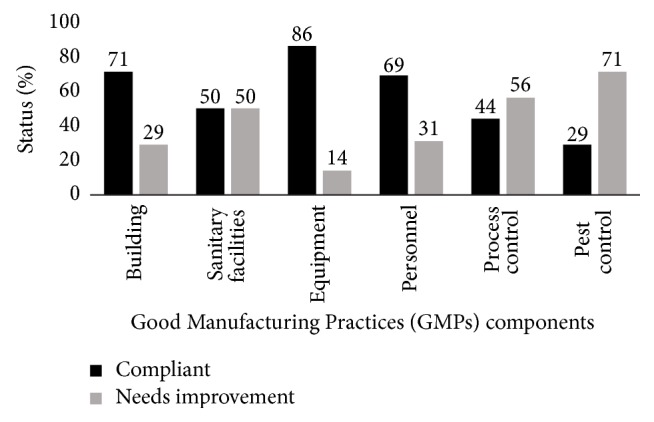
Limited information exists on the status of hygiene and probable sources of microbial contamination in Orange Fleshed Sweet Potato (OFSP) puree processing. The current study is aimed at determining the level of compliance to Good Manufacturing Practices (GMPs), hygiene, and microbial quality in OFSP puree processing plant in Kenya. Intensive observation and interviews using a structured GMPs checklist, environmental sampling, and microbial analysis by standard microbiological methods were used in data collection. The results indicated low level of compliance to GMPs with an overall compliance score of 58%. Microbial counts on food equipment surfaces, installations, and personnel hands and in packaged OFSP puree were above the recommended microbial safety and quality legal limits. Steaming significantly ( < 0.05) reduced microbial load in OFSP cooked roots but the counts significantly ( < 0.05) increased in the puree due to postprocessing contamination. Total counts, yeasts and molds, Enterobacteriaceae, total coliforms, and and counts in OFSP puree were 8.0, 4.0, 6.6, 5.8, 4.8, and 5.9 log cfu/g, respectively. In conclusion, equipment surfaces, personnel hands, and processing water were major sources of contamination in OFSP puree processing and handling. Plant hygiene inspection, environmental monitoring, and food safety trainings are recommended to improve hygiene, microbial quality, and safety of OFSP puree.
关于橙色肉甜薯(OFSP)泥加工过程中的卫生状况及微生物污染可能来源的信息有限。本研究旨在确定肯尼亚OFSP泥加工厂对良好生产规范(GMPs)、卫生和微生物质量的遵守程度。数据收集采用了使用结构化GMPs清单进行的深入观察和访谈、环境采样以及通过标准微生物方法进行的微生物分析。结果表明,对GMPs的遵守程度较低,总体遵守率为58%。食品设备表面、设施、人员手部以及包装好的OFSP泥中的微生物计数均高于推荐的微生物安全和质量法定限值。蒸煮显著(<0.05)降低了OFSP熟块根中的微生物负荷,但由于加工后污染,泥中的计数显著(<0.05)增加。OFSP泥中的总菌数、酵母菌和霉菌、肠杆菌科、总大肠菌群以及 和 计数分别为8.0、4.0、6.6、5.8、4.8和5.9 log cfu/g。总之,设备表面、人员手部和加工用水是OFSP泥加工和处理过程中的主要污染源。建议进行工厂卫生检查、环境监测和食品安全培训,以提高OFSP泥的卫生、微生物质量和安全性。