Department of Neurosurgery, Shanghai Tenth People's Hospital, Tongji University School of Medicine, Shanghai, 200072, People's Republic of China.
Department of Neurosurgery, Nanfang Hospital, Southern Medical University, Guangzhou, 510515, Guangdong Province, People's Republic of China.
J Hematol Oncol. 2018 May 29;11(1):70. doi: 10.1186/s13045-018-0618-0.
Chemoresistance to temozolomide (TMZ) is a major challenge in the treatment of glioblastoma (GBM). We previously found that miR-519a functions as a tumor suppressor in glioma by targeting the signal transducer and activator of transcription 3 (STAT3)-mediated autophagy oncogenic pathway. Here, we investigated the effects of miR-519a on TMZ chemosensitivity and autophagy in GBM cells. Furthermore, the underlying molecular mechanisms and signaling pathways were explored.
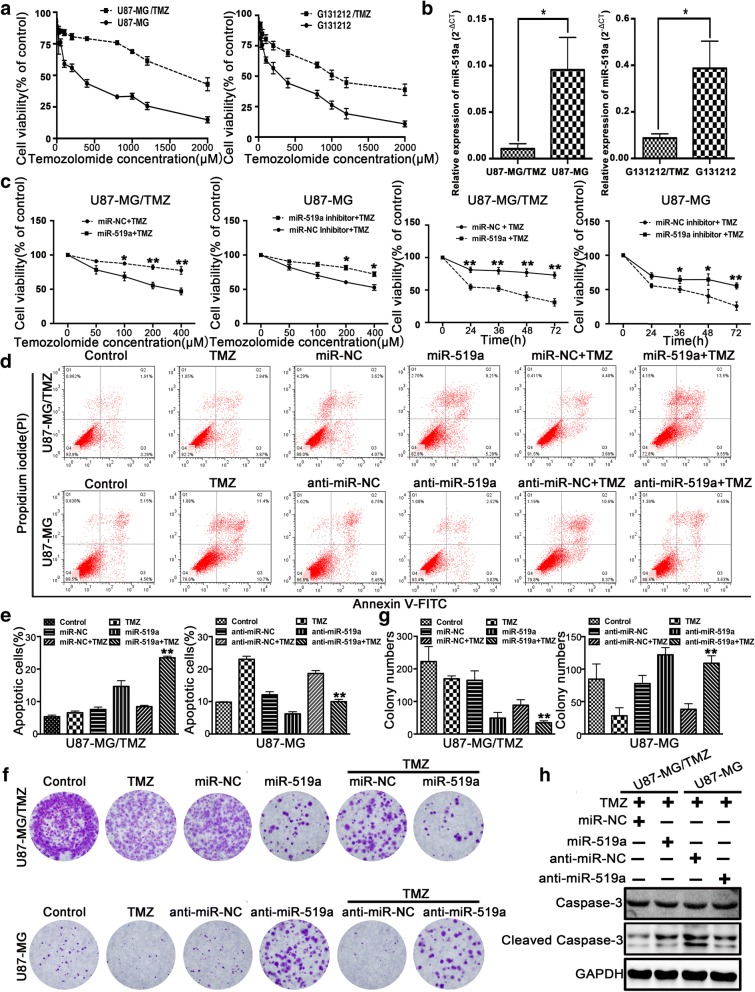
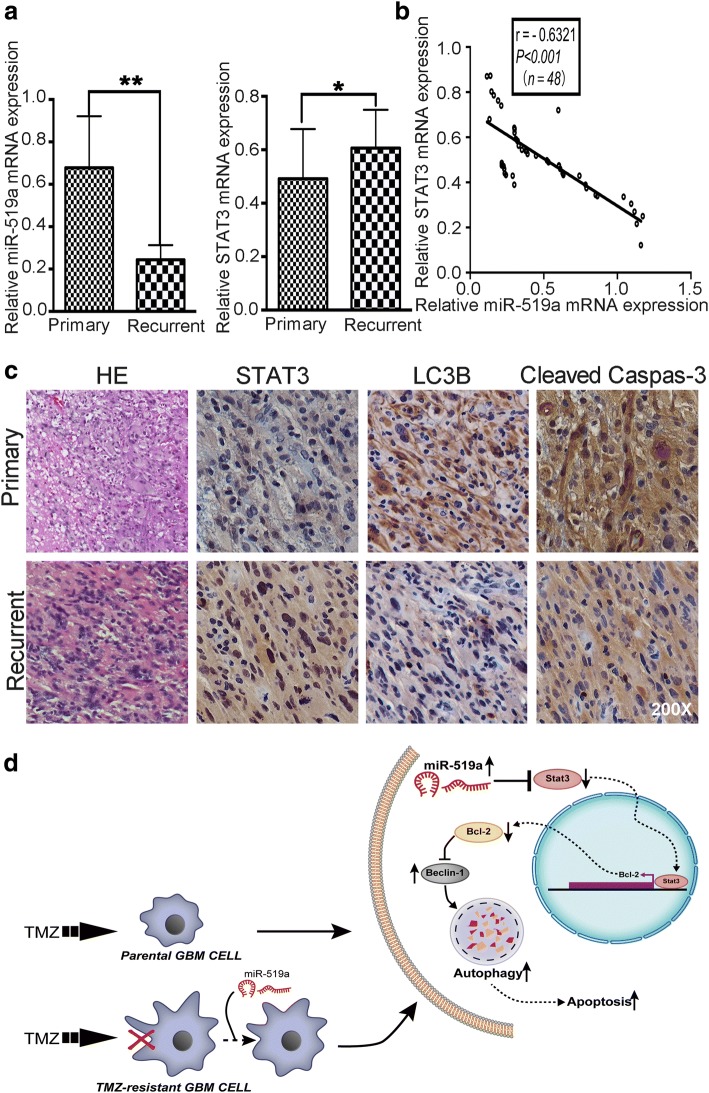
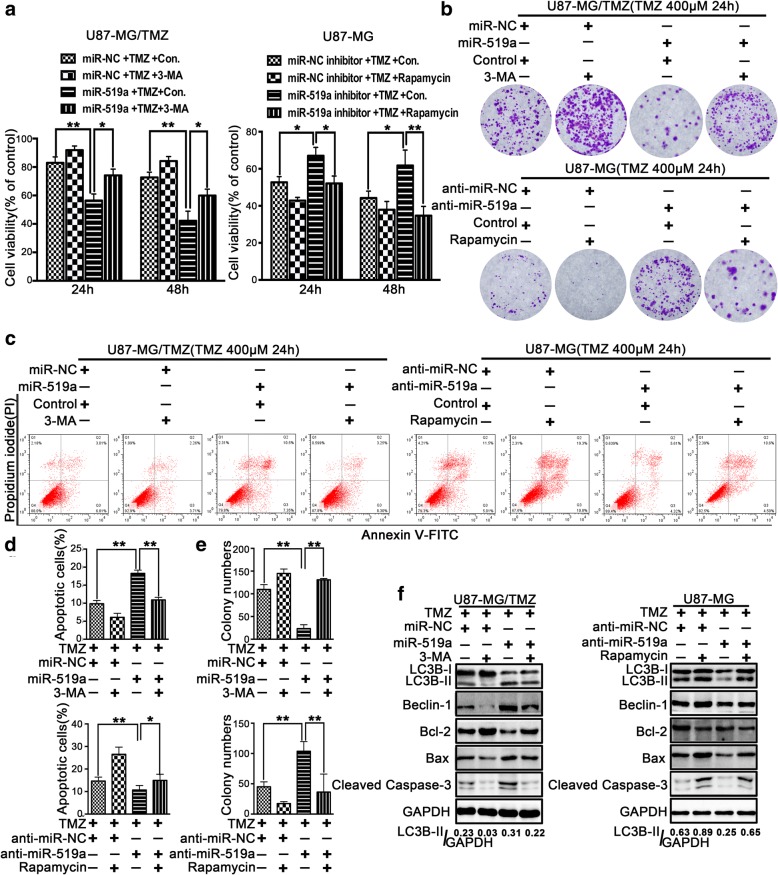
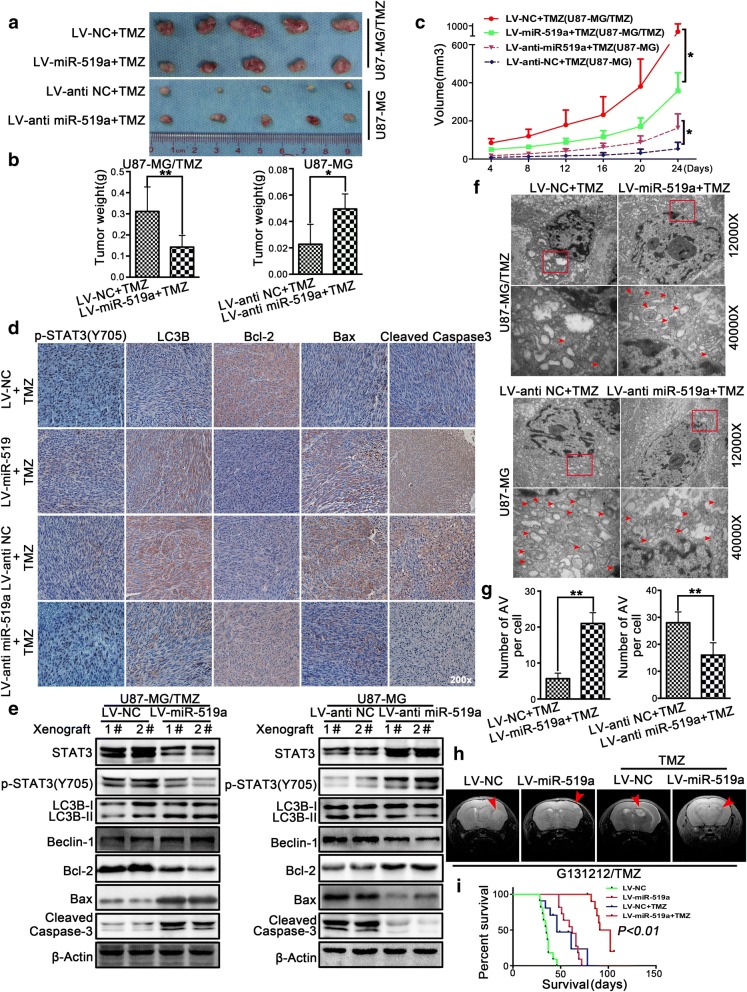
In the present study, two stable TMZ-resistant GBM cell lines were successfully generated by exposure of parental cells to a gradually increasing TMZ concentration. After transfecting U87-MG/TMZ and U87-MG cells with miR-519a mimic or inhibitor, a series of biochemical assays such as MTT, apoptosis, and colony formation were performed to determine the chemosensitive response to TMZ. The autophagy levels in GBM cells were detected by transmission electron microscopy, LC3B protein immunofluorescence, and Western blotting analysis. Stable knockdown and overexpression of miR-519a in GBM cells were established using lentivirus. A xenograft nude mouse model and in situ brain model were used to examine the in vivo effects of miR-519a. Tumor tissue samples were collected from 48 patients with GBM and were used to assess the relationship between miR-519a and STAT3 expression.
TMZ treatment significantly upregulated miR-519a in U87-MG cells but not in U87-MG/TMZ cells. Moreover, the expression of miR-519a and baseline autophagy levels was lower in U87-MG/TMZ cells as compared to U87-MG cells. miR-519a dramatically enhanced TMZ-induced autophagy and apoptotic cell death in U87-MG/TMZ cells, while inhibition of miR-519a promoted TMZ resistance and reduced TMZ-induced autophagy in U87-MG cells. Furthermore, miR-519a induced autophagy through modification of STAT3 expression. The in vivo results showed that miR-519a can enhance apoptosis and sensitized GBM to TMZ treatment by promoting autophagy and targeting the STAT3/Bcl-2/Beclin-1 pathway. In human GBM tissues, we found an inverse correlation between miR-519a and STAT3 expression.
Our results suggested that miR-519a increased the sensitivity of GBM cells to TMZ therapy. The positive effects of miR-519a may be mediated through autophagy. In addition, miR-519a overexpression can induce autophagy by inhibiting STAT3/Bcl-2 pathway. Therefore, a combination of miR-519a and TMZ may represent an effective therapeutic strategy in GBM.
替莫唑胺(TMZ)化疗耐药是胶质母细胞瘤(GBM)治疗的主要挑战。我们之前发现 miR-519a 通过靶向信号转导和转录激活因子 3(STAT3)介导的自噬致癌途径,作为胶质瘤中的肿瘤抑制因子发挥作用。在这里,我们研究了 miR-519a 对 GBM 细胞中 TMZ 化学敏感性和自噬的影响。此外,还探讨了潜在的分子机制和信号通路。
在本研究中,通过将亲本细胞暴露于逐渐增加的 TMZ 浓度,成功地产生了两种稳定的 TMZ 耐药 GBM 细胞系。用 miR-519a 模拟物或抑制剂转染 U87-MG/TMZ 和 U87-MG 细胞后,通过 MTT、凋亡和集落形成等一系列生化测定来确定 TMZ 的化学敏感性反应。通过透射电子显微镜、LC3B 蛋白免疫荧光和 Western blot 分析检测 GBM 细胞中的自噬水平。使用慢病毒建立 GBM 细胞中 miR-519a 的稳定敲低和过表达。使用异种移植裸鼠模型和原位脑模型来检测 miR-519a 的体内作用。从 48 名 GBM 患者中收集肿瘤组织样本,评估 miR-519a 与 STAT3 表达之间的关系。
TMZ 处理显著上调了 U87-MG 细胞中的 miR-519a,但对 U87-MG/TMZ 细胞没有上调。此外,与 U87-MG 细胞相比,U87-MG/TMZ 细胞中的 miR-519a 表达和基础自噬水平较低。miR-519a 可显著增强 U87-MG/TMZ 细胞中 TMZ 诱导的自噬和凋亡性细胞死亡,而抑制 miR-519a 则可促进 U87-MG 细胞中 TMZ 耐药并降低 TMZ 诱导的自噬。此外,miR-519a 通过修饰 STAT3 表达诱导自噬。体内研究结果表明,miR-519a 通过促进自噬并靶向 STAT3/Bcl-2/Beclin-1 通路增强 GBM 对 TMZ 治疗的敏感性,从而导致凋亡。在人 GBM 组织中,我们发现 miR-519a 和 STAT3 表达之间呈负相关。
我们的研究结果表明,miR-519a 提高了 GBM 细胞对 TMZ 治疗的敏感性。miR-519a 的积极作用可能通过自噬介导。此外,miR-519a 过表达可通过抑制 STAT3/Bcl-2 通路诱导自噬。因此,miR-519a 与 TMZ 的联合可能代表 GBM 的一种有效治疗策略。