Santos Jéssica Cavalcante Dos, Cruz Marina Sampaio, Bortolin Raul Hernandes, Oliveira Katiene Macêdo de, Araújo Jéssica Nayara Góes de, Duarte Victor Hugo Rezende, Silva Ananília Medeiros Gomes da, Santos Isabelle Cristina Clemente Dos, Dantas Juliana Marinho de Oliveira, Paiva Maria Sanali Moura de Oliveira, Rezende Adriana Augusto, Hirata Mario Hiroyuki, Hirata Rosario Dominguez Crespo, Luchessi André Ducati, Silbiger Vivian Nogueira
Departamento de Analises Clinicas e Toxicologicas, Universidade Federal do Rio Grande do Norte, Natal, RN, BR.
Departamento de Cardiologia, Hospital Universitario Onofre Lopes, Universidade Federal do Rio Grande do Norte, Natal, RN, BR.
Clinics (Sao Paulo). 2018;73:e203. doi: 10.6061/clinics/2018/e203. Epub 2018 May 28.
Inflammatory molecules play a role in the development of atherosclerosis, which is the primary origin of cardiovascular disorders. However, to the best of our knowledge, no study has attempted to investigate the relationship between these circulating molecules and the prediction of cardiovascular risk. The present study aimed to investigate the relationships of vascular cell adhesion molecule-1, intercellular adhesion molecule-1, E-selectin and matrix metalloproteinase 9 serum concentrations with the extent of coronary lesions.
Seventy-four individuals who were undergoing coronary angiography for the first time for diagnostic purposes were enrolled in this study. The extent of the coronary lesion was assessed using the Friesinger Index, and subjects were classified into four groups: no lesions, minor lesions, intermediate lesions and major lesions. Serum biochemical parameters and serum concentrations of vascular cell adhesion molecule-1, intercellular adhesion molecule-1, E-selectin and matrix metalloproteinase 9 were analyzed.
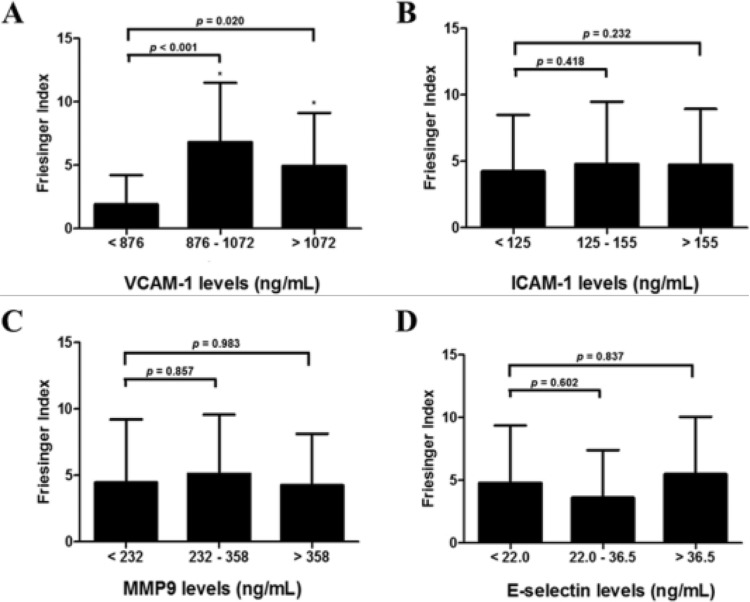
The vascular cell adhesion molecule-1 concentration was higher than 876 ng/mL in individuals with intermediate and major lesions (p<0.001 and p=0.020, respectively). Moreover, logistic regression analysis showed that these patients had an increased risk of having an intermediate lesion (p=0.007). Interestingly, all individuals with major lesions had vascular cell adhesion molecule-1 concentrations higher than 876 ng/mL. No association was found between the concentrations of the other proteins and the Friesinger Index.
Serum vascular cell adhesion molecule-1 may be associated with the extent of coronary lesions. Moreover, it may represent an alternative to improve the cardiovascular risk classification in patients without acute coronary syndrome.
炎症分子在动脉粥样硬化的发展过程中发挥作用,而动脉粥样硬化是心血管疾病的主要根源。然而,据我们所知,尚无研究试图探究这些循环分子与心血管风险预测之间的关系。本研究旨在探讨血管细胞黏附分子 -1、细胞间黏附分子 -1、E - 选择素和基质金属蛋白酶9的血清浓度与冠状动脉病变程度之间的关系。
本研究纳入了74名首次因诊断目的接受冠状动脉造影的个体。使用弗里辛格指数评估冠状动脉病变程度,受试者被分为四组:无病变、轻度病变、中度病变和重度病变。分析血清生化参数以及血管细胞黏附分子 -1、细胞间黏附分子 -1、E - 选择素和基质金属蛋白酶9的血清浓度。
中度和重度病变个体的血管细胞黏附分子 -1浓度高于876 ng/mL(分别为p<0.001和p = 0.020)。此外,逻辑回归分析表明,这些患者发生中度病变的风险增加(p = 0.007)。有趣的是,所有重度病变个体的血管细胞黏附分子 -1浓度均高于876 ng/mL。未发现其他蛋白质浓度与弗里辛格指数之间存在关联。
血清血管细胞黏附分子 -1可能与冠状动脉病变程度相关。此外,它可能是改善无急性冠状动脉综合征患者心血管风险分类的一种替代指标。