Duarte Mychelle Kytchia Rodrigues Nunes, de Araújo Jéssica Nayara Góes, Duarte Victor Hugo Rezende, de Oliveira Katiene Macêdo, de Oliveira Juliana Marinho, Carioca Antonio Augusto Ferreira, Bortolin Raul Hernandes, Rezende Adriana Augusto, Hirata Mario Hiroyuki, Hirata Rosário Domingues, Waitzberg Dan Linetzky, Lima Severina Carla Vieira Cunha, Luchessi André Ducati, Silbiger Vivian Nogueira
Postgraduate Program of Nutrition, Federal University of Rio Grande do Norte, Natal, Brazil.
Department of Clinical and Toxicological Analysis, Federal Universty of Rio Grande do Norte, Natal, Brazil. Avenue General Gustavo Cordeiro de Farias, S/N, Natal, Rio Grande do Norte, CEP: 59014-520, Brazil.
Lipids Health Dis. 2016 Sep 1;15(1):144. doi: 10.1186/s12944-016-0312-6.
The fatty acid profile is associated with the risk and progression of several diseases, probably via mechanisms including its influence on gene expression. We previously reported a correlation between ECHDC3 upregulation and the severity of acute coronary syndrome. Here, we assessed the relationship of serum fatty acid profile and ECHDC3 expression with the extent of coronary lesion.
Fifty-nine individuals aged 30 to 74 years and undergoing elective cinecoronariography for the first time were enrolled in the present study. The extent of coronary lesion was assessed by the Friesinger index and patients were classified as without lesion (n = 18), low lesion (n = 17), intermediate lesion (n = 17) and major lesion (n = 7). Serum biochemistry, fatty acid concentration, and ECHDC3 mRNA expression in blood were evaluated.
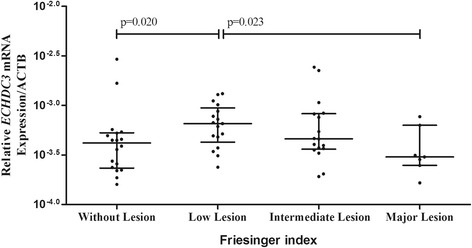
Elevated serum levels of oleic acid and total monounsaturated fatty acids were observed in patients with low and intermediate lesion, when compared to patients without lesion (p < 0.05). ECHDC3 mRNA expression was 1.2 fold higher in patients with low lesion than in patients without lesion (p = 0.020), and 1.8 fold lower in patients with major lesion patients than in patients with low lesion (p = 0.023).
Increased levels of monounsaturated fatty acids, especially oleic acid, and ECHDC3 upregulation in patients with coronary artery lesion suggests that these are independent factors associated with the initial progression of cardiovascular disease.
脂肪酸谱可能通过包括影响基因表达在内的机制,与多种疾病的风险和进展相关。我们之前报道过ECHDC3上调与急性冠状动脉综合征的严重程度之间存在关联。在此,我们评估了血清脂肪酸谱和ECHDC3表达与冠状动脉病变程度的关系。
本研究纳入了59名年龄在30至74岁之间且首次接受选择性冠状动脉造影的个体。通过弗里辛格指数评估冠状动脉病变程度,患者被分为无病变组(n = 18)、低病变组(n = 17)、中度病变组(n = 17)和重度病变组(n = 7)。评估血清生化指标、脂肪酸浓度以及血液中ECHDC3 mRNA表达。
与无病变患者相比,低病变和中度病变患者的血清油酸和总单不饱和脂肪酸水平升高(p < 0.05)。低病变患者的ECHDC3 mRNA表达比无病变患者高1.2倍(p = 0.020),重度病变患者的ECHDC3 mRNA表达比低病变患者低1.8倍(p = 0.023)。
冠状动脉病变患者中,单不饱和脂肪酸水平升高,尤其是油酸,以及ECHDC3上调,表明这些是与心血管疾病初始进展相关的独立因素。