Li Chia-Chin, Chen Chih-Yi, Chien Chun-Ru
Department of Radiation Oncology, China Medical University Hospital Division of Thoracic Surgery, Department of Surgery, Chung Shan Medical University, Chung Shan Medical University Hospital School of Medicine, College of Medicine, China Medical University, Taichung, Taiwan.
Medicine (Baltimore). 2018 Jun;97(22):e10928. doi: 10.1097/MD.0000000000010928.
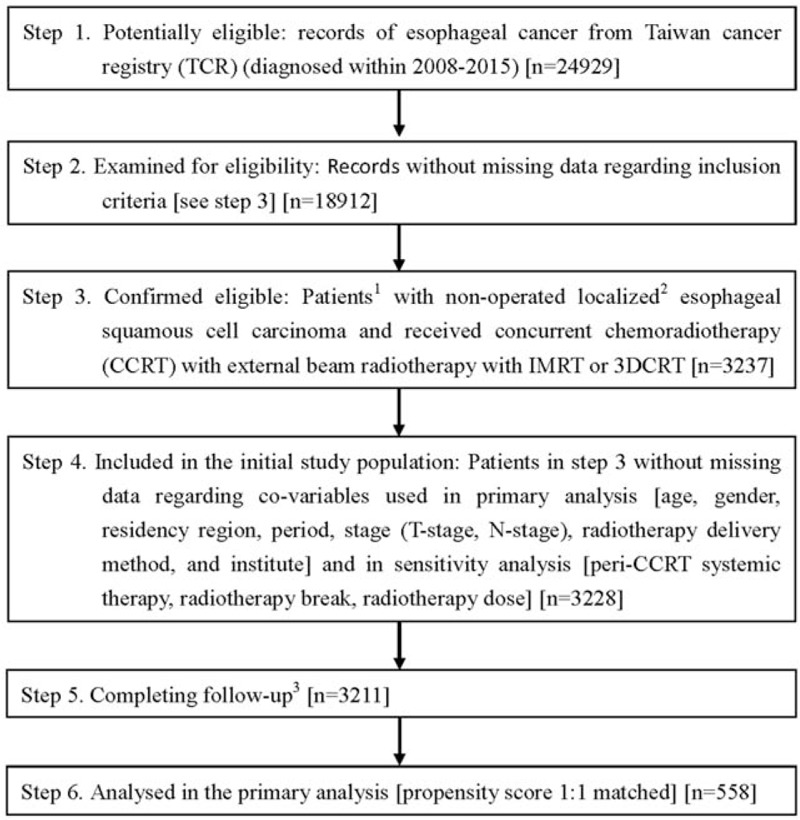
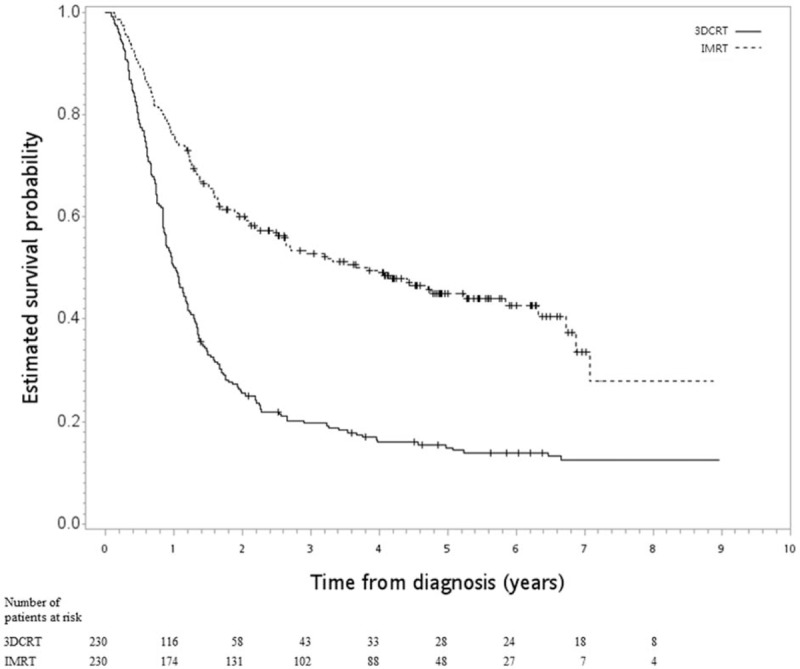
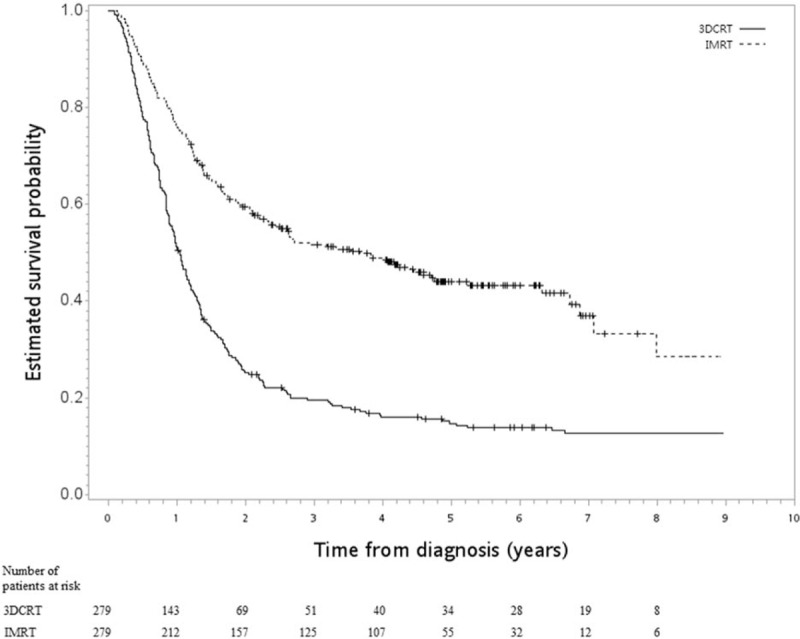
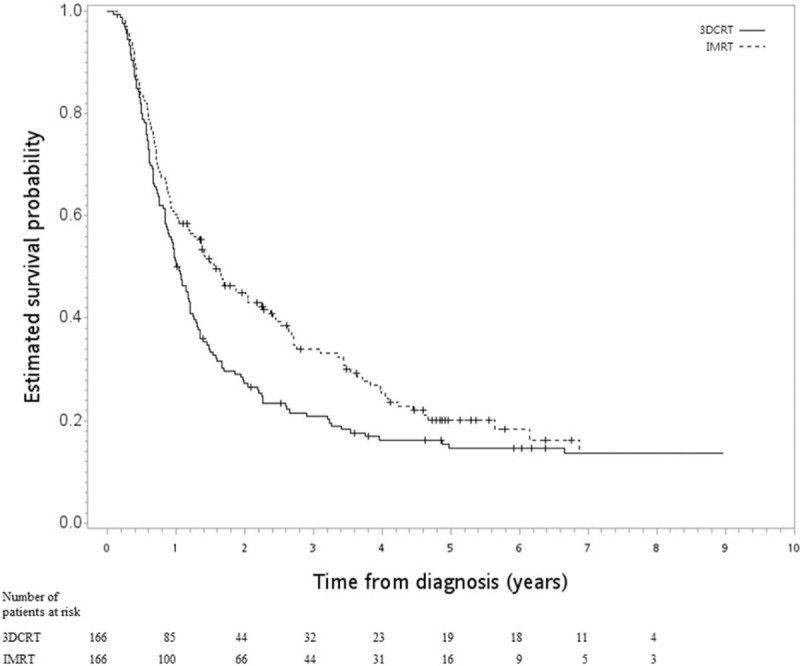
Whether the survival outcome of patients with non-metastatic esophageal squamous cell carcinoma (NM-ESCC) receiving definitive concurrent chemoradiotherapy (CCRT) is better with intensity-modulated radiotherapy (IMRT) or with 3-dimensional conformal radiotherapy (3DCRT) has been debated in the literature. We designed this population-based propensity-score (PS)-matched analysis to address this question. We identified eligible patients diagnosed between 2008 and 2015 from the Taiwan Cancer Registry and constructed a PS-matched cohort (1:1 for IMRT vs 3DCRT) to balance observable potential confounders. We compared the hazard ratio (HR) of death between IMRT and 3DCRT during the entire follow-up period. We also evaluated freedom from local regional recurrence (FFLRR) and esophageal cancer-specific survival (ECSS). Sensitivity analyses (SA) were performed to examine the robustness of our findings. Our study population constituted 558 patients who were well balanced with regard to the measured covariables. The HR of death with IMRT compared to 3DCRT was 0.43 (95% confidence interval 0.35-0.52, P < .001). The results remained significant for FFLRR and ECSS. In SA, our results remained significant when additional covariables were taken into consideration. The survival outcome of patients with NM-ESCC receiving CCRT might be better with IMRT vs 3DCRT. These study results should be interpreted with caution given some possible covariates lacking in the registry. Further studies are needed to clarify this issue.
对于接受根治性同步放化疗(CCRT)的非转移性食管鳞状细胞癌(NM-ESCC)患者,调强放疗(IMRT)或三维适形放疗(3DCRT)的生存结局哪个更好,这一问题在文献中一直存在争议。我们设计了这项基于人群的倾向评分(PS)匹配分析来解决这个问题。我们从台湾癌症登记处识别出2008年至2015年间确诊的符合条件的患者,并构建了一个PS匹配队列(IMRT与3DCRT为1:1)以平衡可观察到的潜在混杂因素。我们比较了IMRT和3DCRT在整个随访期间的死亡风险比(HR)。我们还评估了局部区域无复发生存率(FFLRR)和食管癌特异性生存率(ECSS)。进行了敏感性分析(SA)以检验我们研究结果的稳健性。我们的研究人群包括558名患者,他们在测量的协变量方面得到了很好的平衡。与3DCRT相比,IMRT的死亡HR为0.43(95%置信区间0.35-0.52,P<0.001)。FFLRR和ECSS的结果也具有显著性。在SA中,当考虑额外的协变量时,我们的结果仍然具有显著性。接受CCRT的NM-ESCC患者,IMRT的生存结局可能优于3DCRT。鉴于登记处可能缺乏一些协变量,这些研究结果应谨慎解释。需要进一步的研究来阐明这个问题。