Rabe Kaitlin G, Matsuse Hiroo, Jackson Anthony, Segal Neil A
Department of Rehabilitation Medicine, The University of Kansas, Kansas City, KS(∗).
Department of Orthopedics, Kurume University School of Medicine, Kurume, Fukuoka, Japan(†).
PM R. 2018 Dec;10(12):1301-1310. doi: 10.1016/j.pmrj.2018.05.014. Epub 2018 May 29.
Knee osteoarthritis (OA) is a leading cause of disability that is associated with quadriceps weakness. However, strengthening in people with or with risk factors for knee OA can be poorly tolerated.
To assess the efficacy of a 12-week low-load exercise program, using a hybrid training system (HTS) that uses the combination of neuromuscular electrical stimulation and volitional contractions, for improving thigh muscle strength, knee pain relief, and physical performance in women with or with risk factors for knee OA.
Randomized, single-blinded, controlled trial.
Exercise training laboratory.
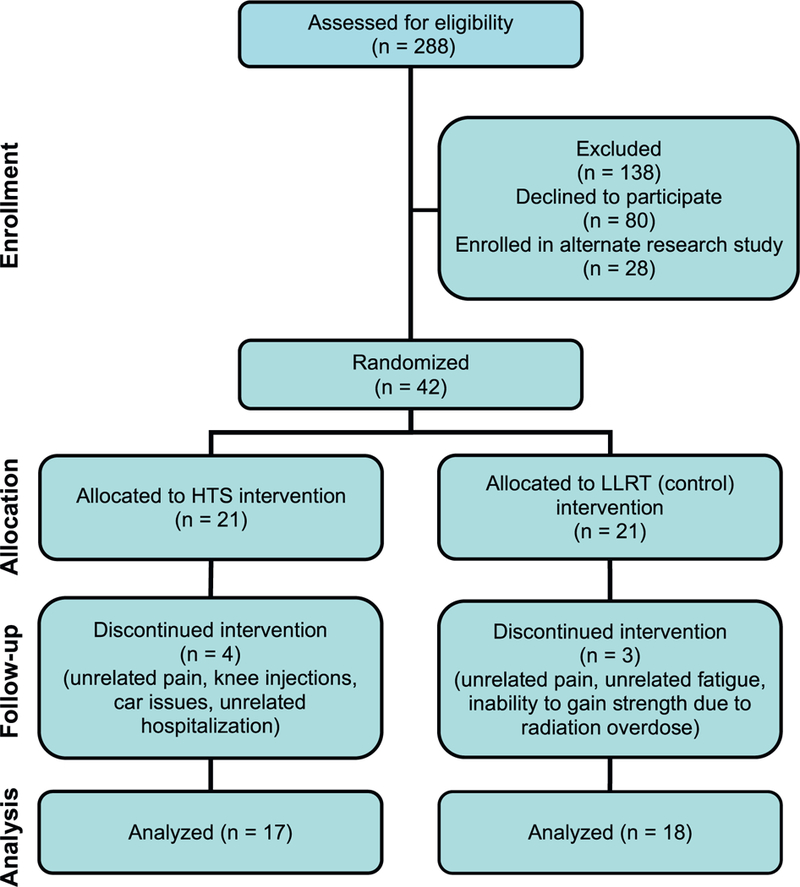
Forty-two women 44-85 years old with risk factors for knee OA.
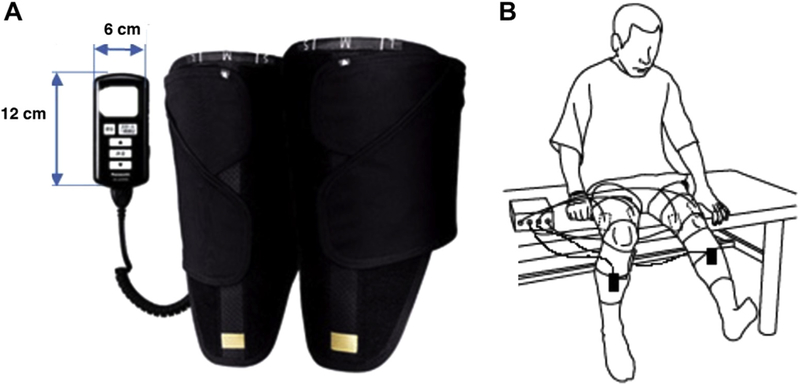
Participants randomized to 12 weeks of biweekly low-load resistance training with the HTS or on an isokinetic dynamometer (control).
Maximum isokinetic knee extensor torque. Secondary measures included maximum isokinetic knee flexor torque, knee pain (Knee Injury and Osteoarthritis Outcome Score), and timed 20-m walk and chair stand tests.
The HTS and control treatments resulted in muscle strengthening, decreased knee pain, and improved physical performance. HTS group quadriceps and hamstring strength increased by 0.06 ± 0.04 Nm/kg (P > .05) and 0.05 ± 0.02 Nm/kg (P = .02), respectively. Control group quadriceps and hamstring strength increased by 0.03 ± 0.04 Nm/kg (P > .05) and 0.06 ± 0.02 Nm/kg (P = .009), respectively. Knee pain decreased by 11.9 ± 11.5 points (P < .001) for the HTS group and 14.1 ± 15.4 points (P = .001) for the control group. The 20-m walk time decreased by 1.60 ± 2.04 seconds (P = .005) and 0.95 ± 1.2 seconds (P = .004), and chair stand time decreased by 4.8 ± 10.0 seconds (P > .05) and 1.9 ± 4.7 seconds (P > .05) in the HTS and control groups, respectively. These results did not differ statistically between the HTS and control groups.
These results suggest the HTS is effective for alleviating pain and improving physical performance in women with risk factors for knee OA. However, the HTS does not appear to be superior to low-load resistance training for improving muscle strength, pain relief, or physical function.
NCT02802878.
I.
膝关节骨关节炎(OA)是导致残疾的主要原因,与股四头肌无力有关。然而,膝关节OA患者或有膝关节OA风险因素的人进行强化训练时耐受性可能较差。
评估为期12周的低负荷运动计划的效果,该计划使用一种混合训练系统(HTS),即结合神经肌肉电刺激和自主收缩,以改善有膝关节OA风险因素或已患膝关节OA的女性的大腿肌肉力量、缓解膝关节疼痛和提高身体机能。
随机、单盲、对照试验。
运动训练实验室。
42名年龄在44 - 85岁之间、有膝关节OA风险因素的女性。
参与者被随机分配,接受为期12周的每两周一次的低负荷阻力训练,一组使用HTS,另一组使用等速测力计(对照组)。
最大等速膝关节伸展扭矩。次要测量指标包括最大等速膝关节屈曲扭矩、膝关节疼痛(膝关节损伤和骨关节炎结果评分)以及20米定时步行和从椅子上站起测试。
HTS组和对照组治疗均导致肌肉力量增强、膝关节疼痛减轻和身体机能改善。HTS组股四头肌和腘绳肌力量分别增加了0.06±0.04 Nm/kg(P>.05)和0.05±0.02 Nm/kg(P =.02)。对照组股四头肌和腘绳肌力量分别增加了0.03±0.04 Nm/kg(P>.05)和0.06±0.02 Nm/kg(P =.009)。HTS组膝关节疼痛减轻了11.9±11.5分(P<.001),对照组减轻了14.1±15.4分(P =.001)。HTS组20米步行时间减少了1.60±2.04秒(P =.005),对照组减少了0.95±1.2秒(P =.004);HTS组从椅子上站起时间减少了4.8±10.0秒(P>.05),对照组减少了1.9±4.7秒(P>.05)。HTS组和对照组之间这些结果在统计学上无差异。
这些结果表明,HTS对缓解有膝关节OA风险因素的女性的疼痛和改善身体机能有效。然而,在改善肌肉力量、缓解疼痛或身体功能方面,HTS似乎并不优于低负荷阻力训练。
NCT02802878。
I级。