Merck Center for Catalysis at Princeton University, Princeton, NJ 08544, USA.
Science. 2018 Jun 1;360(6392):1010-1014. doi: 10.1126/science.aat4133.
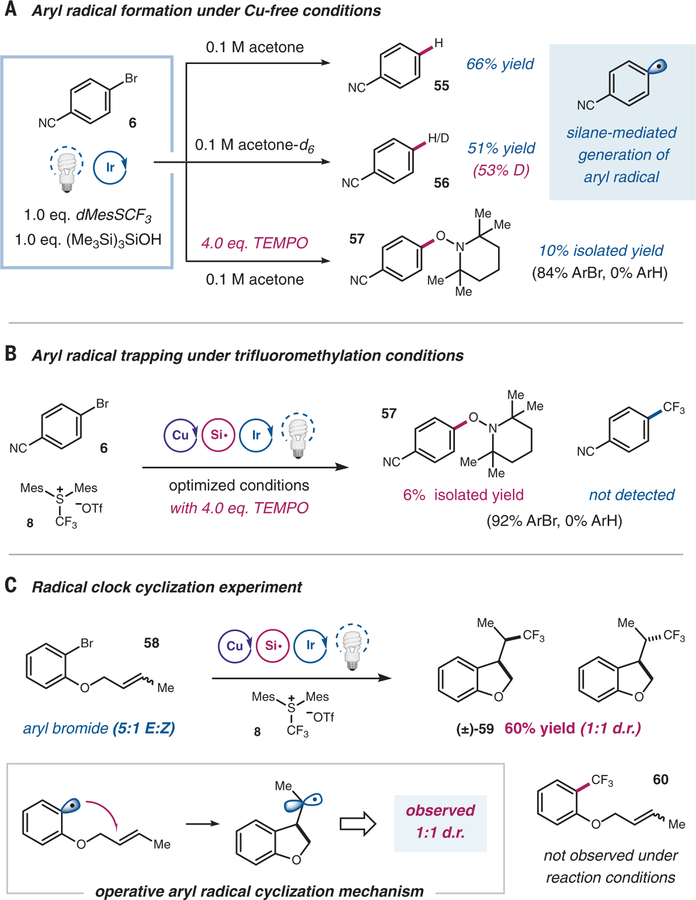
Transition metal-catalyzed arene functionalization has been widely used for molecular synthesis over the past century. In this arena, copper catalysis has long been considered a privileged platform due to the propensity of high-valent copper to undergo reductive elimination with a wide variety of coupling fragments. However, the sluggish nature of oxidative addition has limited copper's capacity to broadly facilitate haloarene coupling protocols. Here, we demonstrate that this copper oxidative addition problem can be overcome with an aryl radical-capture mechanism, wherein the aryl radical is generated through a silyl radical halogen abstraction. This strategy was applied to a general trifluoromethylation of aryl bromides through dual copper-photoredox catalysis. Mechanistic studies support the formation of an open-shell aryl species.
过渡金属催化的芳环功能化在过去一个世纪的分子合成中得到了广泛应用。在这个领域中,由于高价态铜易于与各种偶联片段发生还原消除反应,铜催化长期以来被认为是一种特权平台。然而,氧化加成的缓慢性质限制了铜广泛促进卤代芳烃偶联反应的能力。在这里,我们证明了通过芳基自由基捕获机制可以克服这个铜氧化加成问题,其中芳基自由基是通过硅自由基卤原子夺取产生的。该策略通过双铜光氧化还原催化被应用于芳基溴化物的普遍三氟甲基化反应中。机理研究支持形成开壳层芳基物种。