Departamento de Bioquímica-Alimentos, Facultad de Ciencias Químicas, Edificio 5FCQ-202D, Benemérita Universidad Autónoma de Puebla, Ciudad Universitaria, 72570 Puebla, PUE, Mexico.
Departamento de Análisis Clínicos, Facultad de Ciencias Químicas, Benemérita Universidad Autónoma de Puebla, Puebla, PUE, Mexico.
Oxid Med Cell Longev. 2018 May 2;2018:1390483. doi: 10.1155/2018/1390483. eCollection 2018.
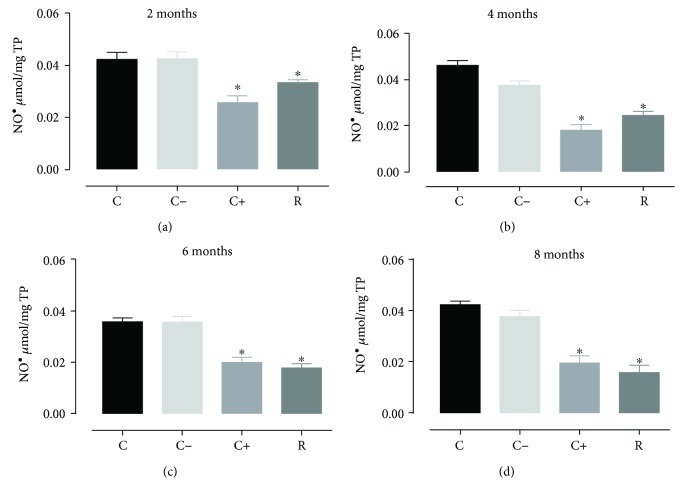
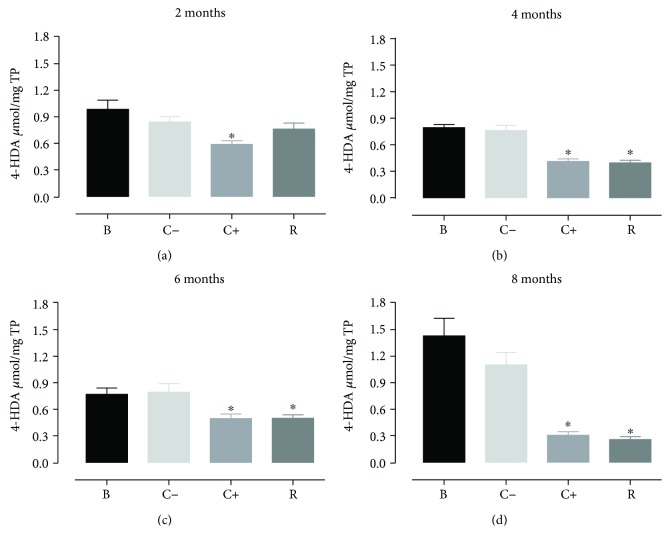
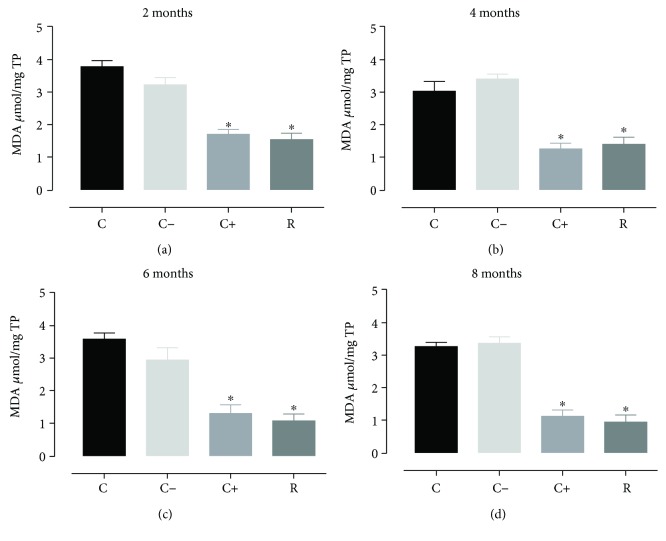
The substantial increase in the number of elderly people in our societies represents a challenge for biology and medicine. The societies of the industrialized countries are subject to a progressive aging process that translates into an increase in the cardiovascular risk of the population. In the present work, the activity of catalase and superoxide dismutase was evaluated, as well as markers of oxidative stress (concentration of nitric oxide and total lipoperoxidation in its main components: malondialdehyde and 4-hydroxyalkene) in cardiomyocytes during the aging process in rats treated with resveratrol. Rats were divided into 4 groups according to the following categories: control (without treatment), negative control group (administered with physiological solution with 10% ethanol), positive control group (administered with vitamin E, 2 mg/kg/day), and group administered with resveratrol (10 mg/kg/day); these groups in turn were divided into 2, 4, 6, and 8 months of treatment. The analysis of nitric oxide showed a decreased level in the cardiac tissue in the groups treated with resveratrol; the same occurs when total lipoperoxidation is analyzed. The enzymatic activity studied (catalase and superoxide dismutase) did not present significant changes with respect to the controls. It is concluded that the cardioprotective effect of resveratrol is due to the antioxidant effect and other antiaging effects and not to the activation of the enzymes catalase and superoxide dismutase.
人口老龄化的数量在我们的社会中大幅增加,这对生物学和医学提出了挑战。工业化国家的社会正经历一个渐进的老龄化过程,这转化为人口心血管风险的增加。在目前的工作中,评估了在给予白藜芦醇的大鼠衰老过程中心肌细胞中过氧化氢酶和超氧化物歧化酶的活性以及氧化应激标志物(一氧化氮浓度和其主要成分的总脂质过氧化:丙二醛和 4-羟烯)。根据以下类别将大鼠分为 4 组:对照组(无治疗)、阴性对照组(给予含 10%乙醇的生理盐水)、阳性对照组(给予维生素 E,2mg/kg/天)和给予白藜芦醇的组(10mg/kg/天);这些组又分为 2、4、6 和 8 个月的治疗期。分析一氧化氮表明,给予白藜芦醇的组中心肌组织中的水平降低;当分析总脂质过氧化时,也会发生同样的情况。研究的酶活性(过氧化氢酶和超氧化物歧化酶)与对照组相比没有显著变化。结论是,白藜芦醇的心脏保护作用归因于抗氧化作用和其他抗衰老作用,而不是过氧化氢酶和超氧化物歧化酶的激活。