Center for Learning and Memory, The University of Texas at Austin, Austin, TX 78712, USA.
Department of Neuroscience, The University of Texas at Austin, Austin, TX 78712, USA.
Sci Adv. 2018 May 30;4(5):eaap9660. doi: 10.1126/sciadv.aap9660. eCollection 2018 May.
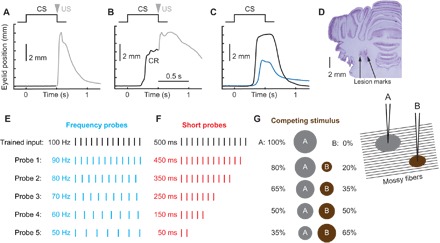
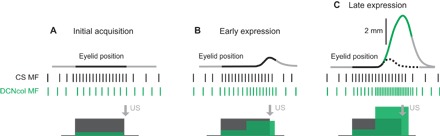
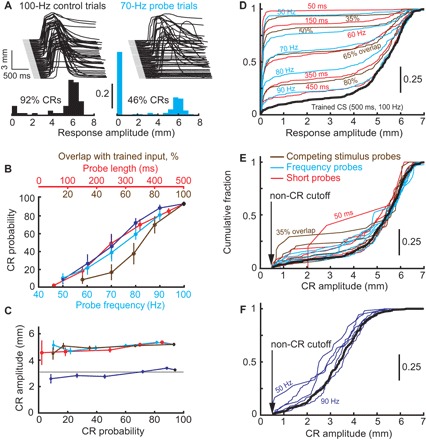
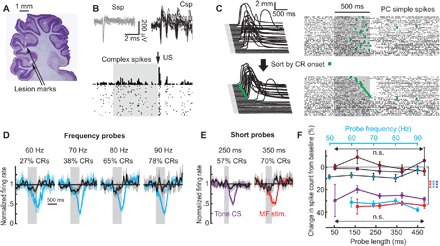
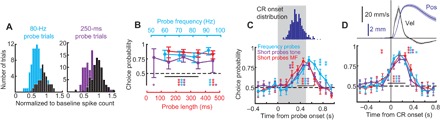
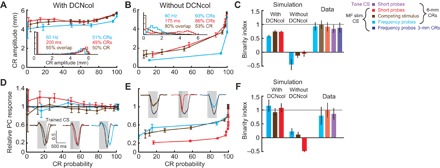
Noise and variability are inherent and unavoidable features of neural processing. Despite this physiological challenge, brain systems function well, suggesting the existence of adaptations that cope with noise. We report a novel adaptation that the cerebellum implements to maintain correct responses in the face of ambiguous inputs. We found that under these conditions, the cerebellum used a probabilistic binary choice: Although the probability of behavioral response gradually increased or decreased depending on the degree of similarity between current and trained inputs, the size of response remained constant. That way the cerebellum kept responses adaptive to trained input corrupted by noise while minimizing false responses to novel stimuli. Recordings and analysis of Purkinje cells activity showed that the binary choice is made in the cerebellar cortex. Results from large-scale simulation suggest that internal feedback from cerebellar nucleus back to cerebellar cortex plays a critical role in implementation of binary choice.
噪声和可变性是神经处理固有的、不可避免的特征。尽管存在这种生理挑战,大脑系统仍能很好地发挥作用,这表明存在适应噪声的机制。我们报告了一种新的适应机制,小脑通过这种机制在面对模棱两可的输入时保持正确的反应。我们发现,在这些条件下,小脑采用了一种概率二进制选择:尽管行为反应的概率根据当前输入与训练输入之间的相似程度逐渐增加或减少,但反应的大小保持不变。这样,小脑就能使对受噪声污染的训练输入的反应保持适应性,同时最小化对新刺激的错误反应。浦肯野细胞活动的记录和分析表明,这种二进制选择是在小脑皮层中做出的。大规模模拟的结果表明,小脑核向小脑皮层的内部反馈在二进制选择的实施中起着关键作用。