Seok Hung Youl, Kim Yoo Hwan, Kim Hayom, Kim Byung Jo
Department of Neurology, Korea University Medical Center, Korea University College of Medicine, Seoul, Korea.
Department of Neurology, Keimyung University School of Medicine, Daegu, Korea.
J Clin Neurol. 2018 Jul;14(3):283-290. doi: 10.3988/jcn.2018.14.3.283. Epub 2018 Apr 27.
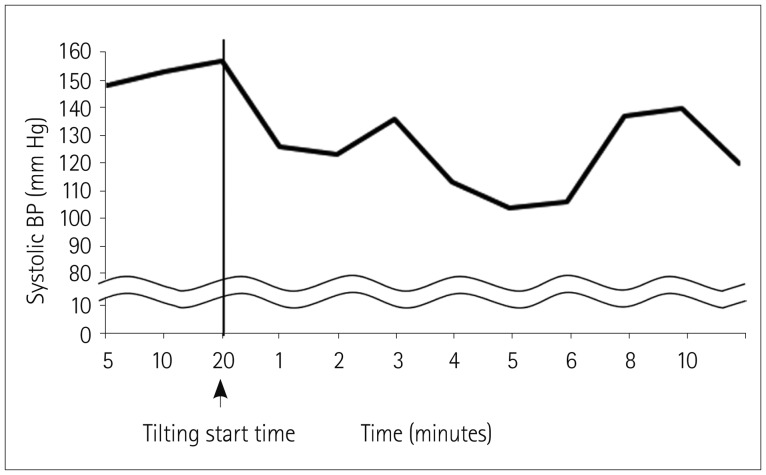
The objective of this study was to determine the patterns of blood pressure (BP) changes during the head-up tilt (HUT) test, particularly in terms of its clinical significance for patients with orthostatic hypotension (OH).
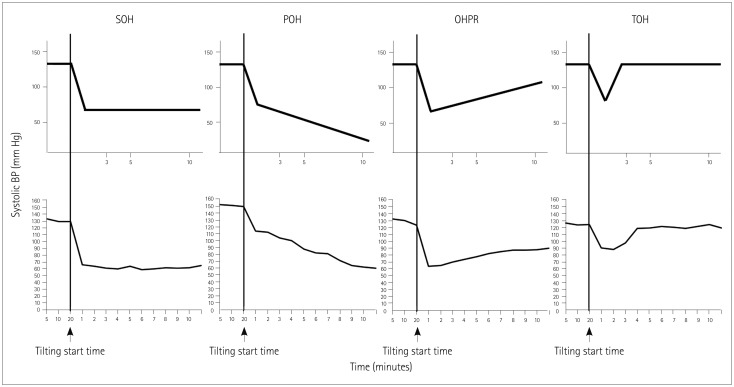
OH was divided into four categories based on systolic BP changes occurring within the first 10 minutes of the HUT test: sustained orthostatic hypotension (SOH), progressive orthostatic hypotension (POH), orthostatic hypotension with partial recovery (OHPR), and transient orthostatic hypotension (TOH).
In total, 151 patients were analyzed: 65 with SOH, 38 with POH, 21 with OHPR, and 27 with TOH. POH patients exhibited the greatest reduction in systolic BP after HUT and were also the most likely to develop symptoms requiring early termination of the HUT test (42.1%, p<0.001). Additionally, SOH patients exhibited smaller heart-rate variation with deep breathing values (p=0.003) and Valsalva ratios (p=0.022) compared to POH patients. The sweat volume was greatest in OHPR patients.
Clinical characteristics, including the findings of autonomic function tests, differed between the OH patient groups. This might reflect differences in the underlying pathophysiologic mechanisms. Determining the patterns of BP changes during the HUT test may facilitate the development of effective management strategies in patients with OH.
本研究的目的是确定头高位倾斜试验(HUT)期间血压(BP)变化的模式,尤其是其对体位性低血压(OH)患者的临床意义。
根据HUT试验前10分钟内收缩压的变化,将OH分为四类:持续性体位性低血压(SOH)、进行性体位性低血压(POH)、部分恢复性体位性低血压(OHPR)和短暂性体位性低血压(TOH)。
总共分析了151例患者:65例SOH患者、38例POH患者、21例OHPR患者和27例TOH患者。POH患者在HUT后收缩压下降幅度最大,也是最有可能出现需要提前终止HUT试验的症状的患者(42.1%,p<0.001)。此外,与POH患者相比,SOH患者深呼吸值(p=0.003)和瓦尔萨尔瓦比率(p=0.022)的心率变异性较小。OHPR患者的出汗量最大。
OH患者组之间的临床特征,包括自主神经功能测试结果,存在差异。这可能反映了潜在病理生理机制的差异。确定HUT试验期间BP变化的模式可能有助于制定OH患者的有效管理策略。