Department of Surgery, Universidad de la Sabana, Chía, Colombia.
Department of Surgery, Maastricht University Medical Center (MUMC+), Maastricht, the Netherlands.
PLoS One. 2018 Jun 1;13(6):e0197276. doi: 10.1371/journal.pone.0197276. eCollection 2018.
The intention to leave surgical training, hereinafter referred as proxy of "attrition," is associated with poor well-being in the workplace. Attrition is suggested to diminish when residents possess job-crafting skills, that is, the ability to redefine their job in meaningful ways and maximize well-being at work by increasing structural and social resources and challenges and decreasing hindering demands. However, the evidence supporting this relationship is scant. This study sought to: 1) investigate to what extent residents possess job-crafting skills and compare residents' levels of job-crafting skills across years of residency training; 2) investigate the relationship between job crafting, well-being as measured by burnout and work-engagement rates, and the intention to leave; and 3) compare the levels of job-crafting skills and well-being between residents with and without serious intentions to leave.
This cross sectional study was conducted in fifteen residency programs in Colombia. Surgical residents completed different questionnaires including the Dutch Job Crafting Scale (DJCS), MBI-Human Services Survey (MBI-HSS), Utrecht Work Engagement Scale (UWES-17) and an adapted version of the Nurse Turnover Intention Scale (NTIS). The objectives were addressed by independent analyses of variance (ANOVA), structural equation modeling techniques (SEM) and independent t-tests, respectively.
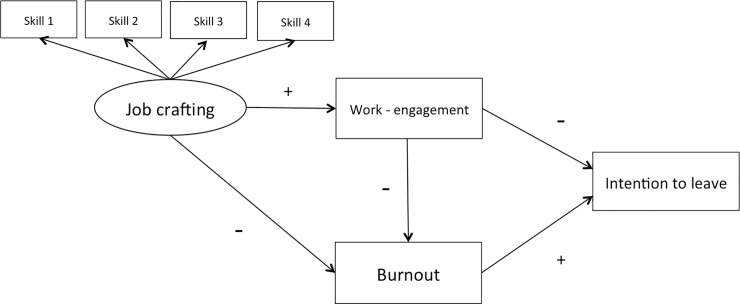
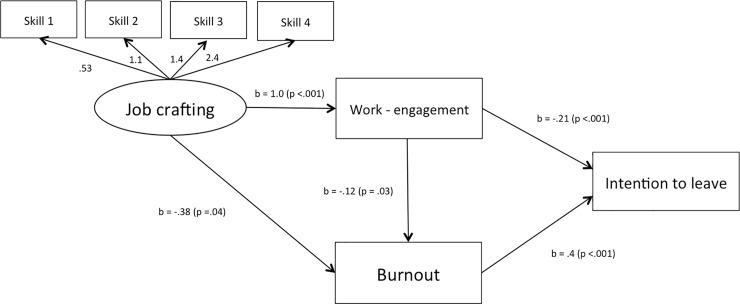
A total of 202 residents participated. Residents generally scored high on their job-crafting skills to increase structural and social resources as well as challenging demands, but were less positive about their skills to reduce hindering demands. No differences across years of training were found. Job crafting correlated positively with work-engagement, which was inversely related to the intention to leave. Conversely, job crafting correlated negatively with burnout, which bore a positive relationship to the intention to leave. Residents with serious intentions to leave exhibited lower levels of most job-crafting skills and work-engagement, compared to those without such intentions.
This study adds evidence that attrition is a process mediated by residents' well being at work, which can be molded by their job-crafting endeavors. Future research is needed to evaluate the effectiveness of interventions aimed at cultivating resident's job-crafting abilities in order to reduce attrition.
离开外科培训的意愿,以下简称“流失”,与工作场所的幸福感差有关。当住院医师具备工作塑造技能时,流失现象被认为会减少,即通过增加结构和社会资源以及挑战,减少阻碍需求,以有意义的方式重新定义工作,并最大限度地提高工作幸福感的能力。然而,支持这种关系的证据很少。本研究旨在:1)调查住院医师掌握工作塑造技能的程度,并比较住院医师在住院医师培训年限内的工作塑造技能水平;2)调查工作塑造与倦怠和工作投入率衡量的幸福感之间的关系,以及离职意愿;3)比较有严重离职意愿和无严重离职意愿的住院医师的工作塑造技能和幸福感水平。
本横断面研究在哥伦比亚的 15 个住院医师培训项目中进行。外科住院医师完成了不同的问卷,包括荷兰工作塑造量表(DJCS)、MBI-人力资源服务调查(MBI-HSS)、乌得勒支工作投入量表(UWES-17)和护士离职意向量表(NTIS)的改编版。分别通过独立方差分析(ANOVA)、结构方程模型技术(SEM)和独立 t 检验来解决这些目标。
共有 202 名住院医师参加。住院医师通常在增加结构和社会资源以及挑战性需求方面的工作塑造技能方面得分较高,但在减少阻碍需求方面的技能得分较低。在培训年限方面没有差异。工作塑造与工作投入呈正相关,而工作投入与离职意愿呈负相关。相反,工作塑造与倦怠呈负相关,而倦怠与离职意愿呈正相关。与没有此类意向的住院医师相比,有严重离职意向的住院医师表现出较低水平的大多数工作塑造技能和工作投入。
这项研究提供了证据表明,离职是一个由住院医师工作幸福感介导的过程,而工作幸福感可以通过他们的工作塑造努力来塑造。未来的研究需要评估旨在培养住院医师工作塑造能力的干预措施的有效性,以减少离职。