Institute of Psychology, University of Silesia, Katowice, Poland.
Faculty of Law, Uppsala University, Uppsala, Sweden.
PLoS One. 2018 Jun 1;13(6):e0198211. doi: 10.1371/journal.pone.0198211. eCollection 2018.
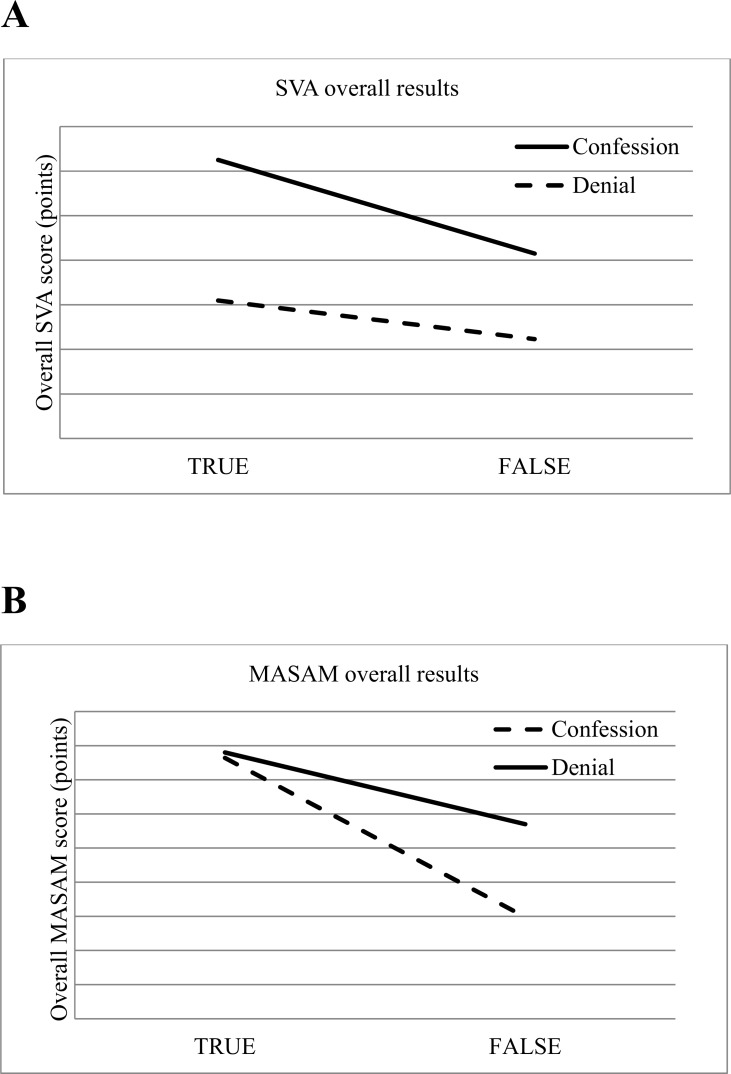
Previous research on statement analysis has mainly concerned accounts by witnesses and plaintiffs. In our studies we examined true and false statements as told by offenders. It was hypothesized that SVA and MASAM techniques would enhance the ability to discriminate between true and false offenders' statements. Truthful and deceptive statements (confessions and denials) were collected from Swedish and Polish criminal case files. In Experiment 1, Swedish law students (N = 39) were asked to assess the veracity of statements either after training in and usage of MASAM or without any training and using their own judgements. In Experiment 2, Polish psychology students (N = 34) assessed veracity after training in and usage of either MASAM or SVA or without prior training using their own judgements. The veracity assessments of participants who used MASAM and SVA were significantly more correct than the assessments of participants that used their own judgements. Results show, that trained coders are much better at distinguishing between truths and lies than lay evaluators. There were significant difference between total scores of truthful and false statements for both total SVA and MASAM and it can be concluded that both veracity assessment techniques are useful in assessing veracity. It was also found, that the content criteria most strongly associated with correct assessments were: logical structure, contextual embedding, self-depreciation, volume of statement, contextual setting and descriptions of relations. The results are discussed in relation to statement analysis of offenders' accounts.
先前关于陈述分析的研究主要关注证人证言和原告陈述。在我们的研究中,我们研究了罪犯所讲述的真实和虚假陈述。假设 SVA 和 MASAM 技术将提高区分真实和虚假罪犯陈述的能力。真实和欺骗性陈述(认罪和否认)来自瑞典和波兰的刑事案例档案。在实验 1 中,瑞典法律系学生(N=39)在接受 MASAM 培训和使用后的评估中,或在没有任何培训和使用自己的判断的情况下,对陈述的真实性进行了评估。在实验 2 中,波兰心理学系学生(N=34)在接受 MASAM 或 SVA 培训和使用后,或在没有事先培训的情况下使用自己的判断对真实性进行了评估。使用 MASAM 和 SVA 的参与者的真实性评估明显比使用自己判断的参与者的评估更准确。结果表明,经过培训的编码员在区分真假方面比非专业评估员要好得多。对于总 SVA 和 MASAM 来说,真实和虚假陈述的总分之间存在显著差异,可以得出结论,这两种真实性评估技术都有助于评估真实性。还发现,与正确评估最相关的内容标准是:逻辑结构、上下文嵌入、自我贬低、陈述量、上下文设置和关系描述。结果与罪犯陈述分析相关联进行了讨论。