Adighibe Omanma, Pezzella Francesco
Nuffield Division of Clinical Laboratory Science-Radcliffe Department of Medicine, University of Oxford, John Radcliffe Hospital, Oxford OX3 DU, UK.
Cancers (Basel). 2018 May 31;10(6):173. doi: 10.3390/cancers10060173.
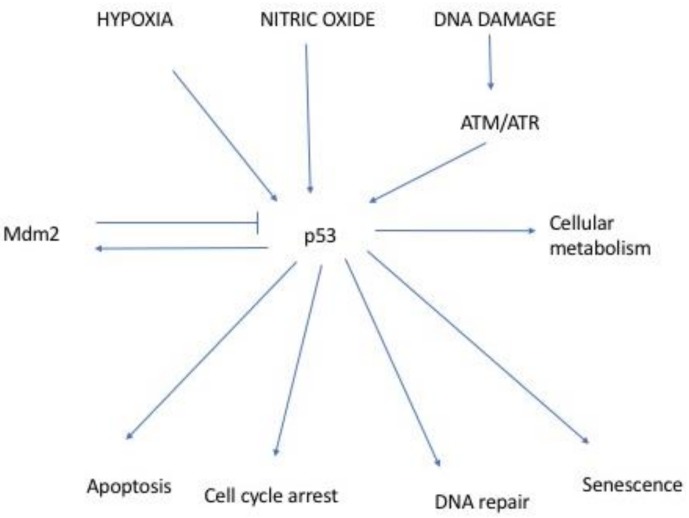
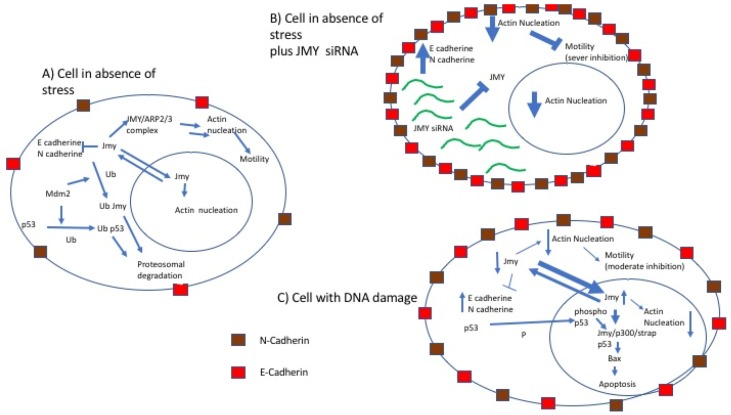
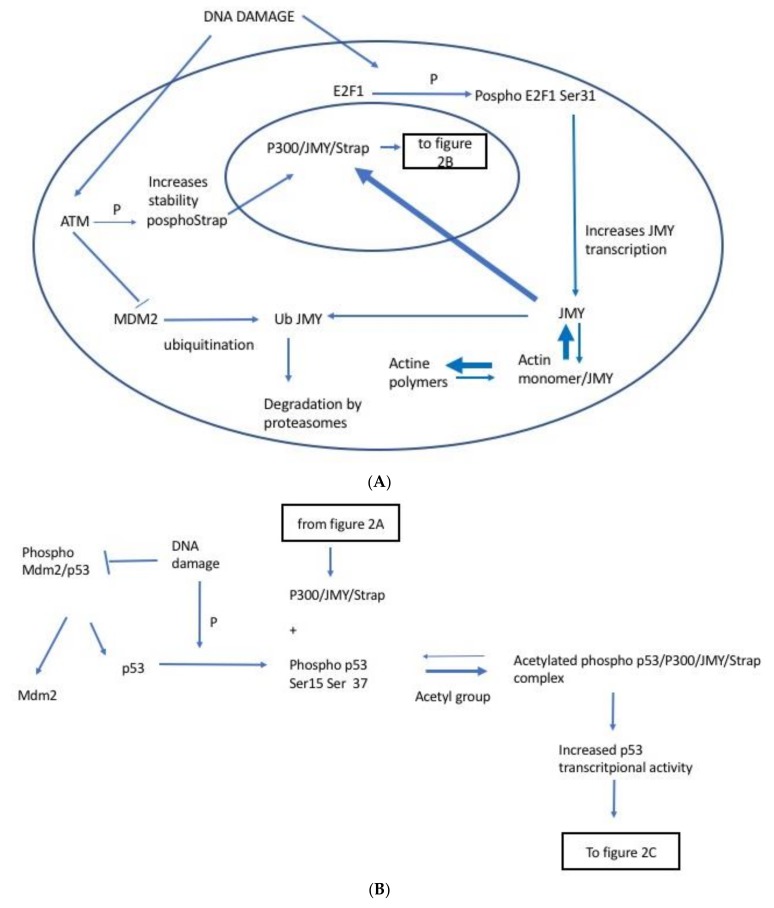
Following the event of DNA damage, the level of tumour suppressor protein p53 increases inducing either cell cycle arrest or apoptosis. Junctional Mediating and Regulating Y protein (JMY) is a transcription co-factor involved in p53 regulation. In event of DNA damage, JMY levels also upregulate in the nucleus where JMY forms a co-activator complex with p300/CREB-binding protein (p300/CBP), Apoptosis-stimulating protein of p53 (ASPP) and Stress responsive activator of p53 (Strap). This co-activator complex then binds to and increases the ability of p53 to induce transcription of proteins triggering apoptosis but not cell cycle arrest. This then suggests that the increase of JMY levels due to DNA damage putatively "directs" p53 activity toward triggering apoptosis. JMY expression is also linked to increased cell motility as it: (1) downregulates the expression of adhesion molecules of the Cadherin family and (2) induces actin nucleation, making cells less adhesive and more mobile, favouring metastasis. All these characteristics taken together imply that JMY possesses both tumour suppressive and tumour metastasis promoting capabilities.
在DNA损伤事件发生后,肿瘤抑制蛋白p53的水平升高,从而诱导细胞周期停滞或凋亡。连接介导和调节Y蛋白(JMY)是一种参与p53调节的转录辅因子。在DNA损伤时,JMY水平在细胞核中也会上调,在细胞核中JMY与p300/CREB结合蛋白(p300/CBP)、p53凋亡刺激蛋白(ASPP)和p53应激反应激活因子(Strap)形成共激活复合物。然后,这种共激活复合物结合并增强p53诱导触发凋亡但不诱导细胞周期停滞的蛋白质转录的能力。这表明,由于DNA损伤导致的JMY水平升高可能将p53的活性“导向”触发凋亡。JMY的表达还与细胞运动性增加有关,因为它:(1)下调钙黏蛋白家族黏附分子的表达,(2)诱导肌动蛋白成核,使细胞黏附性降低且更具移动性,有利于转移。综合所有这些特征表明,JMY兼具肿瘤抑制和肿瘤转移促进能力。