Akaike Keisuke, Suehara Yoshiyuki, Kohsaka Shinji, Hayashi Takuo, Tanabe Yu, Kazuno Saiko, Mukaihara Kenta, Toda-Ishii Midori, Kurihara Taisei, Kim Youngji, Okubo Taketo, Hayashi Yasuhide, Takamochi Kazuya, Takahashi Fumiyuki, Kaneko Kazuo, Ladanyi Marc, Saito Tsuyoshi
Department of Orthopedic Surgery, Juntendo University School of Medicine, Tokyo, Japan.
Department of Human Pathology, Juntendo University School of Medicine, Tokyo, Japan.
Oncotarget. 2018 May 18;9(38):25206-25215. doi: 10.18632/oncotarget.25392.
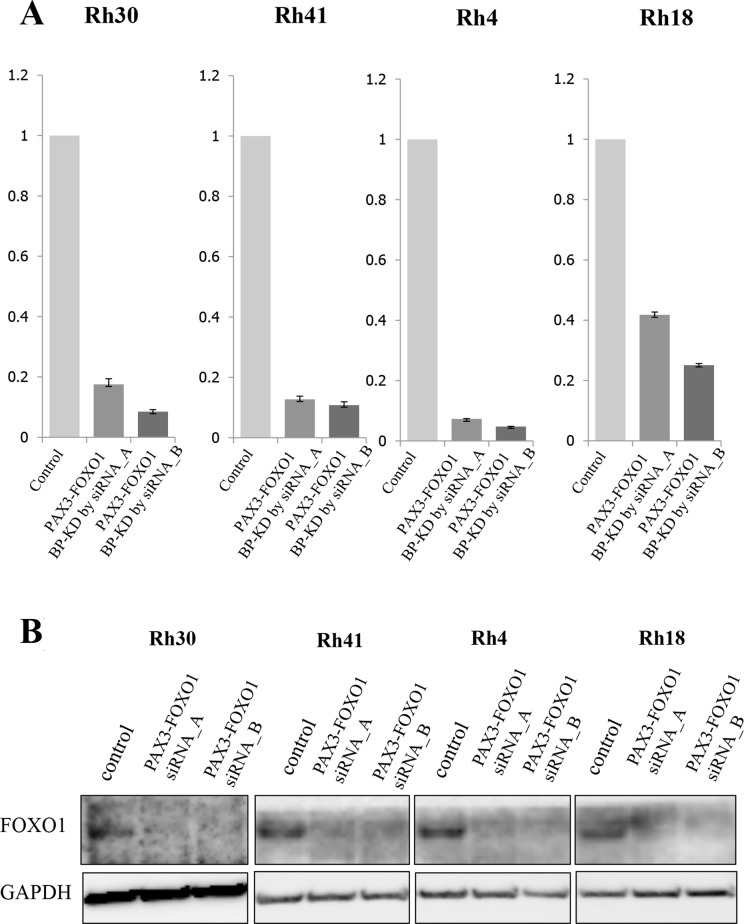
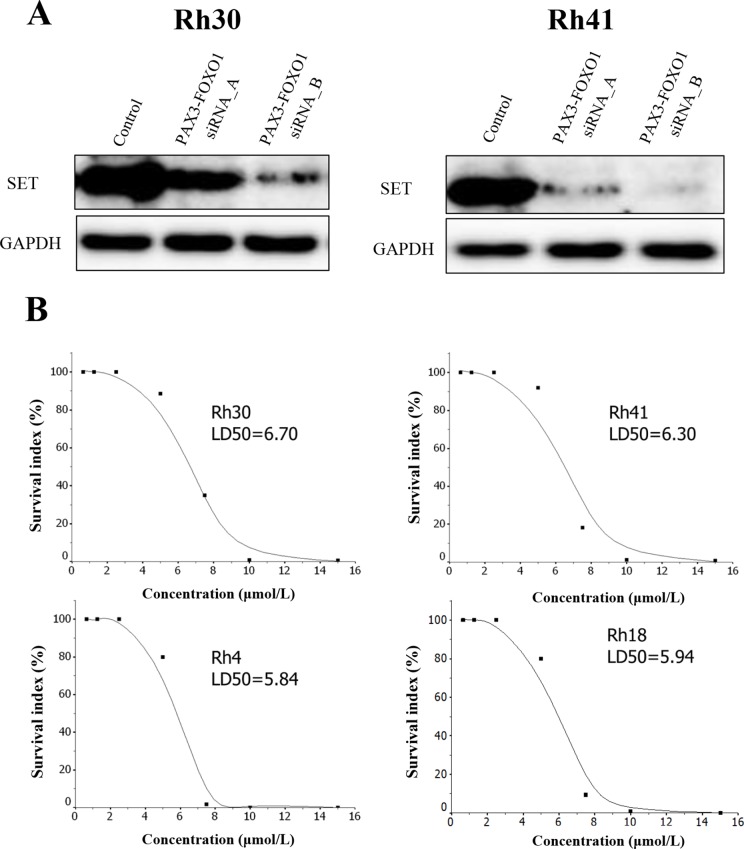
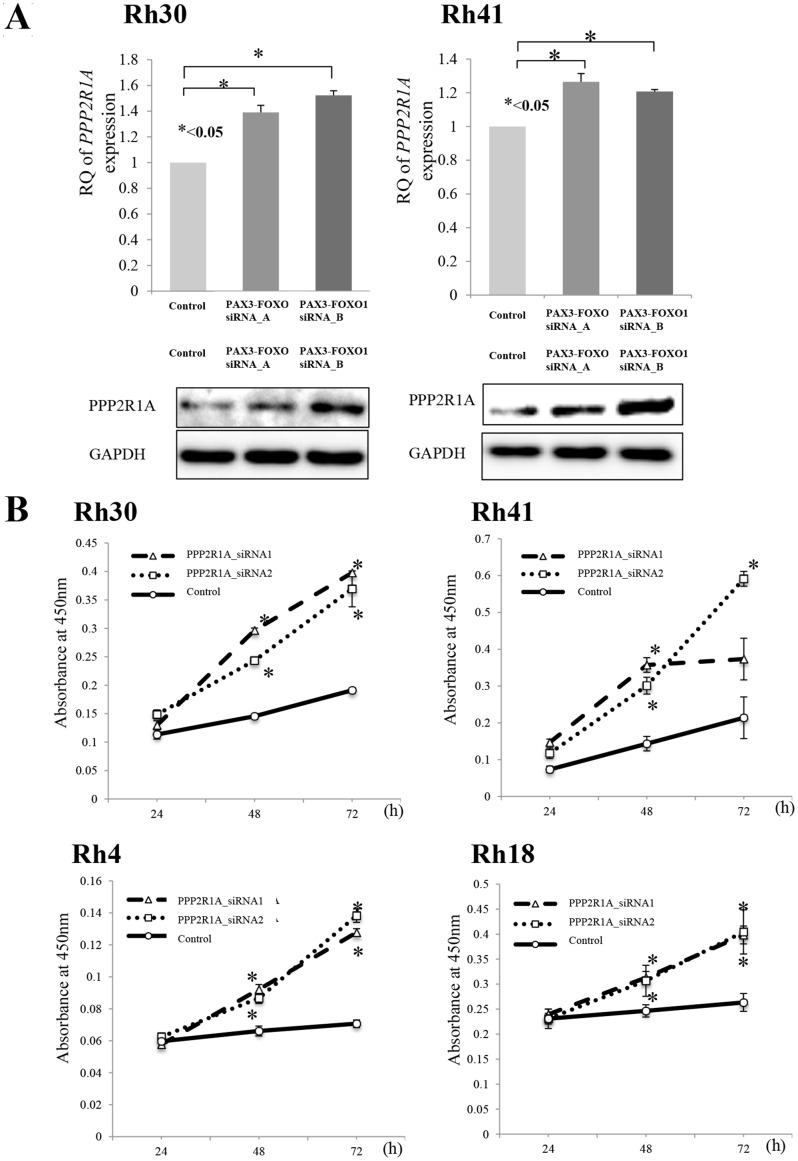
To better characterize the oncogenic role of the fusion protein in the acquisition of aggressive behavior in ARMS, we employed a proteomic approach using a PAX3-FOXO1 knockdown system in ARMS cell lines. This approach revealed a protein list consisting of 107 consistently upregulated and 114 consistently downregulated proteins that were expected to be regulated by PAX3-FOXO1 fusion protein. Furthermore, we identified 16 upregulated and 17 downregulated critical proteins based on a data-mining analysis. We also evaluated the function of PPP2R1A in ARMS cells. The expression was upregulated at both the mRNA and protein levels by silencing. The silencing of significantly increased the cell growth of all four ARMS cells, suggesting that PPP2R1A still has a tumor suppressive function in ARMS cells; however, the native expression of PPP2R1A was low in the presence of PAX3-FOXO1. In addition, the activation of PP2A-part of which was encoded by -by FTY720 treatment in ARMS cell lines inhibited cell growth. On the human phospho-kinase array analysis of 46 specific Ser/Thr or Tyr phosphorylation sites on 39 selected proteins, eNOS, AKT1/2/3, RSK1/2/3 and STAT3 phosphorylation were decreased by FTY-720 treatment. These findings suggest that PPP2R1A is a negatively regulated by PAX3-FOXO1 in ARMS. The activation of PP2A-probably in combination with kinase inhibitors-may represent a therapeutic target in ARMS. We believe that the protein expression profile associated with PAX3-FOXO1 would be valuable for discovering new therapeutic targets in ARMS.
为了更好地表征融合蛋白在腺泡状横纹肌肉瘤(ARMS)侵袭性行为获得过程中的致癌作用,我们采用蛋白质组学方法,在ARMS细胞系中使用PAX3 - FOXO1基因敲低系统。该方法揭示了一个蛋白质列表,其中包括107个持续上调和114个持续下调的蛋白质,预计这些蛋白质受PAX3 - FOXO1融合蛋白调控。此外,基于数据挖掘分析,我们鉴定出16个上调和17个下调的关键蛋白。我们还评估了PPP2R1A在ARMS细胞中的功能。通过基因沉默,其在mRNA和蛋白质水平的表达均上调。PPP2R1A的沉默显著增加了所有四种ARMS细胞的生长,这表明PPP2R1A在ARMS细胞中仍具有肿瘤抑制功能;然而,在PAX3 - FOXO1存在的情况下,PPP2R1A的天然表达较低。此外,在ARMS细胞系中用FTY720处理激活PP2A(其中一部分由PPP2R1A编码)可抑制细胞生长。在对39种选定蛋白质上46个特定丝氨酸/苏氨酸或酪氨酸磷酸化位点进行的人磷酸激酶阵列分析中,FTY - 720处理使内皮型一氧化氮合酶(eNOS)、AKT1/2/3、核糖体S6激酶1/2/3(RSK1/2/3)和信号转导子和转录激活子3(STAT3)的磷酸化水平降低。这些发现表明,在ARMS中PPP2R1A受PAX3 - FOXO1负调控。激活PP2A(可能与激酶抑制剂联合使用)可能代表ARMS的一个治疗靶点。我们认为,与PAX3 - FOXO1相关的蛋白质表达谱对于发现ARMS的新治疗靶点将具有重要价值。