Retegan Marius, Krewald Vera, Mamedov Fikret, Neese Frank, Lubitz Wolfgang, Cox Nicholas, Pantazis Dimitrios A
Max Planck Institute for Chemical Energy Conversion , Stiftstrasse 34-36 , 45470 Mülheim an der Ruhr , Germany . Email:
Molecular Biomimetics , Department of Chemistry - Ångstrom Laboratory , Uppsala University , Box 523 , 75120 Uppsala , Sweden.
Chem Sci. 2016 Jan 1;7(1):72-84. doi: 10.1039/c5sc03124a. Epub 2015 Nov 17.
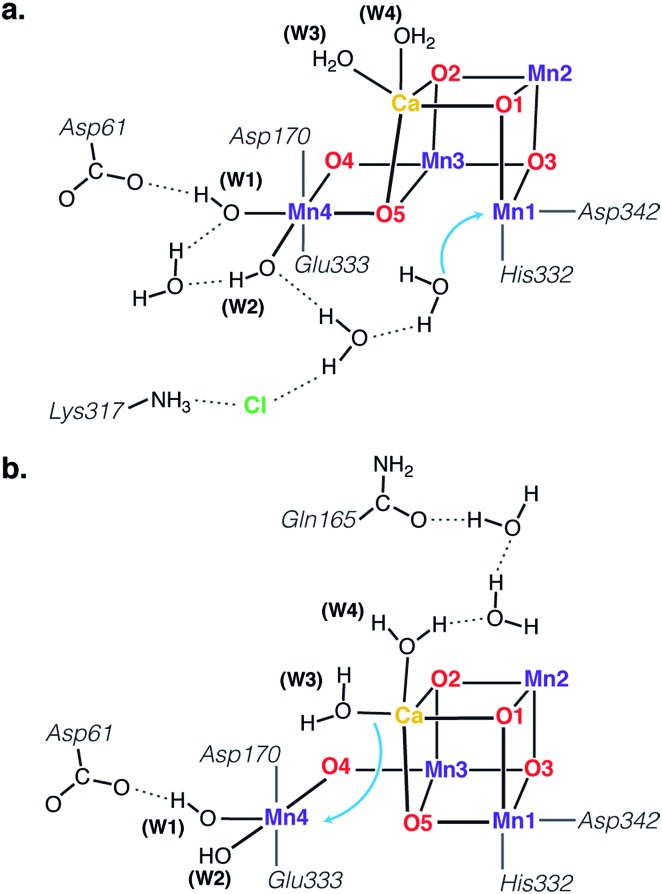
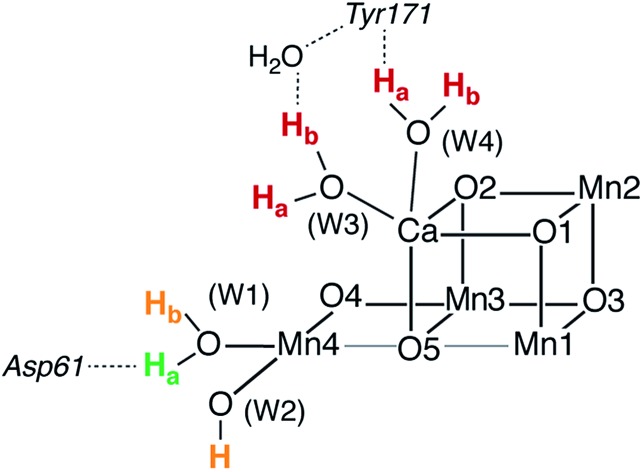
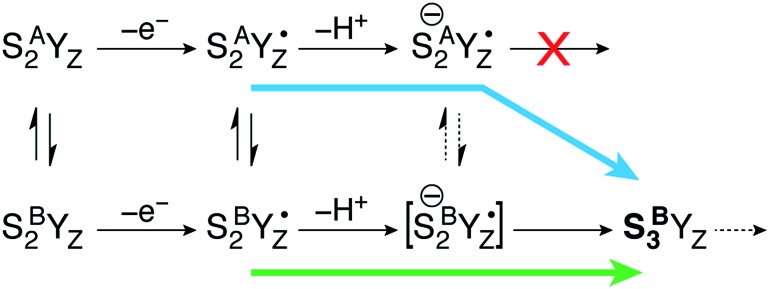
Among the four photo-driven transitions of the water-oxidizing tetramanganese-calcium cofactor of biological photosynthesis, the second-last step of the catalytic cycle, that is the S to S state transition, is the crucial step that poises the catalyst for the final O-O bond formation. This transition, whose intermediates are not yet fully understood, is a multi-step process that involves the redox-active tyrosine residue and includes oxidation and deprotonation of the catalytic cluster, as well as the binding of a water molecule. Spectroscopic data has the potential to shed light on the sequence of events that comprise this catalytic step, which still lacks a structural interpretation. In this work the S-S state transition is studied and a key intermediate species is characterized: it contains a MnOCa cubane subunit linked to a five-coordinate Mn(iv) ion that adopts an approximately trigonal bipyramidal ligand field. It is shown using high-level density functional and multireference wave function calculations that this species accounts for the near-infrared absorption and electron paramagnetic resonance observations on metastable S-S intermediates. The results confirm that deprotonation and Mn oxidation of the cofactor must precede the coordination of a water molecule, and lead to identification of a novel low-energy water binding mode that has important implications for the identity of the substrates in the mechanism of biological water oxidation.
在生物光合作用中,水氧化四锰 - 钙辅因子的四个光驱动转变中,催化循环的倒数第二步,即S到S状态的转变,是使催化剂为最终氧 - 氧键形成做好准备的关键步骤。这个转变过程的中间体尚未完全清楚,它是一个多步骤过程,涉及氧化还原活性酪氨酸残基,包括催化簇的氧化和去质子化,以及一个水分子的结合。光谱数据有可能揭示构成这一催化步骤的一系列事件,而这一步骤目前仍缺乏结构上的解释。在这项工作中,对S - S状态转变进行了研究,并对一个关键的中间物种进行了表征:它包含一个与五配位锰(IV)离子相连的MnOCa立方烷亚基,该锰(IV)离子具有近似三角双锥配体场。通过高水平密度泛函和多参考波函数计算表明,该物种解释了对亚稳态S - S中间体的近红外吸收和电子顺磁共振观测结果。结果证实,辅因子的去质子化和锰氧化必须先于水分子的配位,并导致识别出一种新型的低能水结合模式,这对生物水氧化机制中底物的身份具有重要意义。