Santisteban Jose Arturo, Brown Thomas G, Gruber Reut
Department of Psychiatry, McGill University, Montreal, QC, Canada.
Addiction Research Program, Research Centre of the Douglas Mental Health, University Institute, Montreal, QC, Canada.
Sleep Disord. 2018 May 9;2018:5646848. doi: 10.1155/2018/5646848. eCollection 2018.
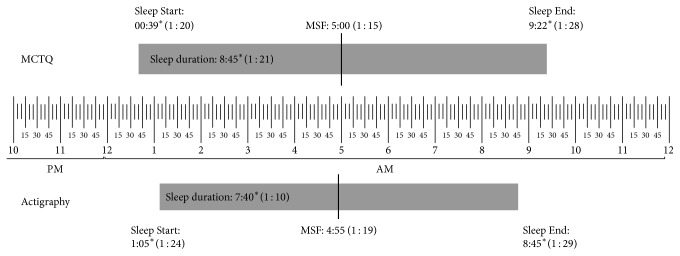
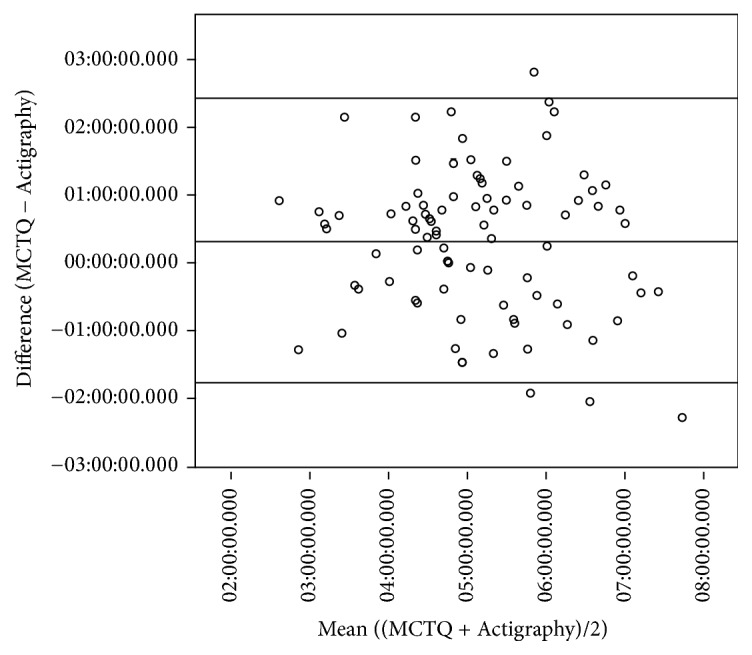
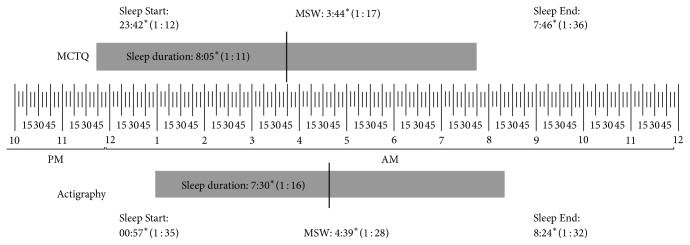
Chronotype refers to individuals' preferences for timing of sleep and wakefulness. It can be quantified by measuring the midpoint time between the start and end of sleep during free days. Measuring chronotype is helpful to diagnose circadian rhythm sleep-wake disorders. The Munich Chronotype Questionnaire (MCTQ) is a self-reported measure of chronotype that calculates the midpoint of sleep on free days based on self-reported bed and wake times. Self-reports of sleep are prone to bias. The objective was to examine the agreement between the MCTQ-derived midpoint and an objective measure obtained using wrist actigraphy. The sleep of 115 participants aged 18-34 (mean = 24, SD = 4.6) was monitored with actigraphy for 4 to 6 consecutive nights. The corrected midpoint of sleep on free days was derived from sleep start and end times on both free days and scheduled days. The corrected midpoint of sleep on free days as measured by the MCTQ was 4:56 (SD = 1 : 16) and by actigraphy was 4:51 (SD = 1 : 23). They were not significantly different ( = 0.66, = 0.51). A strong correlation was found between these two measurements ( = 0.73, < 0.001). The 95% limits of agreement were between -1:37:19 and 2:14:38. MCTQ and actigraphy provide similar results for the corrected midpoint of sleep on free days.
昼夜节律类型是指个体对睡眠时间和清醒时间的偏好。它可以通过测量休息日睡眠开始和结束之间的中点时间来量化。测量昼夜节律类型有助于诊断昼夜节律性睡眠-觉醒障碍。慕尼黑昼夜节律类型问卷(MCTQ)是一种通过自我报告来测量昼夜节律类型的方法,它根据自我报告的上床睡觉时间和起床时间来计算休息日睡眠的中点时间。睡眠的自我报告容易出现偏差。目的是检验MCTQ得出的中点时间与使用手腕活动记录仪获得的客观测量结果之间的一致性。对115名年龄在18至34岁(平均年龄 = 24岁,标准差 = 4.6)的参与者的睡眠进行了连续4至6晚的活动记录仪监测。休息日睡眠的校正中点时间是根据休息日和工作日的睡眠开始和结束时间得出的。通过MCTQ测量的休息日睡眠校正中点时间为4:56(标准差 = 1:16),通过活动记录仪测量的为4:51(标准差 = 1:23)。它们之间没有显著差异(t = 0.66,p = 0.51)。发现这两种测量方法之间存在很强的相关性(r = 0.73,p < 0.001)。一致性的95%界限在-1:37:19至2:14:38之间。MCTQ和活动记录仪在休息日睡眠校正中点时间方面提供了相似的结果。