Tripathy Jaya Prasad, Bahuguna Pankaj, Prinja Shankar
Centre for Operational Research, International Union Against Tuberculosis and Lung Disease, The Union South East Asia Office, New Delhi, India.
School of Public Health, Post Graduate Institute of Medical Education and Research, Chandigarh, India.
Perspect Clin Res. 2018 Apr-Jun;9(2):76-82. doi: 10.4103/picr.PICR_75_17.
Poor prescription practices result in increased side effects, adverse drug reactions, and high cost of treatment. The present study was undertaken to describe the drug-prescribing patterns in two North Indian states through prescription auditing.
The study was carried out in 80 public health facilities across 12 districts in two states of Haryana and Punjab (6 in each) covering all levels of care. The information from prescription slips was abstracted on a structured pro forma for all patients who visited the pharmacy of the health facility.
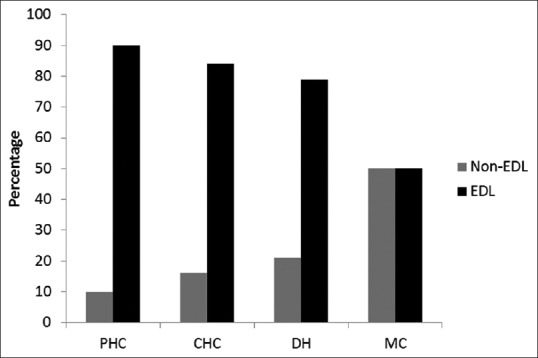
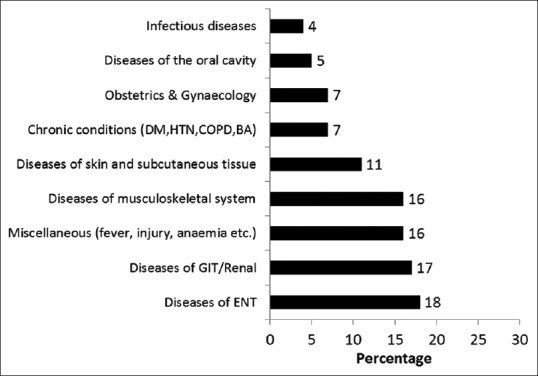
A total of 1609 prescriptions were analyzed. On an average, 2.2 drugs were prescribed per patient. Nearly 84% of the drugs were prescribed from the essential drug list (EDL). Antibiotics were prescribed in 45.3% of prescriptions, followed by vitamins (34.8%) and nonsteroidal anti-inflammatory drugs (33.9%). Drugs were prescribed in their generic names in 70% of cases. Diseases of the ear, nose, and throat (18%) were most common followed by the diseases of the gastrointestinal and renal (17%) and musculoskeletal system (16%). Only 40% of children suffering from diarrhea received oral rehydration salts while 80% of them received antibiotics. Among cases of upper respiratory tract infection, nearly 75% received antibiotics.
The results of this study raise concerns about the overuse of antibiotics although most of the drugs (84%) were from the EDL and in generic names (70%). There is lack of data regarding prescription practices which necessitates real-time prescription monitoring through online data entry and transmission.
不良的处方行为会导致副作用增加、药物不良反应以及高昂的治疗成本。本研究旨在通过处方审核描述印度北部两个邦的药物处方模式。
该研究在哈里亚纳邦和旁遮普邦两个邦的12个区的80个公共卫生机构中进行(每个邦6个),涵盖各级医疗服务。从前往卫生机构药房就诊的所有患者的处方单中提取信息,并填写在结构化的表格上。
共分析了1609张处方。平均每位患者开具2.2种药物。近84%的药物来自基本药物清单(EDL)。45.3%的处方中开具了抗生素,其次是维生素(34.8%)和非甾体抗炎药(33.9%)。70%的病例中药物以通用名开具。耳、鼻、喉疾病(18%)最为常见,其次是胃肠道和肾脏疾病(17%)以及肌肉骨骼系统疾病(16%)。仅有40%腹泻儿童接受了口服补液盐,而80%的腹泻儿童接受了抗生素治疗。在上呼吸道感染病例中,近75%的患者接受了抗生素治疗。
本研究结果引发了对抗生素过度使用的担忧,尽管大多数药物(84%)来自基本药物清单且以通用名开具(70%)。缺乏关于处方行为的数据,因此有必要通过在线数据录入和传输进行实时处方监测。